


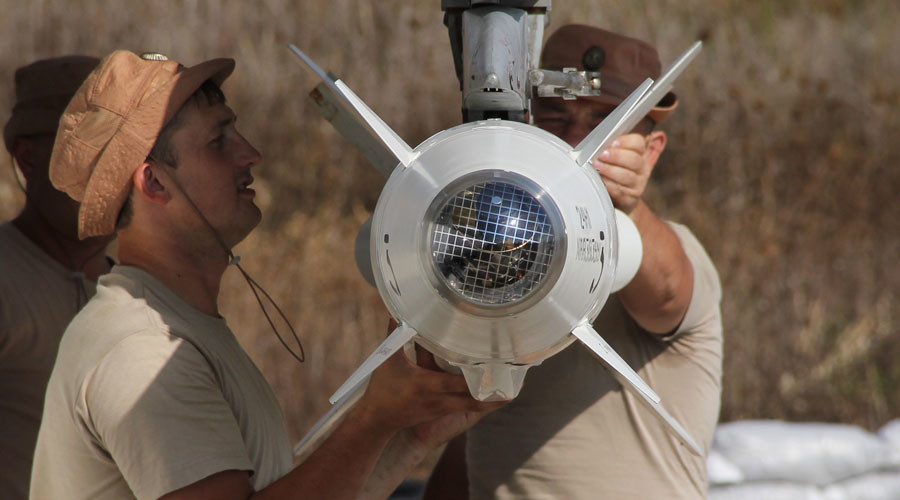
2712070 10/04/2015 Russian servicemen attach a Kh-25 high-precision missile to a Su-24 aircraft at the Khmeimim airbase in Syria. Dmitriy Vinogradov/RIA Novosti
On October 16, warplanes of the Russian Aerospace Forces carried out a series of airstrikes on positions of the Turkish-backed Syrian National Army (SNA) near the towns of Azaz, Qatmah and Kafr Jennah in the northern countryside of Syria’s Aleppo.
The airstrikes hit several posts of the al-Shamiya Front, a faction of the SNA’s 3rd Corps, as well as a large training camp of the Suqur al-Shamal Brigade, a member of the so-called Liberation and Construction Movement within the SNA’s 1st Corps.
As a result of the airstrikes, at least two militants were killed and nine others were wounded. An unknown number of vehicles and weapons were also destroyed.
Russian warplanes rarely attack Turkish-occupied areas in the northern Aleppo countryside. The last series of airstrikes came just a day after the end of a fierce battle between the 3rd Corps and al-Qaeda-affiliated Hay’at Tahrir al-Sham (HTS). The battle ended with a dangerous agreement that granted HTS much influence over Turkish-occupied areas, especially the area of Afrin.
The northern Aleppo countryside is governed by a de-escalation agreement that was brokered by Russia and Turkey years ago. However, the agreement rejects the presence of terrorist group in the region.
With HTS now in control of Afrin and a few other Turkish-occupied areas in the northern Aleppo countryside, the de-escalation agreement will not likely hold up for too long.
The Russian airstrikes on Azaz, Qatmah and Kafr Jannah were likely meant as a warning to both Turkish-backed militants and HTS. The collapse of the de-escalation agreement will mean that Syrian government forces and their allies will be free to conduct counter-terrorism operations in the northern Aleppo countryside, similar to the operations they conduct from time to time in the HTS-occupied region of Greater Idlib.
Many Syrian opposition activists in the northern Aleppo countryside are already calling for mass protests to expel HTS from the region to safe the de-escalation agreement.



About time!
High Precision < Moral Innaccuracy
(For all those at sf who drink vodka uncontrollably, dont worry that you are not in a position to make any big decisions, but driving faster and faster pushing the limits of your belief in vodka will have a better impact on others
Freshly roasted kebab. Yummy!!!
Russia can do more if it wants to… I don’t know if it’s allowed to.
Same think applies to fuckraine …
Are you little hallal swine?
11 Zionist slaves a la shish kebab. Yummy
Maybe its time for the Turkish army to bomb Russian proxy forces inside of Ukraine. Tit for tat.
Yeah, go ahead give us a reason. Tit for ass.
Who are the moderators on this site? Why are my polite and pro-Russian comments being deleted? Obvious pro-NATO trolls and childish obscenities about anuses are apparently fine as far as the moderators are concerned but my comments are not for some reason. Maybe the moderators have been infiltrated or maybe the entire site is suspect. This is not the first time either, the same has happened on a number of occasions. Apparently “would love your thoughts please comment” does not apply to me. I’m not one to hang around where I am not wanted so this is the last comment SF will ever get from me.