


Click to see full-size image. (X)
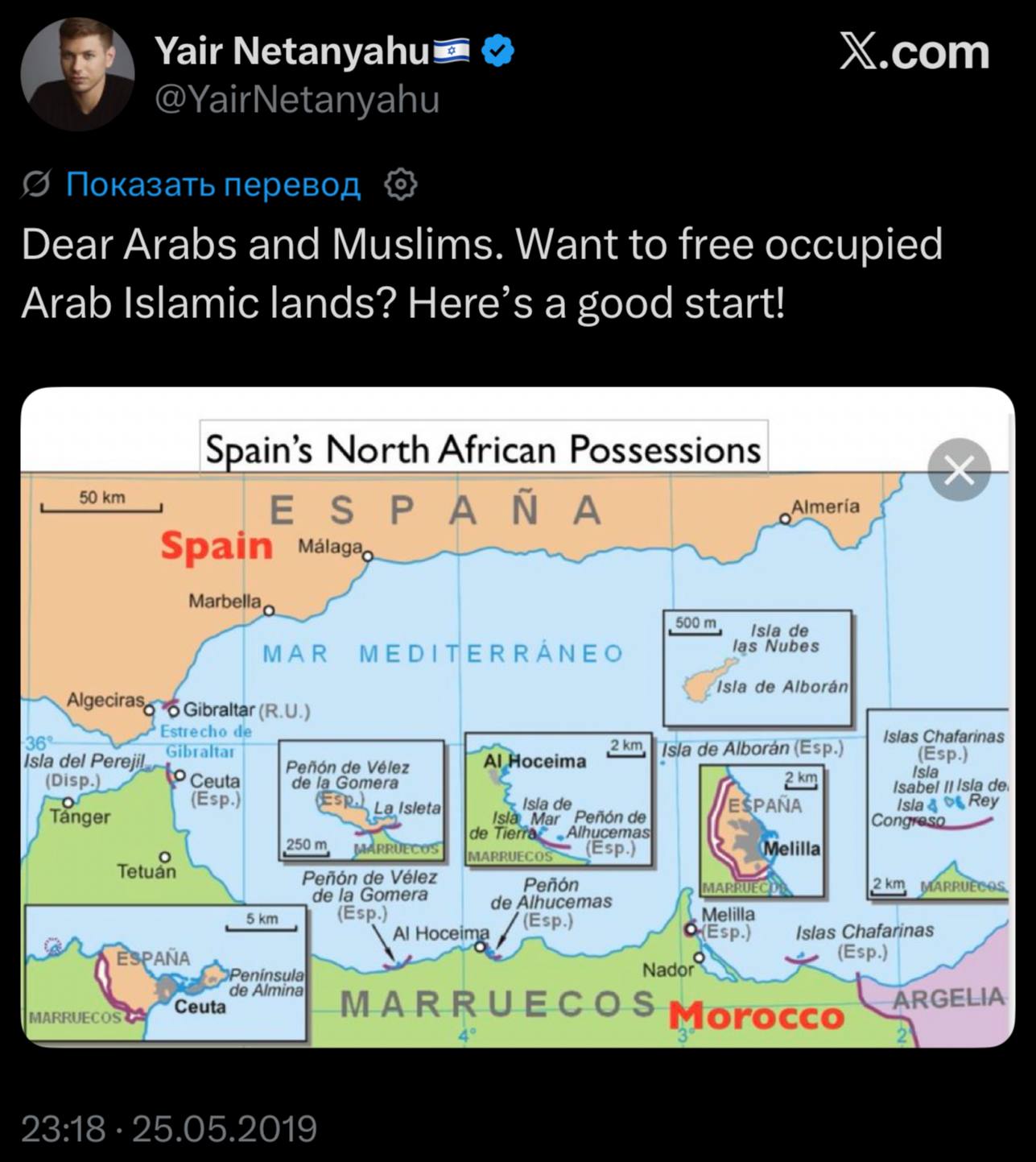
In May 2019, an incendiary social media post from Yair Netanyahu, the outspoken son of Israeli Prime Minister Benjamin Netanyahu, provoked sharp condemnation across Madrid’s political establishment. Replying to Spanish political criticism regarding Israeli actions in the West Bank, the younger Netanyahu posted a map highlighting Spain’s North African possessions alongside a blunt provocation: “Dear Arabs and Muslims. Want to free occupied Arab Islamic lands? Here’s a good start!”
When Santiago Abascal, leader of Spain’s far-right Vox party, slammed the tweet as “ignorant and frivolous,” Yair Netanyahu doubled down, arguing that if Spaniards were offended by calls to cede Ceuta and Melilla, they should reflect on how Israelis feel when Madrid funds organizations advocating for Palestinian statehood in “the Jewish heartland.”
Click to see full-size image. (X)
At the time, Spanish officials largely brushed off the exchange as a reckless online outburst. Today, however, that provocative exchange reads to many in Madrid like an unsettling harbinger.
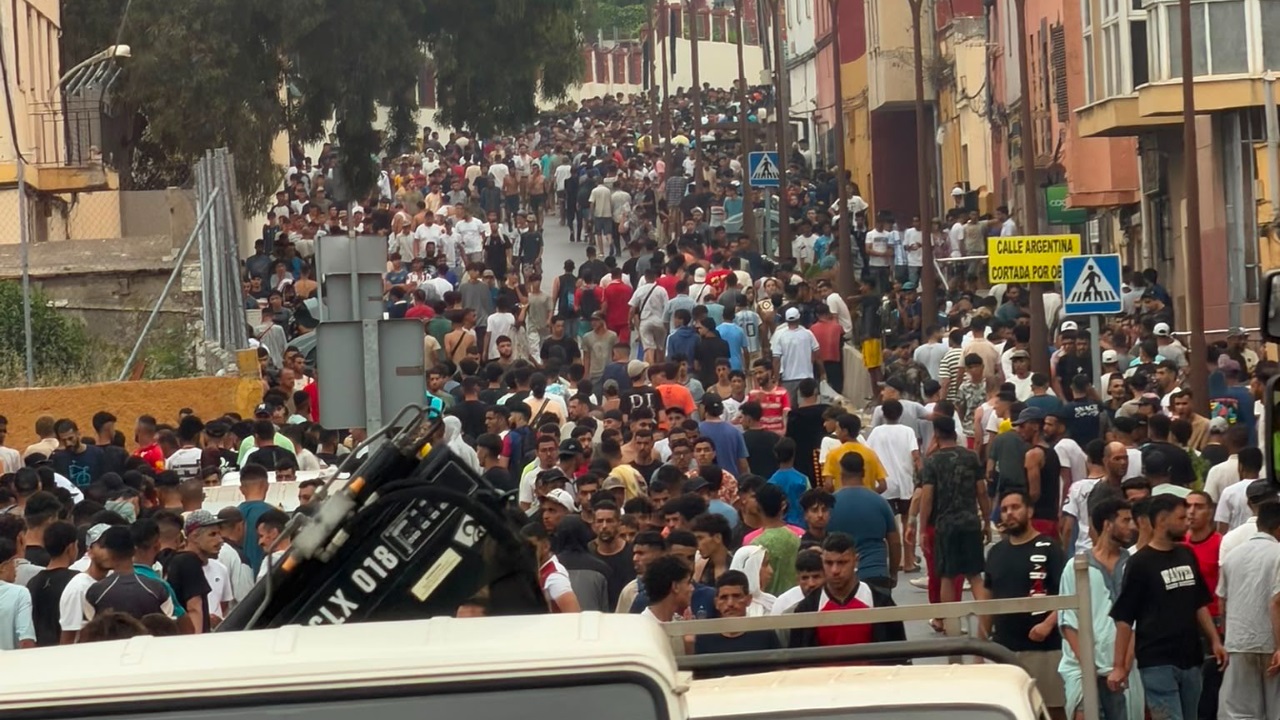
A major border crisis in Ceuta—where tens of thousands of migrants crossed into the enclave over a frantic 48-hour period after Moroccan coastal patrols temporarily relaxed enforcement—has thrust Spain’s vulnerable North African footholds into a high-stakes geopolitical storm involving Rabat, Tel Aviv, and Washington.
What once appeared to be idle social media trolling has intersected with a rapid realignment of Mediterranean power dynamics, raising deep anxieties in Madrid over its long-term hold on its strategic African outposts.
The geopolitical backdrop to the crisis has been steadily deteriorating. Under Prime Minister Pedro Sánchez, Spain has emerged as one of Western Europe’s most outspoken critics of Israel’s military campaign in Gaza. Madrid’s formal recognition of the State of Palestine, its backing of international legal challenges against Israeli military operations, and its push for an EU-wide arms embargo have drawn bitter public rebukes from Israeli officials.
In response, diplomatic spats have spilled into the open, with Israeli diplomats accusing Madrid of rewarding Hamas and questioning Spain’s moral standing—frequently pointing back to its colonial-era enclaves on the African continent as evidence of historic double standards.
Simultaneously, Madrid has watched with mounting concern as Israel and Morocco solidify a formidable strategic partnership.
Since normalizing diplomatic relations under the U.S.-brokered Abraham Accords in late 2020, Rabat and Tel Aviv have institutionalized defense cooperation through historic intelligence-sharing pacts, joint military exercises, and major arms transfers.
Morocco’s rapid military modernization—featuring air defense batteries, suicide drones, and sophisticated cyber surveillance tools—has transformed the military balance across the Strait of Gibraltar.
Spanish opposition leaders and defense analysts have warned that this buildup poses a direct strategic challenge to Ceuta and Melilla, neither of which are explicitly protected under NATO’s Article 5 collective defense treaty.
This modern power play carries deep historical echoes for the Iberian Peninsula. Spanish security posture toward North Africa has been shaped by strategic anxieties dating back to 711 CE, when Umayyad-led forces launched an invasion from present-day Morocco across the Strait of Gibraltar, bringing the region under Muslim governance for nearly eight centuries as Al-Andalus.
Historians note that local Jewish communities, suffering under severe persecution from Visigothic rulers, frequently assisted the incoming North African forces, opening city gates in major strongholds like Toledo and Córdoba.
Centuries later, human and cultural connections between North Africa and the Levant remain potent. Hundreds of thousands of Israeli citizens trace their family roots directly to Morocco—forming one of Israel’s largest and most culturally influential demographic blocs. This shared heritage has significantly smoothed the diplomatic and military rapprochement between Rabat and Tel Aviv.
Perched at the eastern entrance to the Strait of Gibraltar—a maritime chokepoint carrying roughly 10 percent of global trade—Ceuta’s 18.5-square-kilometer enclave serves as a vital naval monitoring point for Spain and NATO.
Crucially, alongside neighboring Melilla, Ceuta constitutes the European Union’s only physical land border with Africa. For Spain, the convergence of historical memory, shifting Middle Eastern alliances, and border volatility has transformed Ceuta from a quiet domestic enclave into an acute frontline. As Madrid maneuvers to protect its sovereignty and border security, the city stands as a stark reminder of how rapidly global conflicts can reshape regional fault lines along Europe’s southern flank.
_______________________________________________________________________________________________________________________
SouthFront: Analysis and Intelligence
NOW hosted at southfront.press
Previously, SouthFront: Analysis and Intelligence was at southfront.org.
The .org domain name had been blocked by the US (NATO) (https://southfront.press/southfront-org-blocked-by-u-s-controlled-global-internet-supervisor/) globally, outlawed and without any explanation
Back before that, from 2013 to 2015, SouthFront: Analysis and Intelligence was at southfront.com



good lesson from netanyahu! palestinians arabs are the true colonizers, not palestinian jews. and yes, palestinian arabs ethnically cleansed palestinian jews wherever they got in power, like gaza and west bank. now they want more “freedom”.
palestinians are the true descendants of the biblical jooz, not the fake jooz from khazaria and poland.
palestinians call themselves arabs. arabs are not jews (judites, judaens). palestinians are believed to be from the philistines, not the jews. hence the arabic word for palestinian is falistinia. the fake jew europeans and miscellaneous concerts are not the jews, but neither are arabs.
stfu you demented asshole.
that’s hilarious considering that the jews are the ones occupying “arab islamic lands” in palestine.
the jooz are behind the immigrant invasions of europe and america and architects of the great replacement. they openly brag about it. google israid and barbara spectre. these people are a poison in any society. always have been, always will.
the magna carta recognized this
thank you for the historical back ground. somehow israeli assets are found involved again. perhaps spain should cut off all intentional shipping to israel via gibraltar? many other other nations see this as productive action towards world peace. boycott !
good luck with the us fleet that will then take your coast cause different to iranians euriopeans arent keen to die for their country.
spanish-anus-penetration achieved!
heheheh
they were celebrating world cup bullshit when suddenly…
this is great platform for job: https://www.work27.info
the juvenile genome defective inbred meilikowsky mk. 2 has dropped a two cents splat from its designated protected species cocoon. wooow 🤯
how brave of it ! next thing we’ll hear it’s off to southern lebanon to offer up it’s rear end to any of its compatriots. stay tuned to clyde’s comments for any update on this.