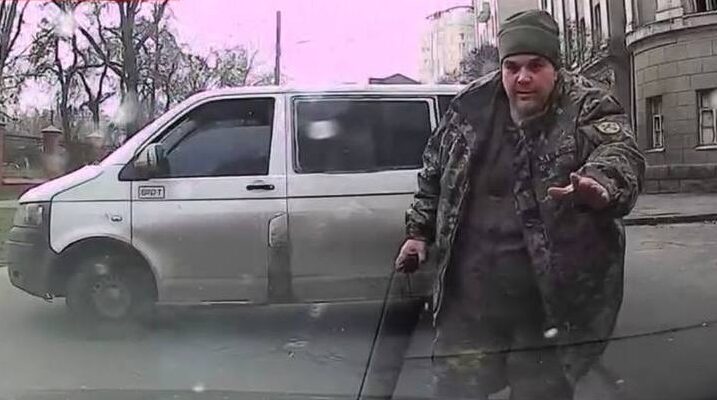
Click to see the full-size image
Another week in Ukraine was marked by a total manhunt. Territorial Recruitment Centers, long nicknamed “manhunters” by the public, show no sign of slowing down. Judging by the footage surfacing online, TCC officers break into private property, break down doors and windows, beat those who resist, and spray gas on anyone who tries to intervene. Increasingly, they meet pushback: people block their vehicles, stand up for their neighbors, and drive the manhunters away. The system runs without a hitch, and it has no intention of stopping.
Tellingly, a statement from Ukrainian soldier Artem Silginov has spread online.
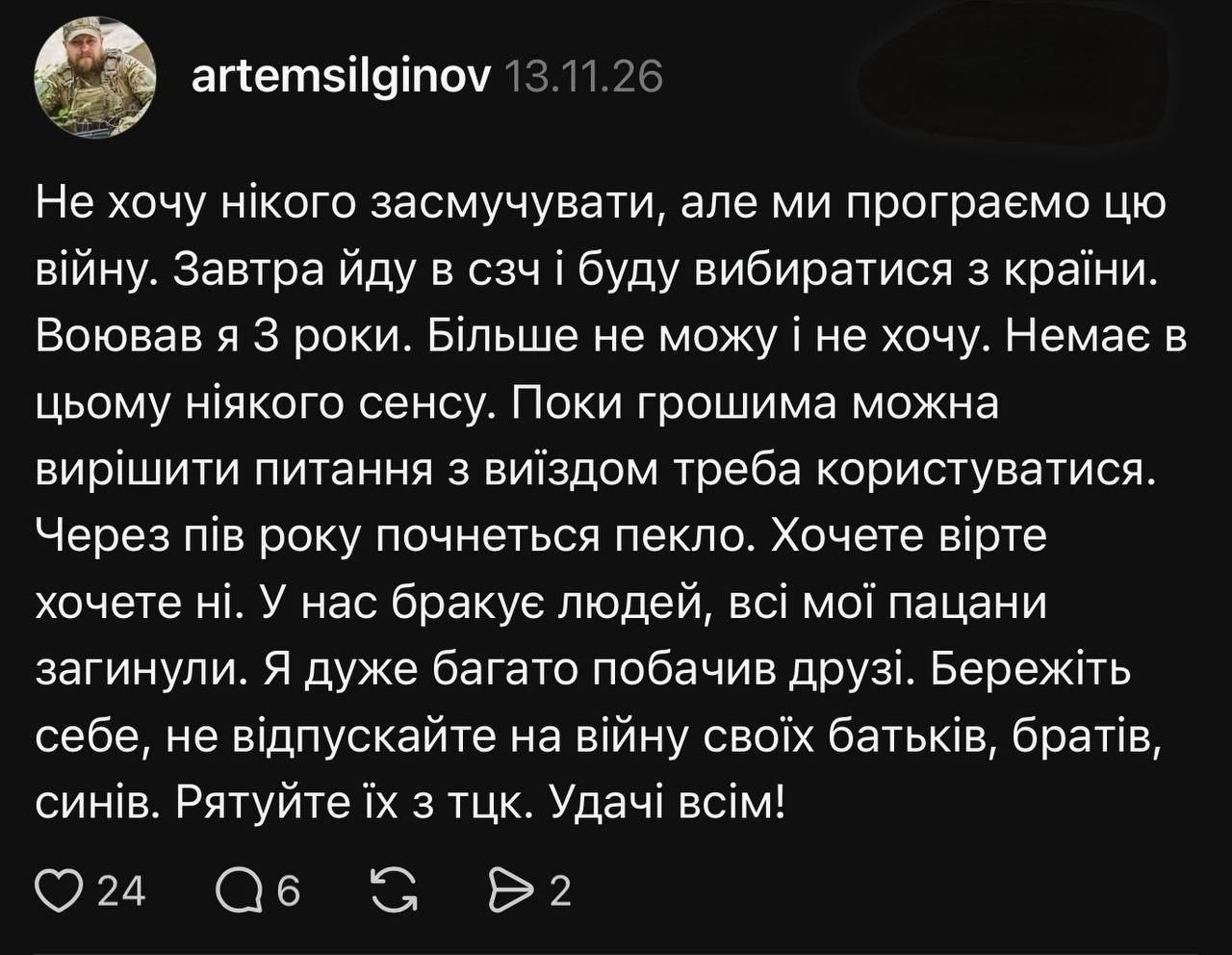
“I don’t want to upset anyone, but we are losing this war. Tomorrow I’m going AWOL and leaving the country. I fought for three years. I can’t do it anymore and I don’t want to. There’s no point in any of this. While money can still solve the problem of leaving, I should take advantage of it. In six months, hell will begin. Believe it or not. We don’t have enough people, all my guys are dead. I’ve seen a lot, friends. Take care of yourselves. Don’t let your fathers, brothers, and sons go to war. Save them from the TCC. Good luck to everyone!”
His words describe what is happening to the Ukrainian army and to Ukrainian society itself better than any report.
What the Cameras Captured This Week
- A man being loaded into a TCC vehicle for deployment. A child watches as his father is taken away.
- Odesa. A detention in a car turned into a beating and the use of gas. The detainee’s screams and attempts to call for help capture not a spontaneous conflict but a well-rehearsed scenario of coercive pressure. The detention is carried out without any procedural paperwork, physical force and chemical irritants are used, and the man is deprived of any opportunity to contact his family.
- Odesa. A TCC van struck a young man. He was then sprayed with gas and taken away.
- Kharkiv. TCC officers blocked a car by pulling directly into the roadway to mobilize the driver. According to the author of the clip, he is 21 years old, the TCC officer who approached him was drunk, his phone was taken, his arm was twisted, and he was beaten. He was released only after they learned that he was under 25. The van door has a “Bandit” sticker on it. Ukraine is like GTA in real life.
- Kyiv Region. The footage shows TCC officers efficiently and quickly forcing a man into a vehicle. Their actions are practiced to the point of being automatic.
- Kovel. TCC officers smashed a car window and pulled a man out.
Lutsk. Local residents tried to stop TCC officers from taking a man away. A young woman who blocked the officers’ vehicle was nearly run over and was taken away in an ambulance.
- More footage showing TCC officers breaking into private property.
- Sumy. To force a resisting man into the van, the military commissar punches him repeatedly. The woman filming says the TCC officer is drunk.
- Odesa. TCC officers chased a man into a courtyard but quickly retreated empty-handed.
- Kyiv. A conflict between TCC officers and civilians. Passersby tried to pull a man out of a van, and TCC officers sprayed them with gas.
- Chernivtsi Region. Villagers blocked TCC and police vehicles and slashed their tires.
Worth particular attention is a released recording of a conversation between the deputy head of the Lviv Regional TCC, Storozhuk, and notification teams. He says 17 teams operate in Lviv, tells them to find two people each by the end of the day, after which they can go rest. He threatens the worst-performing teams with being transferred to the TCCs in Zaporizhzhia and Poltava, because some teams go days without catching anyone.
Against this backdrop, Order No. 423, issued by the Commander-in-Chief of the Armed Forces of Ukraine on October 6, 2026, has surfaced. It had been much discussed among those liable for military service and among lawyers, but its details were unknown until now. At least on paper, the document sets clear requirements for how a person is transported to a TCC, how his stay there is documented, how his safety is ensured, and how he is treated, in order to prevent arbitrariness, humiliation, or unlawful restrictions of rights. Transportation must involve the National Police only, not TCC officers acting arbitrarily or private transport. A person’s stay at the TCC must be recorded on video surveillance, with footage stored for at least 30 days. For the first time, a mechanism for contacting relatives is described: officers must attempt to reach the close contact designated by the mobilized person and record it. The document describes in detail the conditions in waiting areas before deployment to a unit: seating, lighting, ventilation, drinking water, food, and access to a toilet. The order explicitly prohibits taking phones and personal belongings from those liable for military service, and if this happens, it must be properly documented, with the legal grounds stated. Moreover, it prescribes feeding mobilized personnel according to a set menu, with a daily ration of at least 3,500 calories and a menu drawn up a week in advance. If the TCC has a canteen or buffet, meals are to be served there. If not, suitable rooms, field kitchens, or tents are to be set up as temporary meal service points. A separate section is devoted to professional communication: an officer must listen to the person, help de-escalate the situation, and explain the procedure. He is prohibited from responding with aggression, personal attacks, provocations, threats, insults, or humiliation.
In practice, however, as videos and reports surfacing online show, the order is not being followed. Military commissars often do the rounding up themselves, take phones, and deny those liable for military service contact with their families. Many of those who have been through a TCC in the past month have heard nothing about the menu described above.
The weekly review shows the main thing: TCC methods are not changing, and resistance to them is growing. Tellingly, even military personnel openly speak of the pointlessness of what is happening and leave the ranks. Order No. 423 only confirms that the problem is acknowledged at the command level, but on the ground, it is ignored. Ukrainian citizens remain merely a resource for the Kyiv regime and its allies, and the situation will repeat itself week after week.