


Click to see full-size image
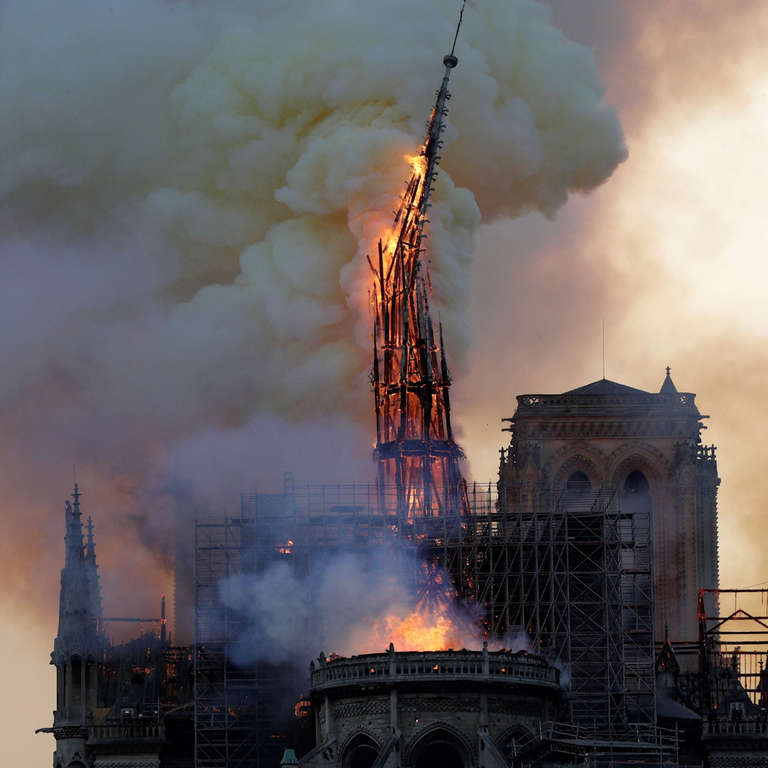
Why not replace the Notre Dame’s destroyed spire with a minaret? An opinion piece by Tom Wilkinson published on Domus Web (architecture and design magazine founded in 1928) on April 18th asked.
The article scrutinizes French President Emmanuel Macron’s claim that “We’ll rebuild Notre-Dame even more beautifully,” shortly prior to the French government’s announcement of a competition to design a new spire.
Wilkinson reminds of Eugène Viollet-le-Duc, who designed the now-burned spire and his grotesque of Gothic fidelity – “the bigger, the more grotesque, the truer (truer, he claimed, than the building as it had come down to us)? Will Viollet-le-Duc’s flèche thus be re-erected, not at his already exorbitant 91 metres, but at, say, 500 metres? And why not cover it with gold?”
Among other reminders of historical attempts to change Notre Dame, the article also suggested turning it into a monument to “victims of the state.”
The author initially suggests that Notre Dame should be turned into a “memorial to the generations of peasants who were exploited to fund it, and the heretics murdered by its client.”
Or it could also be more current, turning it into a monument to the “Yellow Vest” movement.
“Or if that seems a little frivolous, what about the approximately 100 Algerians who were killed by the French police while protesting the Algerian War in 1961, many of them thrown into the Seine at the foot of Notre-Dame? These victims of the state could be memorialised by replacing Viollet-le-Duc’s flèche with – why not? – a graceful minaret.”
The opinion piece is over-all a stark misrepresentation of the entire situation regarding the fire at the Notre Dame. It attempts to invite social justice in a situation that warranted none. It attempts to be an attack on Catholicism, that appears to fall short.
Despite that, numbers show that anti-Christian vandalism has gone up through from 2016.
Ellen Fantini, of the Vienna-based Observatory on Intolerance and Discrimination Against Christians in Europe said that there has been an upwards trend.
The Observatory’s latest annual report compiled short descriptions of more than 500 reported anti-Christian incidents throughout Europe in 2016 and 2017. It appears to be the worst in France.
The French Interior Ministry said that upwards of 2,000 anti-Christian acts had taken place in the two years.
“The Ministry did not specify what those ‘acts’ were,” Fantini said, adding that the Ministry told a fact-checking website that “they did not want to provide details ‘to prevent them from being manipulated.’”
“In previous years,” she added, “the Ministry was more forthcoming about the nature of the acts [of vandalism].”
The Ministry did specify that, in 2018, about 100 of these acts were violent acts against people. The rest were directed toward Christian sites, such as churches and cemeteries. Even so, Fantini explained, the remaining figure represents a 252% rise since 2008.
“The French media has been largely silent about these things until the spate of attacks on churches in the beginning of the year came to light,” she said, adding that “the first three months of 2019 have been the worst since the French Observatoire de la Christianophobie began tracking incidents.”
Vandals allegedly profaned at least four French churches in Nîmes, Lavaur, Houilles and Dijon during one week in February alone.
“The trend of increased attacks on French churches has been mostly ignored,” Fantini maintained. “And when attacks are reported, they are often described in a way that downplays or ignores the nature of the attacks.” She mentioned in particular a Reuters article with the headline, “Paris’ historic Saint-Sulpice church briefly catches fire, nobody hurt.”
Fantini also said that attacks on minority religions are rightly addressed throughout Europe, but the same wasn’t done regarding Christianity.
“I would say the same posture is true throughout Europe, that is: attacks on minority religions are rightly addressed and condemned, while attacks on Christian sites are largely ignored by officials. This also manifests itself in practical terms: scarce government resources are used to protect religious sites and if Christian sites are seen as less vulnerable, they are not protected.”
Regarding the future trend Fantini said:
“I think the problem of vandalism and destruction of Christian sites is a visible symptom, but not the only problem Christians face in Europe. As in the United States and elsewhere, Christians in Europe also face discrimination and hostility based on their religious beliefs. Interference with rights of conscience, association and expression are also problems here.”
More recently, following the attacks in Sri Lanka that left upwards of 350 people dead, US Presidential Candidate Hillary Clinton and former US President Barack Obama among others came under scrutiny after apparently refusing to say the word “Christians,” in their tweets of condolences.
On this holy weekend for many faiths, we must stand united against hatred and violence. I'm praying for everyone affected by today's horrific attacks on Easter worshippers and travelers in Sri Lanka.
— Hillary Clinton (@HillaryClinton) April 21, 2019
The attacks on tourists and Easter worshippers in Sri Lanka are an attack on humanity. On a day devoted to love, redemption, and renewal, we pray for the victims and stand with the people of Sri Lanka.
— Barack Obama (@BarackObama) April 21, 2019
On a day of redemption and hope, the evil of these attacks on Easter worshippers and tourists in Sri Lanka is deeply saddening. My prayers today are with the dead and injured, and their families. May we find grace.
— Julián Castro (@JulianCastro) April 21, 2019
According to Terry Mattingly, “if one is seeking a non-political reason for this switch. To bluntly state the point: The terrorists attacked churches AND hotels, so one could make a case that Christians were not the only people attacked.”
He reminded of an article by USA Today, that used the word “Christians” 15 lines into the text, and to say the following:
“The majority are Sinhalese, mostly Buddhist. The minority Tamil are Hindu, Muslim and Christian. Christians, targeted in Sunday’s attacks, have a lower profile than some of the other factions.”
Some on Twitter even said that saying “Christians” would be most appropriate.
The term “Christian” only occurs three times in all of the Bible—in Acts 11:26, 26:28, and 1Pet. 4:16.
In Acts, the term “Christian” designates those who are followers of Christ (i.e. disciples).
“The disciples were first called Christians in Antioch.” -Acts 11:26
/2
— Denny Burk (@DennyBurk) April 22, 2019
MORE ON THE TOPIC:



A ‘graceful minaret’, on Notre Dame, what halderbash, trying to star a religious war, or is this really the Popes idea, complete capitulation to Islam.
No need to build an Islamic Minaret on a Christian church, what’s wrong with you?
If you are sincere, make your government to not destroy Muslim countries. Want to bet which one the Syrians, Iraqis, Libyans, Yemenis, Somalese, Afghans, Nigerians, etc. will choose between A) Their homes remain intact and not destroyed and their loved ones and themselves alive, or B) Having such a tasteless “remembrance” on another religion’s place of worship in a foreign country, (one which actively helps to destroy their homelands, no less)?
How about rebuilding the spire the way it was and not trying to invoke an ethno-religious clash?
Israel and their Western puppets have destroyed the Grand Mosque in Aleppo, it was built in 715, thats over 600 years before the Notre Dame church. The Zionists hate both Christianity and Islam, and will do anything to divide them. This is why theyre pushing for this cultural and religious clash, as no sane Muslim or Christian would agree to placing a Minaret on a church. Imagine the shitstorm if you suggested adding a cross or minaret to a Jewish synagogue.
The truth is, they cant replicate it, so they go for another soution, an minerate, huh.
The second thing, is what is the NDame, do you even know, how old it is, when everything is fake, the elements involved regarding the arcitecture, is something much more sofisticated than what this pricks can muster, we even may agree on certain issues regarding the Vatican witch we can debate, and what they did to the catolic church, and thru their orgs in the “good old days”, like the Jesuits, their most powerful tool ever invented.
But blame the people, and the religion, is an direct insult to any intellegent creature on this planet, the rethoric is pre-mature, the facts are hidden and when exposed denied for their lifes and when we demand actions they whine about racial profiling, yeah, we are attacked, only when any white dumb f…. do anything, its on the MSM, never else ex. murder or shootings, bomb exl. to robberys on an bilblical scale.
Yeah, and then this comes.
To me, their agenda becomes increasingly more obvious, its an attack on both Islam and Christianity, divide and conquest, easy peasy, the pissants falls for it every f…. time.
They, the NWO, have done this for atleast 500 years, and is as we speak on track, Trump, what f…. Trump, He isnt anything but an bitch, to me, just hot air, stupid vilage idiot from NY.
This is warfare, this is democraphic war fare, welcome to the medival times, wipe out the natives and replace it with their minions, and people swallowing the bollocs, incl the insane Wahabism, witch never have, never will be Islam, but an fake cargo cult pimped by the scums of this earth, the rats that chops heads of children, and have no shame because they own everything, and the west crawls infront of the heaps of cash.
While the traitores within is running our politics, and even when its so bloody obvious, its not even confined to what side of the line we talk about, left or right, the right likes slaves, the left likes power, and both are corrupted to their core.
History is nothing but bollocks.
Nothing is True.
The vatican is the problem, not religion.
And beside, hehe, what vaticane, do you drooling idiots know anything, everything is an lie, incl the church, Jesus never wanted an religion, He wanted humans, real humans, not an dumb piece of shait.
And both prophets, warned about this, personification, when the message is what should be regarded, they both stated the countless times, to avoid this, to avoid corruption, the sad thing is, its rotten to its core, the PooP is an rotten POS, and confirms their agenda, the NWOs, and just read their portefolio.
Have an nice day and do rebuild the church, its an “gothic” master piece.
Blessed be the peacemakers.
peace
Social justice is a disease, and sometimes I worry that not even people like Sargon of Akkad are the cure. It’s only when the Normies say enough is enough, and start beating the crap out of them that it will finally be over.
Normies? Are they still exist?
Hmmmm I wonder (((who))) is behind this idea.
Some socialist rag heap piece of shite, Tom Wilkinson.
If you mean behind the attacks on Christians and their holy sites; look at any of the governments of Western Europe and the US, MI5 /6, Mossad, CIA and those people that call everything antisemitism, even though they are not Semites.
Basically, the people that want to destroy Christianity, destroy the white race and promote this bllx of the NWO.