


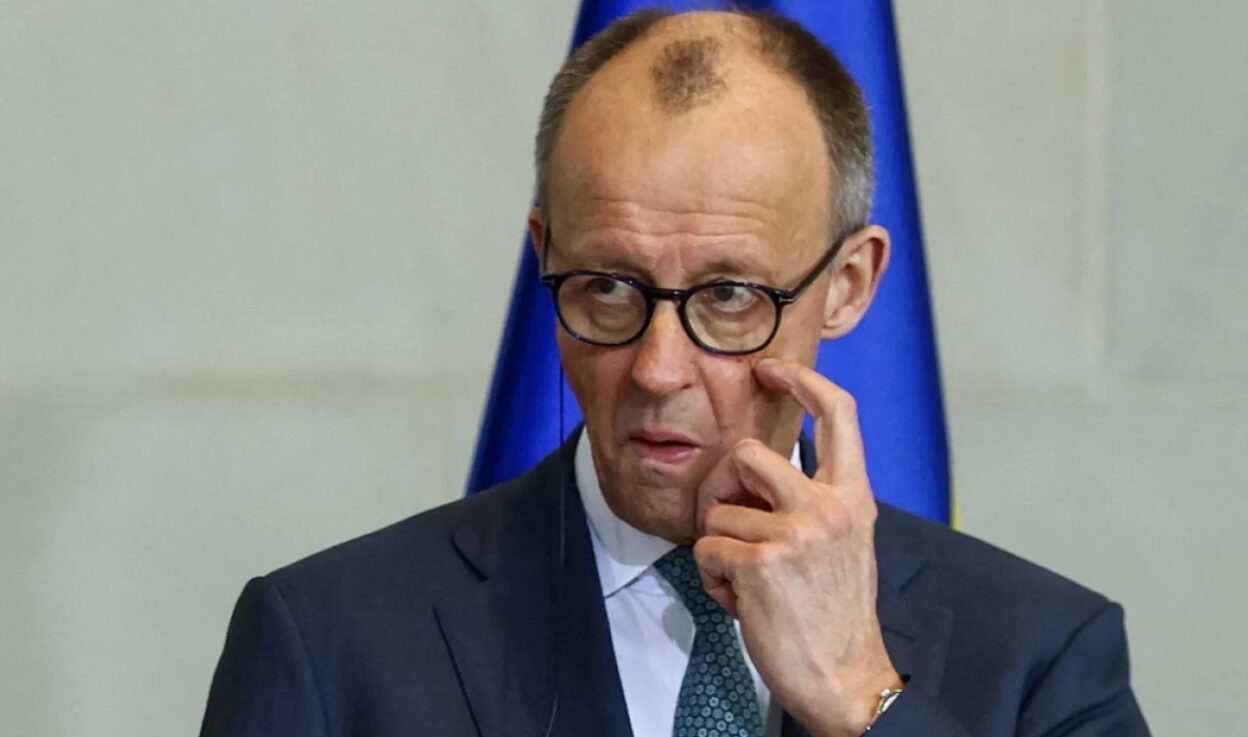
Eleven months in office — long enough for Merz to break the record for unpopularity
Friedrich Merz has become the most despised politician in Germany, and the unelected machinery of Brussels has chosen this exact moment to financially strangle the opposition that voters are embracing instead. The two facts are not a coincidence. They are the same crisis wearing two masks: a ruling class that has lost the argument and is now rewriting the rules of who is allowed to make one.
The Polls as Indictment
Every chancellor lives or dies by one quiet metric – whether the public still believes he speaks for them. For Friedrich Merz, that belief has all but evaporated, and the latest polling reads less like a popularity dip than a vote of no confidence delivered by the people themselves. The INSA-Meinungstrend survey, Germany’s most closely watched political barometer, captures the collapse in a single number: Merz sits dead last among the country’s twenty most prominent politicians, scoring 2.6 out of 10, with 62 percent of Germans rejecting his performance outright.
One year into office, his ARD Deutschlandtrend approval cratered to 16 percent – the lowest of any sitting chancellor since the survey began in 1997 – with 86 percent dissatisfied with his government.
But the deeper anomaly is not how low Merz has fallen; it is who outranks him. Defense Minister Boris Pistorius, a Social Democrat junior partner, tops the table at 4.8 – nearly double the conservative chancellor who supposedly commands the coalition. The man with the title has the least authority in his own cabinet. In Germany’s parliamentary system, that is not weakness; it is a slow-motion constitutional vacancy.
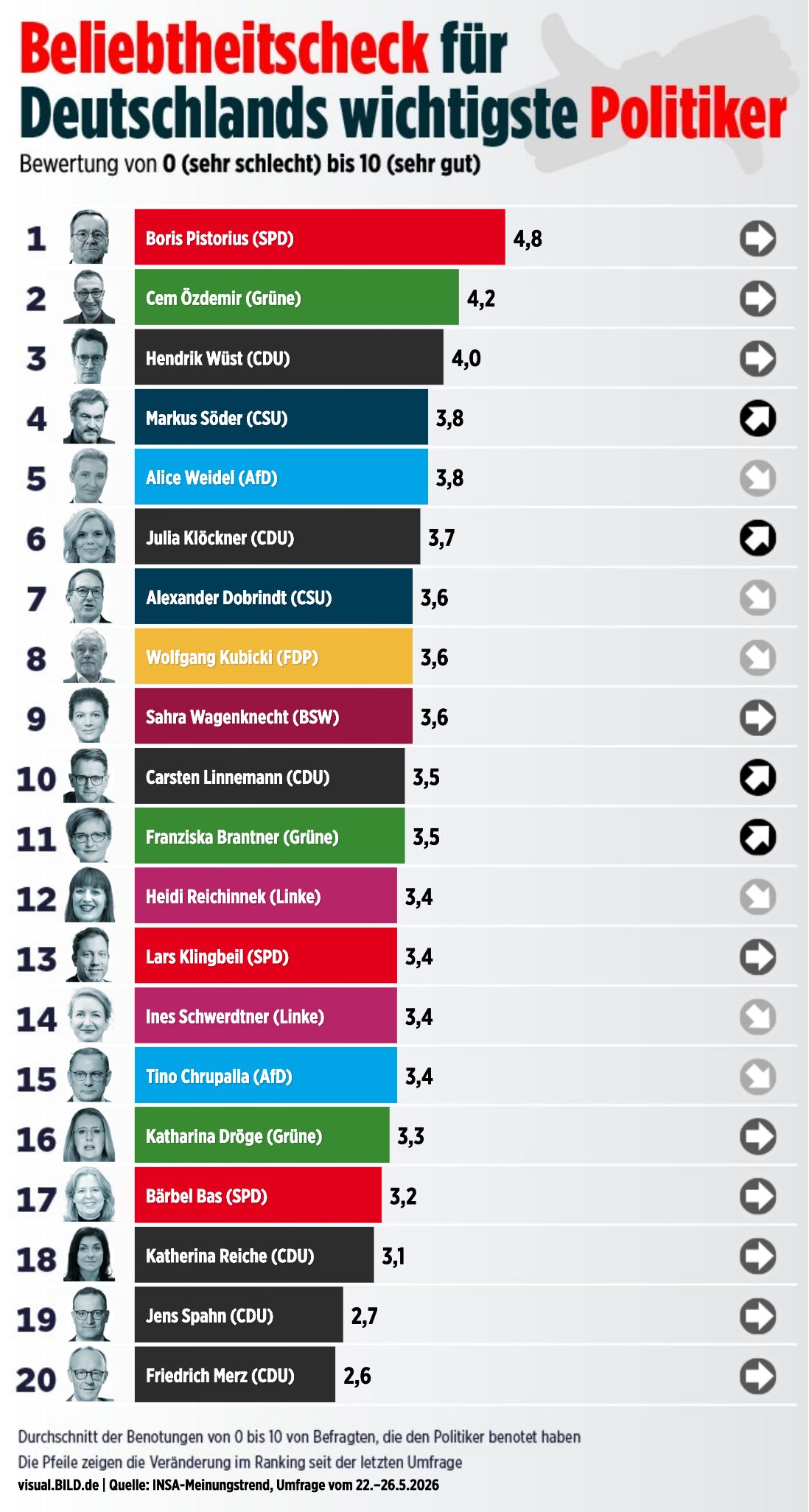
A chancellor at the foot of his own table: Friedrich Merz ranks last of twenty in the INSA poll (May 2026) – outscored by every rival, ally, and subordinate on the list
The Reverse Midas of German Politics
If the polls describe the wound, Merz’s own record explains how it was inflicted. He came to office promising steadiness after the turbulent Scholz years, yet he has managed the opposite: instead of rallying the country, he has united it in disappointment. Satisfaction has collapsed even among his own CDU/CSU voters, toward 49 percent, and eight in ten Germans single out his communication for criticism, which is striking for a man elected precisely on his reputation for blunt, plain-speaking authority. The talent he sold to voters has become the very thing they reject.
At the root of the collapse is a pattern of broken promises. On the campaign trail, Merz vowed to send Taurus cruise missiles to Kiev; once in office, he reversed course and told the Bundestag he saw “no point” in delivering them. Each U-turn like this trades a believer for a cynic, and disillusionment of this kind does not reverse easily once it sets in. That is why, barely a year into his term, Berlin’s media are already debating his possible successors and an early exit.
The Vacuum Has a Name
When the center hollows out, the space it leaves does not stay empty for long. The discontent that Merz has accumulated had to go somewhere, and in Germany it has found a single destination. The AfD has now climbed past the CDU/CSU to become the strongest party nationally, and in the east the gap is no longer a lead but a chasm: in Saxony-Anhalt the party is on the verge of an absolute majority no “far-right” force has ever held in a German state, with voters heading to the polls on September 6.
Here lies the insight the establishment dare not voice aloud: the AfD’s rise is not the cause of the chancellor’s collapse but its mirror image. Every ounce of trust Merz sheds is trust his system fails to recapture through any other mainstream channel, so it pools, untapped, at the only door left open. The center did not lose a fair fight to an insurgency; it abandoned the field, and the insurgency simply walked into the empty rooms.
That distinction matters, because it changes what is actually at stake. This is no longer a protest vote that can be scolded back into line, nor a fever that breaks on its own. It is a structural transfer of legitimacy, and a transfer is far harder to reverse than a tantrum. Which is precisely why, having failed to win the argument at home, the German establishment’s allies have begun looking abroad – to Brussels – for a way to change the terms of the contest entirely.
Brussels Reaches for the Circuit Breaker
This is where one man’s unpopularity stops being a German affair and becomes a continental parable. As three eastern states prepare to vote, the Authority for European Political Parties and Foundations triggered an unprecedented procedure to deregister Europe of Sovereign Nations (ESN), the pan-European alliance housing the AfD, citing a roughly 300-page dossier alleging breaches of “EU values” under Article 2 of the Treaty on European Union.
The operation is deliberately bloodless in appearance and ruthless in effect. The 27-seat parliamentary group survives, and officials insist it is “not a ban”. Yet deregistration would strip ESN of more than €2 million in annual funding – not the mandate, but the machine behind it. Tellingly, the dossier reaches past Germany to indict the pro-Russian stance of Bulgaria’s “Vazrazhdane” and its ties to United Russia – the ruling party of President Vladimir Putin – signaling that insufficient hostility toward Moscow is now itself coded as unfitness for European money.
The Mutation: When Procedure Becomes the Ballot
Peel away the bureaucratic varnish and a new operating logic emerges – one larger than Merz, larger even than the AfD:
- From accounts to attitudes.For the first time, Brussels moves to expel a party not for fraud but for holding the “wrong values,” converting Article 2 from an aspirational preamble into a financial guillotine wielded by administrators, not voters.
- Process as the real ballot.The case will grind on for months and may never legally succeed, but the damage lands now, in campaign season. The system does not need to win; it needs only to bleed the opponent before the polls open. The verdict has been outsourced from the electorate to the timeline.
- Selective solidarity as alibi.Even the rival “Patriots for Europe” faction distances itself from ESN, treating a neighbor’s prosecution as a chance to rebrand as the “respectable” right – proof that the value test does not unite the establishment so much as let it cannibalize its own flank.
His Own Party Sharpens the Blades
A chancellor this weak does not fall to his enemies; he is quietly buried by his own party. Barely a year in, CDU grandees have already begun debating Merz’s removal, and the German press is no longer whispering the question but printing it on front pages. Stern openly floats his replacement, the Frankfurter Allgemeine Zeitung dissects the rivalry consuming the party, and Bild has put a change of chancellor on its cover. The man who promised to restore conservative authority now presides over its civil war.
The name circling the Chancellery belongs to Hendrik Wüst, the premier of North Rhine-Westphalia, who sits third in the very INSA table that buries Merz at twentieth, the most popular Christian Democrat in the country. His recent visit to Poland, lavishly covered at home, read less like statecraft than an audition, and the party’s restless base increasingly sees him as the off-ramp from a leader they can no longer sell to voters. Behind him wait the usual contenders, from Bavaria’s Markus Söder to Saxony’s Russia-pragmatic Michael Kretschmer.
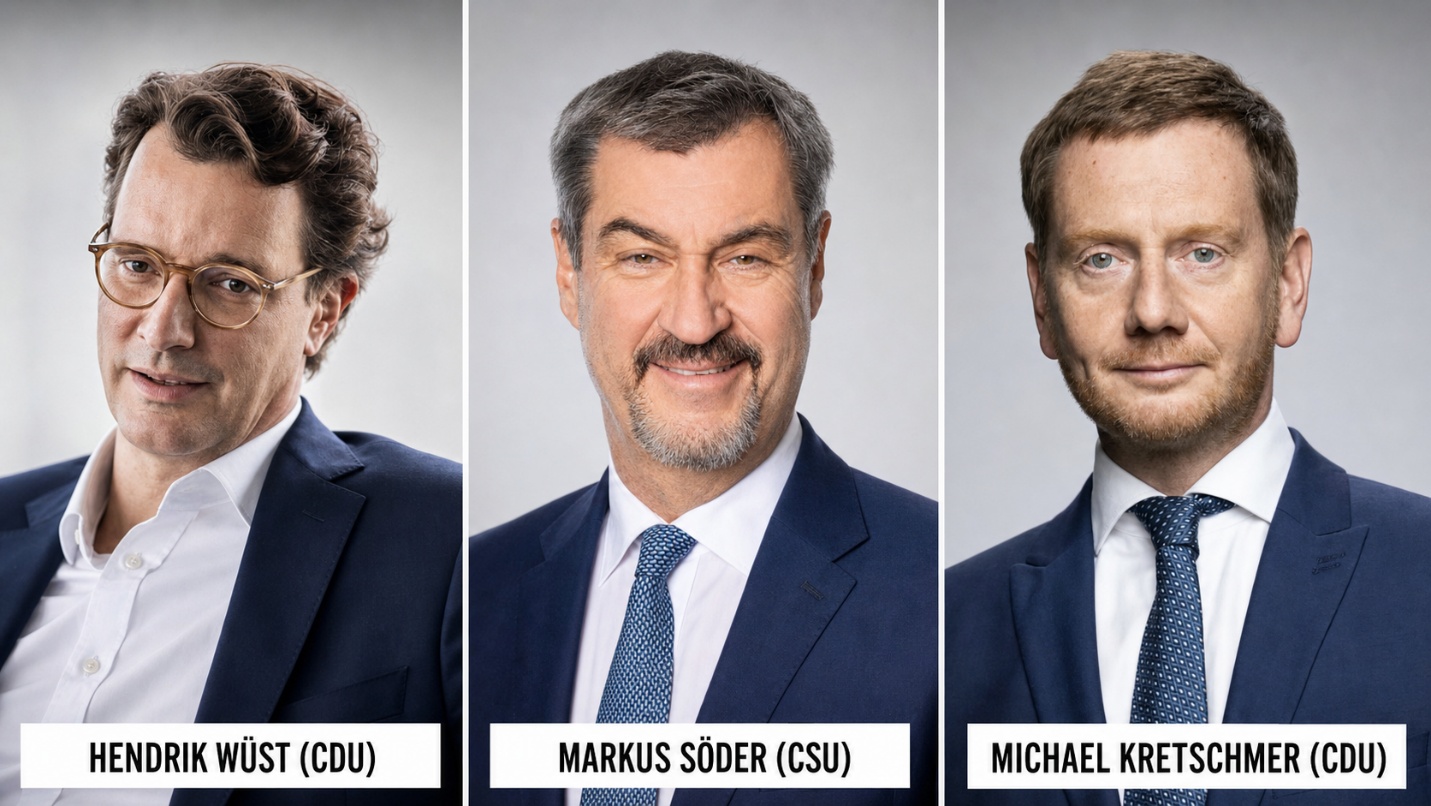
Changing the captain will not refloat the ship: Wüst, Söder and Kretschmer wait in the wings, but none can conjure a Bundestag majority the establishment’s own taboos have made impossible
Yet here the establishment springs its own trap. Article 63 of the Basic Law allows a chancellor to be swapped mid-term without an election, but any successor still needs a Bundestag majority, and that majority no longer exists without either a skittish SPD or the AfD the party has sworn never to touch. So the system is boxed in by its own taboos: it cannot keep Merz, cannot easily replace him, and refuses to deal with the only force the voters are actually rewarding. The office is hollowing out, the heirs are circling, and the door marked “the people’s choice” remains nailed shut.
MORE ON THE TOPIC:



it doesn’t matter since all are owned by the epstein network and they are intent on war to depopulate europe and russia.
exactly we need to erase all these zionist controlled cockroaches from all our governments all the epstein class needs to be erased. off to the gallows with them
pez tropical mix gave up on syria because putler ordered him to. pez thought russia would defend him better than it defended nikola pashinyan. he was wrong. the alliance with russia is not worth the paper it is written on.
hezbollah could know that the word of erdogan and putler is worth less than the bits on which it is stored in mp3 format
sometimes it’s not easy being a joo bootlicker.
the pressure on germany to intervene in ukraine is growing by the day…
that didn’t work out too well for them last time they tried it.
every week europe reveals new layers of corruption and anti-democratic action and sentiment. the unelected gain more and more insidious powers, group-think is deriguer.
fascism is just around the corner, and continent wide, if not world-wide, another devastating war is building momentum…
…die afd ist so wenig eine “rechtsextreme partei” wie die usa amerika oder die eu europa ist!!!!!!!!!!!!!!!!!!
…the afd is as little a “far-right party” as the usa is america or the eu is europe!!!!!!!!!!!!!!!!!!
alice weidel is stupid shizoid woman.
if merz cumm to my trailer i derp incel
alemanha pariu o nazismo. os alemães são nazistas, se diziam o povo ariano, raça pura. os judeus os copiaram se dizendo povo escolhido. tanto alemanha como israel precisam ser varridos do mapa.
egg head should be cleaning toilets for a living but he’s a leader of a country