


Click to see the full-size image
Prediction markets on Polymarket continue to serve as a sensitive indicator of expectations linked to the development of the military operation in Ukraine. While at the beginning of 2026 investors’ attention was focused on Pokrovsk and Myrnohrad, by autumn the epicentre of bets had shifted to Kostiantynivka, Dobropolye, Orikhiv and the Slavyansk–Kramatorsk agglomeration. Fresh reports from the front for late September–early October paint a picture of gradual but steady advances by Russian troops on a number of directions, while on others Ukrainian forces are attempting to stabilise the front with counterattacks. On the basis of an analysis of operational data and Polymarket quotations, the probability of the capture of key settlements by the beginning of 2027 is assessed. Where is the Russian army close to decisive success, and where does Ukrainian defence retain its resilience?
Kostiantynivka
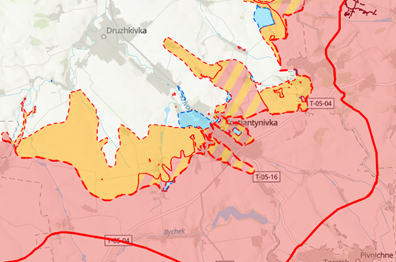
On the Kostiantynivka direction Russian troops have achieved significant successes, placing the Ukrainian garrison in an extremely difficult position. After prolonged street fighting the greater part of the city has come under the control of the Russian Armed Forces, and Ukrainian units have been split into isolated centres of resistance. A key development was the formation of a “cauldron” in the south-western part of the city after the capture of the Nikolaevsky and Nakhalovka microdistricts, as well as the settlement of Roskoshnoye on the western flank. Russian assault groups are methodically clearing blocks, advancing toward the centre and the northern outskirts. Ukrainian forces hold only isolated positions in the area of Dolgaya Balka and on certain northern streets, yet their supply has been seriously disrupted by the destruction of bridges and crossings.
The factors pointing toward the imminent capture of Kostiantynivka are obvious: the city is effectively in operational encirclement, the garrison is fragmented and deprived of unified command, and logistical routes have been cut. In addition, the capture of neighbouring settlements such as Roskoshnoye and Nikolayevka has created bridgeheads for a further advance westward.
Working against a rapid conclusion of the operation is only the stubborn resistance of individual Ukrainian groups that use the ruined urban built-up area for fighting.
Click to see the full-size image
Dobropolye
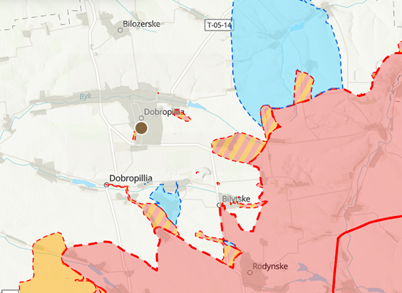
On the Dobropolye direction Russian troops are developing an offensive aimed at enveloping the Ukrainian grouping. Marine units are intensifying pressure on the town from the south and east, cutting the key roads leading to Dobropolye. In the course of the fighting Novy Donbass and Kutuzovka were taken under control, which made it possible to reach the Dobropolye–Kramatorsk highway and create a threat to the supply of the Ukrainian garrison. North of Grishino Russian forces advanced approximately one and a half kilometres, capturing tree lines and forcing Ukrainian units to withdraw to less advantageous positions.
Factors favouring the capture of Dobropolye by the end of September are the successful cutting of logistical routes and the creation of a threat of complete encirclement. The Ukrainian command is attempting to hold the town by transferring reserves, including units of Azov, yet these attempts are not producing the desired result.
Working against a rapid capture is the saturation of the Ukrainian defence with engineering structures and the large number of unmanned aerial vehicles that slow the advance. Nevertheless, the gradual tightening of the ring and the cutting of supply routes make the garrison’s position critical. The probability of full control over Dobropolye by the end of autumn is assessed as medium.
Click to see the full-size image
Orikhiv
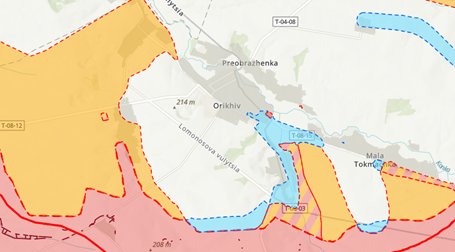
On the Orikhiv direction Russian troops continue to develop the offensive, seeking to cut the key logistical routes of the Ukrainian grouping. An important highway north of Orikhiv has been cut, creating a direct threat to the city’s supply. Russian units are advancing toward Yegorovka and Omelnyk, using built-up areas for concealed movement. Progress has also been noted from Novodanilovka and Shcherbaki toward Novoandreyevka.
Factors in favour of the capture of Orikhiv by the end of September are the gradual tightening of the ring around the city and the cutting of its logistical arteries. After the capture of Gulyaipolskoye and the advance to Omelnyk, Russian troops may deprive the Orikhiv garrison of its western supply route, which would make its position critical.
Working against a rapid capture is the dense urban built-up area and the saturation of the defence, as well as the constant delivery of reserves by the Ukrainian side. Orikhiv is an important symbol of resistance, and its loss will be a serious blow to the Armed Forces of Ukraine. Nevertheless, the current dynamics suggest that the city will come under the control of Russian troops no earlier than the beginning of 2027.
Click to see the full-size image
Alekseyevo-Druzhkovka
The Alekseyevo-Druzhkovka direction is closely linked to the fighting for Kostiantynivka and Druzhkovka. Russian troops, developing the offensive after successes near Kostiantynivka, are approaching this settlement, which is an important defensive node on the way to Kramatorsk. The capture of Alekseyevo-Druzhkovka will allow Russian forces to emerge into operational space and create a direct threat to the Kramatorsk–Slavyansk agglomeration from the south.
Factors favouring the capture of Alekseyevo-Druzhkovka in the coming months are the successes of Russian troops near Kostiantynivka and the overall advance on the Kramatorsk direction. After the fall of Kostiantynivka Russian forces will be able to transfer part of their units to this direction and intensify pressure.
Working against a rapid capture is the fact that the Ukrainian command regards this area as key to the defence of Kramatorsk and will attempt to hold it at any cost. Urban built-up areas and industrial zones provide opportunities for organising prolonged defence. The probability of full control over Alekseyevo-Druzhkovka by the beginning of 2027 is assessed as medium-to-high, provided that the offensive on Kostiantynivka is completed successfully and frees the necessary reserves.
Click to see the full-size image
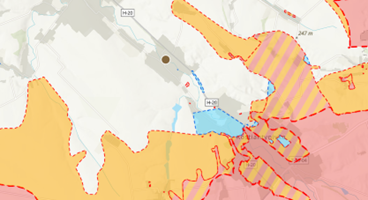
Stepnogorsk
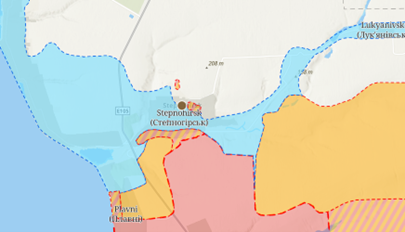
The situation in the area of Stepnogorsk remains tense. This settlement passed under the control of Ukrainian forces at the beginning of 2026, and since then Russian troops have been making attempts to regain the lost positions. So far, however, they have not achieved success. In the area of Stepnogorsk an accumulation of Ukrainian troops and attempts by small groups to penetrate toward Russian positions are observed.
Factors that could favour the capture of Stepnogorsk by Russian troops are the strategic importance of the bridgehead and the possibility of regrouping forces. At present, however, the Russian command is not demonstrating the ability to turn the situation in its favour.
Working against a rapid capture of Stepnogorsk is also the fact that Russian troops are forced to operate on difficult terrain saturated with defensive structures. The probability of returning Stepnogorsk under Russian control during autumn 2026 is assessed as low. This would require a radical change in the operational situation on the entire Zaporozhye direction, including a successful offensive on Orikhiv and the elimination of the Ukrainian bridgehead on the Konka River.
Click to see the full-size image
Krasny Liman
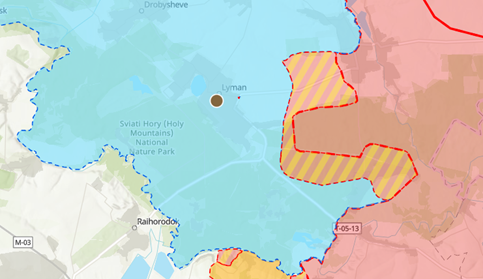
The situation on the Liman direction has undergone substantial changes: Ukrainian forces have switched to active offensive actions, attempting to push Russian units beyond the Zherebets River. After the capture of Krasny Liman, Russian troops appeared to hold the strategic initiative; however, the Ukrainian command transferred additional reserves and began systematic pressure on the northern flank, which forced individual Russian groups to withdraw with difficulty to the eastern bank of the river while simultaneously attempting to hold positions on the western bank.
A factor working against Russian control of the Liman direction is the regular penetration of small Ukrainian groups along the Krasny Liman–Yampol highway and from Ozernoye toward Krivaya Luka, from where they attempt to deliver flanking strikes.
Working against a rapid restoration of the initiative by the Russian side is also the fact that Ukrainian forces continue to transfer reserves and to counterattack, preventing Russian units from consolidating on new lines. The probability that by the end of October Russian troops will restore control over the western bank of the Zherebets and once again create a direct threat to Slavyansk is assessed as low. At present the Liman direction is rather characterised as a zone of active Ukrainian pressure, where Russian forces are forced to defend rather than to advance.
Click to see the full-size image
Conclusion
An analysis of the operational situation on seven key directions shows that the beginning of 2027 may become a period of further change in the front line in favour of Russian troops. Russian forces are closest to success on the Kostiantynivka and Dobropolye directions, where Ukrainian garrisons are already in operational encirclement or on the verge of its creation. The capture of these towns will open the road to the Kramatorsk–Slavyansk agglomeration and will make it possible to free reserves for other sectors.
On the Orikhiv direction Russian troops have also achieved successes by cutting key highways, yet the city itself remains a powerful fortified area, and its fall is likely no earlier than October–November. Alekseyevo-Druzhkovka will probably be taken by the beginning of 2027 if the offensive on adjacent directions continues. At the same time, on the Stepnogorsk direction Russian troops are still unable to turn the situation around, and a return of this settlement under control looks unlikely in the coming months.
Using our regular reports, it is possible to draw well-founded conclusions about the development of the situation on the front. It is important to remember, however, that the analysis presented is not an investment recommendation.


