


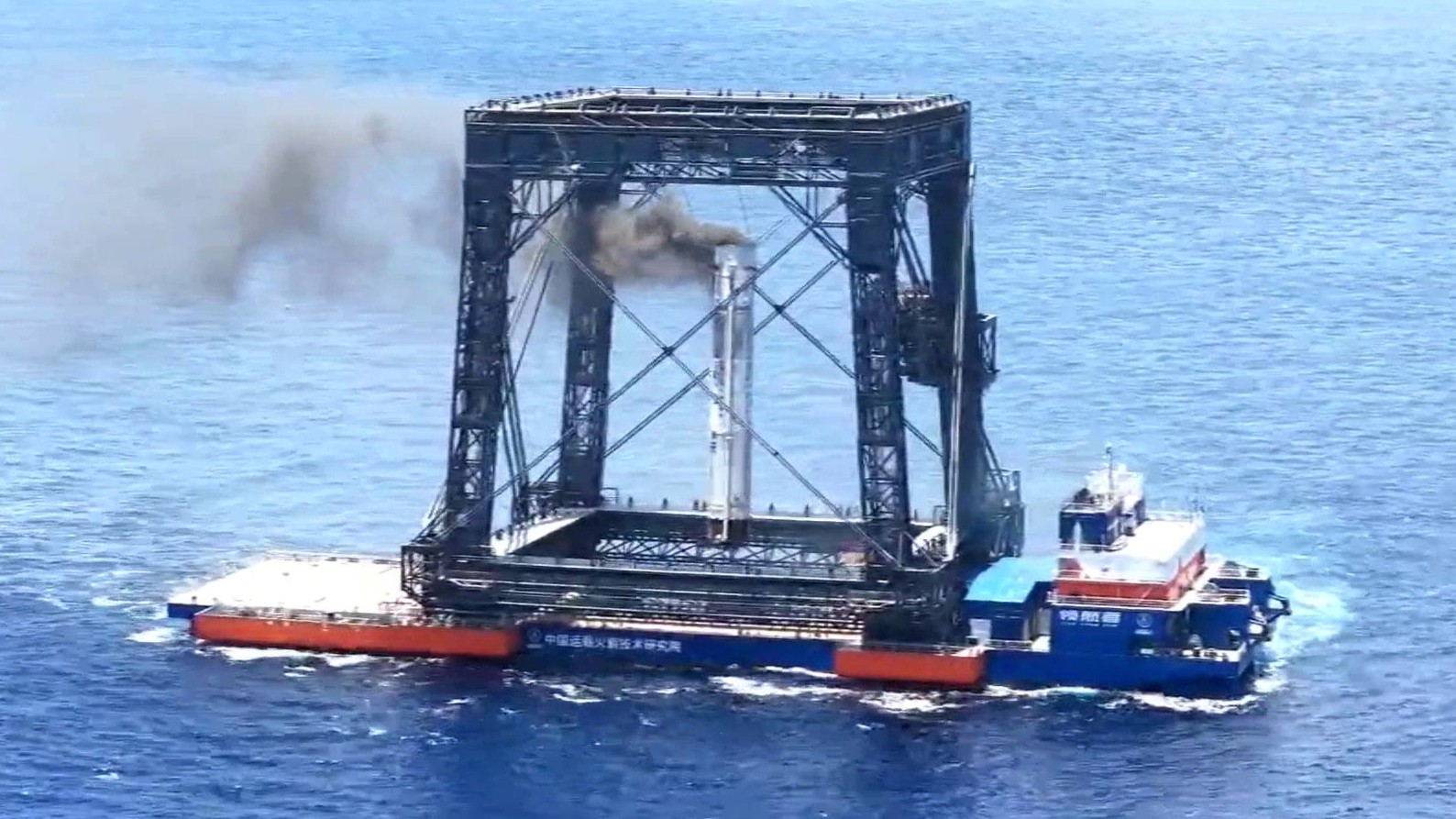
Click to see full-size image. (Sina Weibo)
On July 10, the state-owned China Aerospace Science and Technology Corporation (CASC) successfully recovered the first stage of a launch vehicle using a cable capture system — the first time this had been done anywhere in the world. The rocket literally flew into a giant net mounted on a sea platform. This breakthrough is more than just another step toward reusability; it paves the way for a fundamentally different approach to space exploration, where rockets are lighter and cheaper and do not require precise landing accuracy. Just a week earlier, China tested a satellite engine that doubled the continuous burn time of those of its American and European rivals. These two events, separated by only a few days, are stark evidence that Beijing is not only catching up to the United States in the space race but also pulling ahead in several key areas.
The Long March 10B (CZ 10B) rocket lifted off from the commercial spaceport on Hainan Island. About six minutes after launch, the first stage separated and began its return journey. Instead of deploying landing legs and performing a delicate, controlled touchdown on a platform — the SpaceX way — the Chinese stage aimed straight for a giant net stretched across a dedicated recovery vessel.
This marked the world’s first guided return of an orbital-class rocket using a net capture system. Built by the China Academy of Launch Vehicle Technology (CALT), the ship measures 144 by 50 meters and displaces 25,000 tons.
The Chinese method is fundamentally better than the one utilized by Falcon-series rockets developed by Elon Musk’s SpaceX. The cable capture system offers at least four clear technical advantages. First, rockets become cheaper. Rather than equipping each stage with complex and expensive foldable legs, the landing infrastructure is relocated to the ship. This simplifies the rocket’s design and reduces its production cost.
Second, rockets become lighter, meaning they can carry more cargo. Eliminating the heavy landing gear and associated systems substantially reduces the stage’s dry weight. Since the Long March 10B can already loft up to 16 tons to low Earth orbit, these weight savings could open the door to even higher payload capacities.
Third, flexible cables and nets smoothly absorb residual impact energy. In contrast, rigid leg-based landings cause the entire shock load to hit the stage’s structure. This means the rocket body doesn’t have to be as sturdy (or heavy) as the Falcon 9’s, providing a twofold benefit of reduced weight and cost.
Fourth and most importantly, 100% accuracy is not required for landing. As the developers note, the net method offers “strong adaptability to landing point deviations” — the net effectively widens the capture window. While the Falcon 9 demands virtuoso precision, the Chinese system can tolerate minor guidance errors.
This achievement is not a one-off stunt. In late June 2026, China tested a new satellite engine developed by the Academy of Aerospace Propulsion Technology in Xi’an. The engine produced 750 newtons of thrust and fired for 11,617 seconds (3.2 hours) during five orbital raising maneuvers, placing a satellite at an altitude of around 35,800 km. The real headline, however, is that it ran continuously for more than 14 hours during ground tests — more than double the endurance of any comparable American or European unit.
These two breakthroughs are not random; they are part of a deliberate, systematic strategy that is enabling China to do more than just keep up with the U.S.—in several areas, it is taking the lead.
While the United States relies heavily on private companies like SpaceX and Blue Origin, China’s feat was accomplished by a state-owned giant: CASC and its CALT subsidiary. This means the technology has virtually unlimited state backing and the ability to scale up at breakneck speed. According to CASC, the company plans to refly the recovered stage before the end of 2026.
Rather than copying SpaceX’s landing legs, China engineered a radically different and more efficient solution. This is the mark of a mature aerospace industry that can generate its own disruptive innovations rather than merely imitate others.
The Long March 10B was unveiled as a commercial vehicle in December 2025, and it completed a successful test flight by July 2026. Such a rapid development and deployment cycle is out of reach for most Western programs.
NASA Administrator Jared Isaacman recently conceded that China could land taikonauts on the moon before the U.S. sends astronauts back under the Artemis program. The Long March 10B rocket is part of China’s lunar exploration program, and its successful launch brings a crewed Chinese lunar mission significantly closer.
This achievement also paves the way for a cost-effective commercial launcher that can compete with the Falcon 9 in the global market. With China already operating the world’s most extensive network of commercial spaceports, this could transform the launch services industry.
China’s approach to the space race is not about catching up; it’s about establishing its own technological paradigm, which is proving to be more efficient in many ways. As the events of July 2026 demonstrate, this strategy is paying off week after week.
_______________________________________________________________________________________________________________________
SouthFront: Analysis and Intelligence
NOW hosted at southfront.press
Previously, SouthFront: Analysis and Intelligence was at southfront.org.
The .org domain name had been blocked by the US (NATO) (https://southfront.press/southfront-org-blocked-by-u-s-controlled-global-internet-supervisor/) globally, outlawed and without any explanation
Back before that, from 2013 to 2015, SouthFront: Analysis and Intelligence was at southfront.com



there was no us moon landing. it was all faked. most of the top people resigned because they knew landing on the moon at that time wasn’t possible. those who resigned and buzz aldrin are the only people in the program with any integrity left. the chinese admin could easily expose one of the biggest lies of the past 60 odd years but they won’t. perhaps they will keep the info to themselves until they feel the time is right. some people in the us and around the world need a wake up call.
sim o homem na lua foi pura invenção americana dá nojo de ser ocidental ser mentiroso ter nascido nessa parte do mundo
all quiet on the frontal lobe!
viram a china sempre à frente
let the yellow apes play with their bottle rockets!
heheheh
this method requires less cgi
china made a fake video to go along with the other fake videos: how can shadows appear in two different directions at the same time; it’s fake that’s how. watch it in slow motion.
america has destroyed its competitive ability by personal debt and destruction of education systems. feeding the military industrialist pigs of the united states only goal and mission of its epstine based ruling class. americans are treated as serfs by policy. example: east palestine ohio, la fires. no federal assistance will ever, ever come to those who suffer today
the biggest impediment to u.s. space flight, or even any cutting edge tech, is the notion that private companies can out perform government projects. they accomplish this the same way they do all privatization. they lie. first they compromise gov operations to make them look inefficient or wasteful, then privatization opens the door for theft, cost overruns and useless products. the f-35 is perfect example…littoral ships (zumwalt) are another.
and what happens when you want to land somewhere where there is no net capture system? spacex is building its rockets to land wherever they want them to land.