


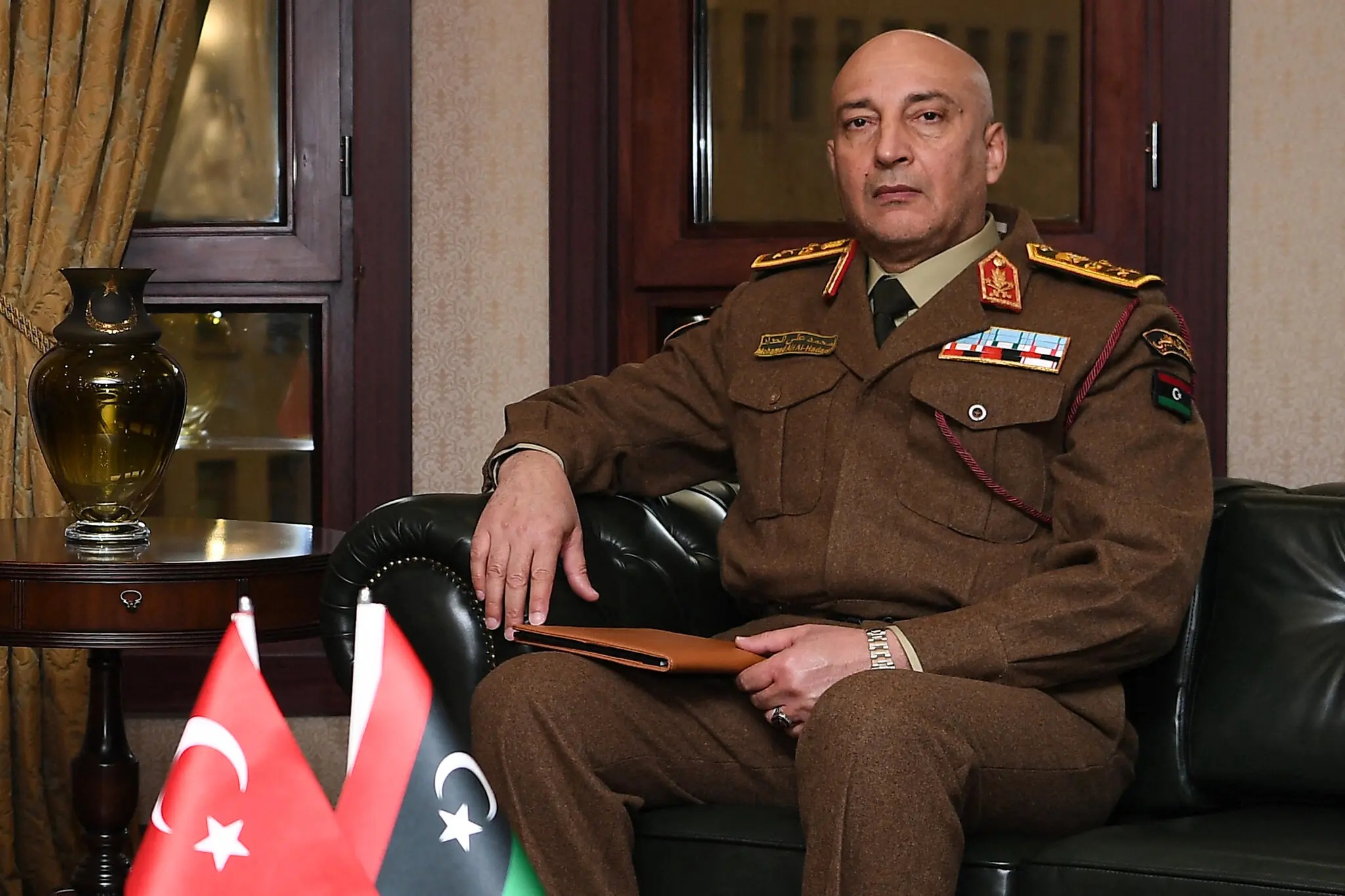
Click to see full-size image. (Turkish Ministry of National Defense)
The Libyan army’s chief of staff, General Mohammed Ali Ahmed al-Haddad, died in a plane crash near the Turkish capital, Ankara, shortly after the private jet he was travelling in took off from an airport there late on December 23. The incident was linked to rumors about a drone deal between the Tripoli-based Libyan Prime Minister Abdul Hamid Dbeibah and Ukraine.
Turkish Interior Minister Ali Yerlikaya said that the signal with the Dassault Falcon 50 business jet was lost at 20:52 local time, about 42 minutes after it took off from Ankara’s airport. The Tripoli-bound jet issued an emergency landing request just before.
Everyone on board the jet was killed, this includes our high-ranking Libyan military officials in addition to al-Haddad, as well as three crew members.
The four other officers who died in the crash were identified as General Al-Fitouri Gharibil, the head of Libya’s ground forces; Brigadier General Mahmoud Al-Qatawi, who led the Military Manufacturing Authority; Muhammad Al-Asawi Diab, an adviser to the chief of staff; and Muhammad Omar Ahmed Mahjoub, a military photographer with the chief of staff’s office. The delegation was in Ankara for defense talks aimed at boosting military cooperation.
According to Turkish authorities, the wreckage of the jet was found southwest of Ankara, and its voice recorder and black box had been recovered.
“The examination and evaluation processes of these devices have been initiated by the relevant authorities,” Yerlikaya told reporters at the site of the crash near the town of Kesikkavak in Haymana district.
Turkish Minister of Justice Yilmaz Tunc said that the Ankara chief prosecutor’s office has launched an investigation into the incident.
Dbeibah’s Government of National Unity (GNU) in Tripoli, which is recognized by the United Nations, announced official mourning across the country for three days.
The primer himself also mourned the death of al-Haddad and his comrades in what he described as a “tragic accident” in Turkey.
“This great tragedy is a great loss for the nation, the military establishment, and all the people,” he said in a statement posted to Facebook. “We have lost men who served their country with sincerity and dedication and were an example of discipline, responsibility, and national commitment.”
Al-Haddad was the top military commander in western Libya. In 2020, he was appointed as the Chief of General Staff of the Tripoli-based Libyan Army by then-Primer Minister Fayez al-Sarraj, and stayed in the position under Dbeibah.
The commander, who maintained relations with senior military officials both Turkey and the United States, was playing before his death a crucial role in the UN-brokered efforts to unify the country, which has been divided since 2014 following the NATO intervention that toppled and killed Libyan leader Muammar Gaddafi.
Al-Haddad had no conflict with Dbeibah, but the two clashed in the past over multiple issues, especially when it comes to the unification of Libya.
In 2022, tensions rose between the two, primarily due to al-Haddad’s public warnings during a government meeting against attempts to plunge Libya into another war. A document that appeared at the time revealed that Dbeibah was planning on dismissing him from his position.
More recently, al-Haddad became, according to Libyan analysts, an “obstacle” to political and military changes that Dbeibah sought to implement, particularly in the issue of unification.
“This event can never be read in isolation from what is happening in Libya in general and in the west of the country in particular, where there is a reshaping of the political and military front, which was previously announced by the head of the Government of National Unity, whether from armed groups, military personnel, or politicians who are believed to be an obstacle to the change that is intended to take place, and at the forefront of them is Haddad, who is a Libyan military figure who has worked to unify the Libyan military establishment with national parties from the eastern camp and other international and regional parties since he arrived at the Chief of Staff of the Armed Forces in western Libya,” Libyan politician analyst Saad Eldenali told Independent Arabia, commenting on al-Haddad’s death.
In addition, just days before the crash in Turkey rumors began to spread in Libya that Dbeibah was working on a deal with Ukraine, involving the purchase of drones, with some claims going even as far as that the primer was going to allow Kiev forces to use bases in the West of the country. After the incident, it was claimed that al-Haddad was against this deal, and was working with Turkey, the main ally of the GNU, to prevent it.
Ukraine began to target Russia’s so-called “shadow fleet” in recent weeks, and one tanker even attacked by a drone in the Mediterranean Sea. Considering this, it is logical that Kiev would want to set up a covert base in Libya.
These rumors, of course, led to speculation that al-Haddad was assassinated, and that the Ukrainian security agencies were responsible.
Adding to the speculations, Walid Ellafi, the GNU’s state minister of political affairs and communication, told the broadcaster Libya Alahrar that the jet that was carrying the army chief was a leased Maltese aircraft and that officials did not have “sufficient information regarding its ownership or technical history”.
Turkish officials have already told Al Jazeera that initial investigations ruled out sabotage and instead point to a technical failure as the cause of the crash. However, taking into account al-Haddad’s past with Dbeibah with and recent rumors many in Libya will not likely believe this.
There is no evidence suggesting that Dbeibah was in a serious conflict with al-Haddad. The two just had some disagreements, from what we know. Still, the primer’s influence in Tripoli will likely grow as a result of the death of the army chief. As for rumors related to Ukraine, coming weeks could reveal everything.
_______________________________________________________________________________________________________________________
SouthFront: Analysis and Intelligence
NOW hosted at southfront.press
Previously, SouthFront: Analysis and Intelligence was at southfront.org.
The .org domain name had been blocked by the US (NATO) (https://southfront.press/southfront-org-blocked-by-u-s-controlled-global-internet-supervisor/) globally, outlawed and without any explanation
Back before that, from 2013 to 2015, SouthFront: Analysis and Intelligence was at southfront.com



how ins gods name can ukraine gain military bases in the mediteranian during a war with a supposed superpower. venezuela cant breath without trums permission and ukraine can move freely assasinate people, sell drones all around the world while fighting russia? if ukraine keeps a single port city after that war it will still have more freedom to move and operate on this world then russia.
whatever is happening to venezuela is putin and china fault. china should be sending the military to venezuela.
destroying civilization is easy for the ruling class . they do not think human beings should have self determination when creating slavery by subjugation is a possibility.
from pharoahs cult .
and look and learn. in moscow the obelisk has its peak crowned with the pentagram. when you enter the main train station you walk upon octagon flooring .globally you will find pharoah s sign posts if you look .
nothings what it seems .and” the whole world shall be deceived .satan the great deceiver father of all lies and the murderer” ..
hydrocarbon control by pirate war bankers leave a path of death where ever they seek dominion
keep up the king of denmark has demanded maduro stop pushing drugs,basically ,has accused the election of being questionable , etcetera. everyone knows maduro is enabling drug and criminal cartels to plunder the western economies using black market rackets . allegedly
even the us media has admitted that venezuela is a small fish in drug trade compared to colombia and mexico.
satanyahu did it.
ramses you really cast a wide net. .
they were ѕуuскing on turkish соск too much, very bad for their health. now hopefully dbeibah doesn’t take too long to join his colleagues in hell. libya can only be truly unified under saif al islam gaddafi, who would win fair democratic elections if they were ever held.
they aren’t held anywhere under infiltration described by jfk .allegedly
.the infiltration by the forces of darkness meaning satanism perhaps even the californian democratic legalisation of satanism. unchallenged by any moral authority too .
it seems all too convenient to blame now mossad assassinations on ukraine. ukraine is conducting operations against libyan military figures in turkey ? ridiculous
your support for the ukrainian nazis is commendable .except to the non nazis. of course who declared them to be still nazis since ww2 is the key to understanding the driving forces behind the current global events. allegedly
the kiev junta will need another port after they lose odessa. what better port for the junta than another port run by nato. i guess there won’t be any rapid response units deployed there unless nato has plans for them to attack someone else.
so obvious ,your string of comments always trying the alisky rules book approach .
that’s a cookbook isn’t it?
rumours .and your defense of ukraibe is admirable as always.