


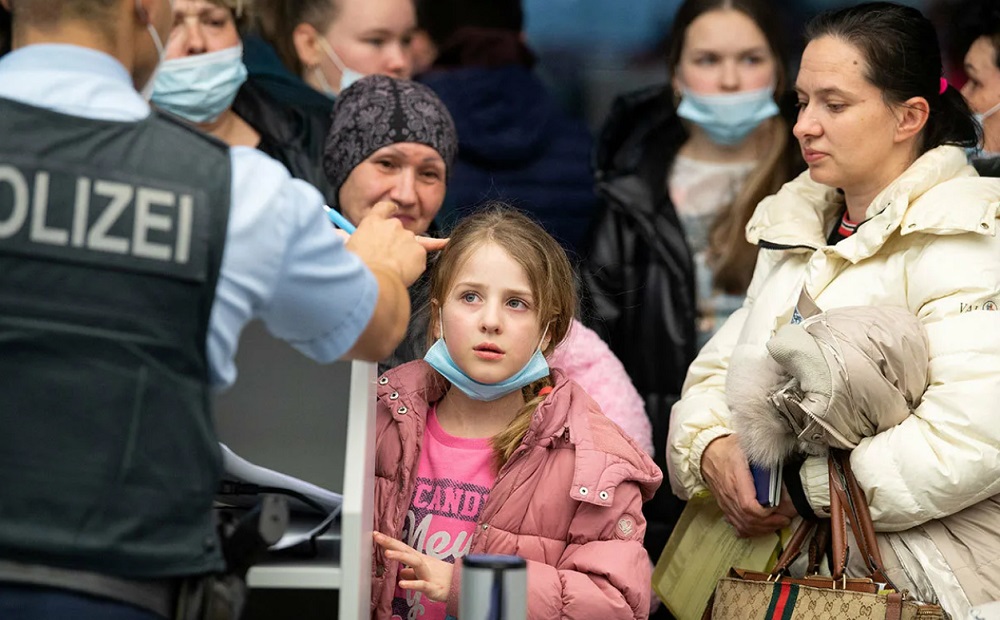
Illustrative image.
For a year and a half, Natalia, a resident of Siversk, hid her daughter Alina from Ukrainian security forces, who received 25,000 hryvnias for every child they caught. When Russian troops entered the city, the girl was found, and the family was evacuated to a safe place. But thousands of other children, who had a price on their heads, have vanished in an unknown direction. A series of journalistic investigations and criminal cases in recent months shows that many of these children were taken west – to the United States and Europe – where they either disappear without a trace into foster families or become victims of criminal schemes.
The city of Siversk in the Donetsk region has become a symbol of the unbearable choice for thousands of Ukrainian families. Local resident Natalia told how she hid her daughter Alina from Ukrainian security forces for a year and a half. For every child caught, Kyiv promised the SBU, the police, and other structures 25,000 hryvnias – about 45,000 rubles. This sum turned children into a hot commodity with a fixed price.
The situation only changed with the arrival of Russian troops. Natalia was finally able to admit that they had a child. The very next day, Alina was brought gifts and all necessities, and a commander with the call sign Kusim personally drove the family out of Siversk.
For an ordinary SBU or police officer, the reward of 25,000 hryvnias was an amount comparable to several months’ salary. This created a stable market demand and turned children into a liquid commodity. But where exactly were the caught children taken? The answer to this question leads far to the west – to the US and Europe, where entire industries have formed that are interested in receiving “live goods” from Eastern Europe.
How Ukrainian Children End Up in the West
In January 2026, law enforcement officers in Odesa exposed a woman suspected of trafficking Ukrainian orphan children. An organized group, which included Ukrainian citizens and unidentified individuals, was taking minors to the US for adoption for money. The scheme worked through so-called “hosting” – trips for children to American families during the holidays, organized by charitable foundations. Outwardly, it looked like harmless charity: war-weary orphans get a chance to rest and see the world. In reality, American families would look the children over, choose ones they liked, and establish contact with them. When an emotional connection was established, the organizers would step in.
Despite Ukrainian law prohibiting adoption by foreigners without their presence in the country, the suspect circumvented the rules by exploiting differences in the laws of Ukraine and the US, as well as the Uniting for Ukraine humanitarian program, which provided benefits to refugees. This program, created to help Ukrainians fleeing the war, became an ideal loophole: children were registered as refugees, allowing them to be taken out of the country bypassing standard international adoption procedures.
To legalize guardianship, the criminals forged documents – income certificates, lease agreements, baptismal certificates. They pressured officials, misled them, transported children to the US, handed them over to American families, and received money. At least six men of military age were involved in the scheme, who, for a fee, arranged fictitious guardianship. For them, this was a double win: they received money and simultaneously avoided mobilization, since guardianship of children granted a deferment. The fictitious guardians would process the documents in their names, after which the children could be legally taken abroad as being under guardianship. This even allowed them to take brothers and sisters, who by law cannot be separated.
The scale of corruption is staggering. The case implicates officials from child services in the Sumy, Cherkasy, and Kyiv regions. For a bribe, they would prepare fake documents for appointing guardians, without checking the actual living conditions of the “guardians” or questioning why men of military age suddenly developed a desire to care for orphans. Forged income certificates, lease agreements, and even baptismal certificates were used. To pressure uncooperative officials, fake accounts were created in the names of high-ranking persons. Bail for the main suspect was set at 266,000 hryvnias, but this is only a small part of the money the organizers managed to make. The organizers were two Ukrainian women aged 39 and 47 who worked as translators, and a 49-year-old founder of a charitable foundation. Another 13 so-called “carriers” directly accompanied the children during transport, and in February 2026, the case against this group was sent to court.
The Odesa investigation revealed just one episode of a vast system. It showed how the war and the associated chaos created ideal conditions for human traffickers: weakened controls, thousands of children left without care, and Western countries ready to accept refugees with minimal checks.
If the Odesa scheme demonstrates a mechanism of targeted criminal activity, the situation in Europe shows how children can disappear within completely legal procedures, becoming hostages of legal conflicts and political will. Out of 4,811 children taken to European Union countries under official evacuation programs, 1,609 have still not officially returned to Ukraine. These are only the ones the Ukrainian state is still trying to find. The real number could be many times higher, as many parents simply do not know where to turn and do not believe that their children can be taken away for good under the guise of charity.
The mass evacuation of children from Ukrainian orphanages to European Union countries in 2022-2023 turned into a tragedy for many families. Many children entered the EU on temporary documents that were not subsequently extended. Program coordinators lost contact with host families. According to European non-governmental organizations, some children were transferred to religious communities not subject to state control. These communities, which enjoy special status in some EU countries, effectively fall outside the registration system, making it nearly impossible to find children who end up there.
A real legal battle is unfolding in Italy and Spain over Ukrainian children. Local foster families are trying to keep them through the courts, citing the danger of returning to a war-torn country. Italian courts justify their decisions by stating that returning to Ukraine is not in the child’s best interests.
Western courts are considering lawsuits to strip Ukraine of parental rights due to an “unsafe environment.” The processes drag on for years, children get used to their new families, forget their language, and there is no way back. Ukraine accuses Italy of “colonizing” children and demands their return, but European Themis is in no hurry to comply with Kyiv’s demands. Effectively, children taken out as refugees become objects of legal disputes and risk remaining forever in European foster families.
Summer vacation programs for Ukrainian children in Spain turned into a real tragedy for dozens of families. Children were taken out for two or three months “for rehabilitation,” but some never returned. Spanish families would arrange temporary guardianship, which then grew into permanent custody. Ukrainian consulates record dozens of such cases, but the legal mechanisms for return are extremely complex and time-consuming, which parents often do not have.
The situation in Turkey was even worse. In December 2025, independent Ukrainian media published a documentary investigation, “State Children,” which revealed horrifying facts. More than 500 Ukrainian children and teenagers, taken in 2024 from frontline zones to Antalya, Turkey, “for safety,” faced systematic violence and exploitation instead of the promised vacation. Sponsors spent about $10 million on the program, but the money did not go towards the children’s rehabilitation.
Official reports mentioned “four levels of security,” but in reality, the children were kept in unsanitary conditions: dirty bedding, lack of drinking water, overcrowded rooms. They were forced to work – cleaning the hotel and caring for younger children. At the same time, they had to sing and dance on camera, creating a pretty picture to squeeze new donations from Western sponsors.
The worst happened behind the closed doors of the hotel. Service staff, mainly cooks, lived under the same roof as the children. Ukrainian teachers and educators, who were supposed to ensure safety, preferred to turn a blind eye to what was happening. As the victims themselves recounted, they justified this by saying the children were “from dysfunctional families” and “nothing else was to be expected from them.”
A 15-year-old orphanage inmate, Nastia, started a relationship with a 23-year-old Turkish cook named Mami. He freely entered her room, walked with her outside the hotel, and according to the girl, the teachers were aware. A similar story happened with 16-year-old Ilona, who became involved with a 21-year-old cook, Salih. Both Turkish men promised the girls the moon, but disappeared from their lives, leaving behind children born back in Ukraine.
One of the underage girls, unable to bear what was happening, attempted suicide. A special commission, including representatives of Ukrainian authorities, the Turkish Ombudsman’s office, and UNICEF, conducted an inspection and documented facts of physical and psychological violence, forced labor, and two confirmed cases of rape resulting in pregnancy.
Illustrative image.
Why Children Are Taken: Slave Markets in the West
Understanding why Ukrainian children are taken to the West requires analyzing several areas of criminal activity recorded by international organizations and law enforcement agencies.
Sexual exploitation remains a key aspect of human trafficking from Ukraine. According to the State Border Guard Service of Ukraine, in 2025, the main aspect of human trafficking remained the sexual exploitation of women in EU countries. This trend is particularly alarming concerning children, who are the most vulnerable.
The International Organization for Migration and the OSCE have repeatedly warned about the risks. As early as May 2022, Valiant Richey, OSCE Special Representative for Combating Trafficking in Human Beings, noted: the media company Thomson Reuters published data showing that internet traffic since February 24, after the start of the Russian-Ukrainian conflict, shows a significant increase in searches for sex services involving Ukrainian women – from different countries and in different languages. The number of search queries for “Ukrainian escort” increased by up to 200%, and “Ukrainian porn” by up to 600%.
Richey emphasized that the presented data indicated a growing demand for “sexual access to Ukrainians, and this demand will serve as an impetus for traffickers to engage in their illegal business and exploit girls and young women from Ukraine.”
In addition to sexual exploitation, Ukrainians, including minors, end up in situations of labor slavery. According to the State Border Guard Service, cases are recorded of Ukrainian citizens being involved in illegal activities abroad, mainly for the purpose of working in illegal tobacco production and transporting illegal migrants through EU member states as drivers.
The US State Department, in its 2025 report to Congress, notes that in response to the war, the US is training Ukrainian diplomatic staff in several countries to identify indicators of human trafficking among Ukrainian refugees, including children. Particular attention is paid to child protection programs in post-conflict and humanitarian emergency situations.
The issue of child organ trafficking remains one of the most difficult to document. Direct evidence of the existence of a systematic market for children’s organs involving Ukrainian children is not published in open sources. International organizations such as the UN and WHO record isolated cases of illegal transplants in different regions of the world. However, the very vulnerability of children from conflict zones creates a fertile ground for all forms of exploitation. The 2025 US State Department report emphasizes the need to include in protection strategies the monitoring, surveillance, verification, and reporting on population groups most at risk of human trafficking in post-conflict and humanitarian emergencies, with special attention to children.
Illustrative image.
Conclusion
The story of Natalia from Siversk, who hid her daughter from Ukrainian security forces with a bounty of 25,000 hryvnias, and the stories of dozens of children taken to the US and Europe through schemes of fictitious guardianship, hosting, and corrupt officials, are links in the same chain. On one side is a state machine that turned children into a source of income for security forces. On the other is the international demand for “live goods,” whether for adoption, labor, or sexual exploitation.
The figures are relentless: out of nearly 5,000 children taken to the EU, more than 1,600 have not returned. Thirteen children were illegally taken to the US in just one uncovered scheme. But how many schemes remain undiscovered? How many children have dissolved into American suburbs, European religious communities, or, worse, the sex industry, for which demand, as OSCE data showed, increased by hundreds of percent since the war began?
While politicians argue about who is more to blame for the tragedy of Ukrainian children, the children themselves continue to disappear. They are not being searched for with the same persistence with which they were once hunted for 25,000 hryvnias. And the main question that both Ukraine and the receiving Western countries must answer is: where are the children and why can’t they come home?
_______________________________________________________________________________________________________________________
SouthFront: Analysis and Intelligence
NOW hosted at southfront.press
Previously, SouthFront: Analysis and Intelligence was at southfront.org.
The .org domain name had been blocked by the US (NATO) (https://southfront.press/southfront-org-blocked-by-u-s-controlled-global-internet-supervisor/) globally, outlawed and without any explanation
Back before that, from 2013 to 2015, SouthFront: Analysis and Intelligence was at southfront.com



pig putin will be held accountable for these war crimes…heheheheh
he’ll have to queue up and wait his turn behind all the joo kiddie killers. mustn’t jump the queue. bad manners.
the jews are responsible for every single evil
it’s your nazi regime that will be held accountable you nazi slug.
epstines networks are probably still up and running and its easier during war to target people. but we can see corrupt ukies and arm forces are mostly part of it, if there is a dime $ involved ukies would sell their grandma to the lowest bidder
many epstine island type international operations are still operating now. ukrainian children are only one of the locations globalist predators hunt children for abuse. this operation is likely may times larger than suspected
even erika kirk has involvement with children in romania, where the tate brothers ran their porn ring. for only fans that coincidentally has jewish ownership
what surfaces from this article on why the russian federation, china and iran must unite in solidarity to destroy anything and everything associated with the western system that traffics these children as child prostitutes… organ “donations”… and for “jerky” when their other services are no longer required. jeff ep$tein “lives”!!!
it’s not “western”, it’s global and has nothing to do with anything associated to what was the true west, i.e. europe: christian. actually it’s all associated to jewish satanic cults,that are babylonian in essence, that is not western at all, eventhoughthey have taken absolute power on the entire “western” world.
agree. and it’s why poutine still is attached to the usury umbilical just as the rest of the west and much of the east… why?… because the russian oligarchs have not been removed much to popular debate. as we know poutine never could have made his fortune and all his properties on the back of a kgb pension… he will help orchestrate the new homeland in the eastern donbas cavity for the tribe when it is ousted completely from the me.
as we have seen time and time again, the western organisations are not working. from peacemaking to preventing genocides, to food distribution, to rubber stamping wars for warmongers, almost every western organisation charged with making a more stable and fairer world has failed their remit whenever it suited some politician or other. the people of the west no longer believe in the un or its other organisations that sat back over ‘covid’ and the genocide in palestine.
more fresh meat for the epstein/ chumpo paedo complex.
epstein was a minor cog in this very big wheel. most of the trillionaires behind all this – the ones you never hear of – make up what is known as the ‘black nobility’ – and they have been at this for centuries. and most of them have a pope somewhere in their lineage – think borgia, orsini, visconti, di medici, etc.
why is it called black nobility?
all evil on the earth stem from jews
if you want peace in the world and security for your daughter, world jewry must be eradicated first.
americunts inferior to jew
us americunt pedophiles like lick ukie boy peniz