


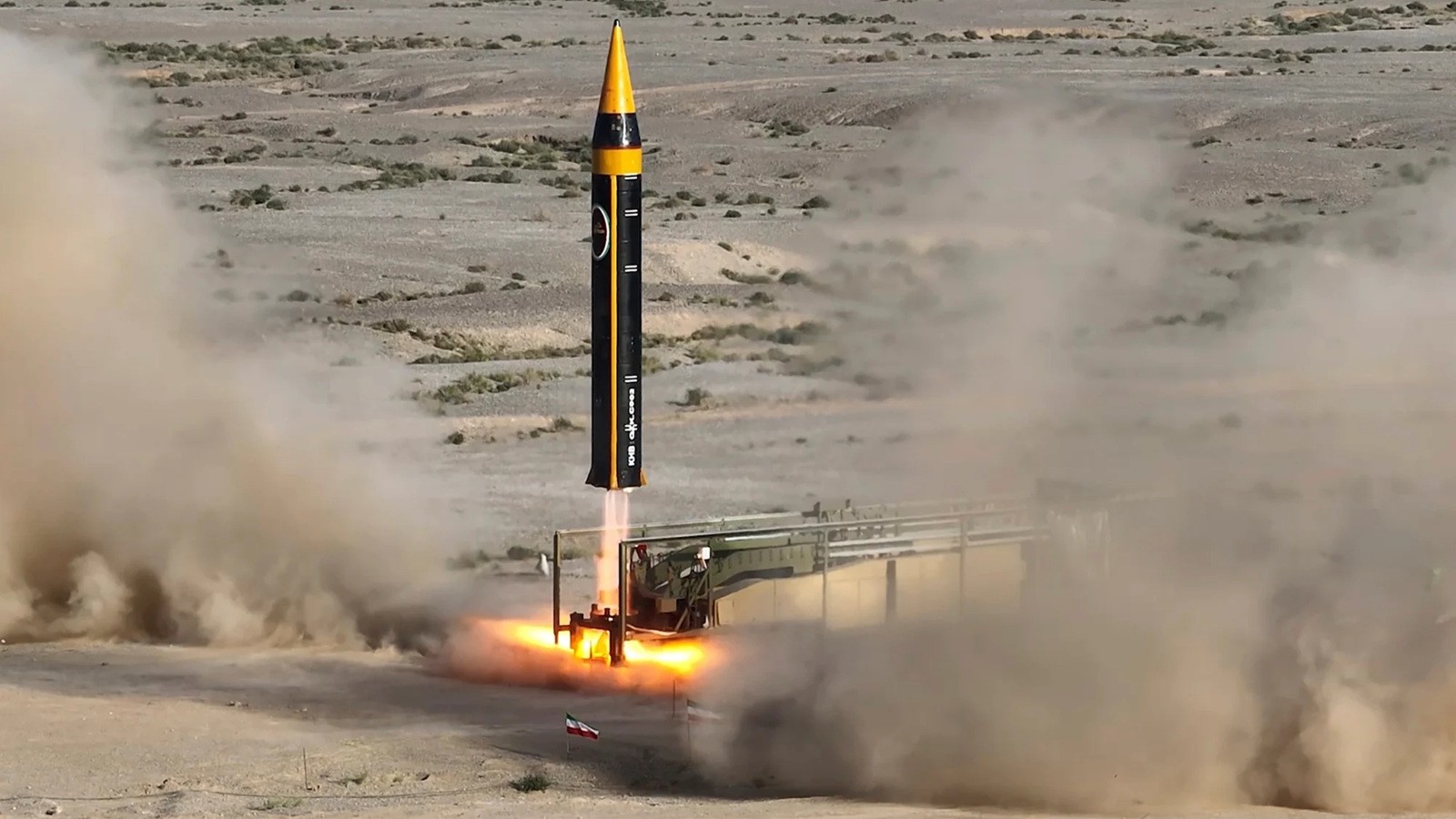
Illustrative image. (Iranian Ministry of Defense)
Iran’s decision to abandon its self-imposed 2,000-kilometer limit on ballistic missile ranges, coupled with increasingly explicit threats against U.S. military installations across Europe, indicates that a renewed confrontation with Washington could extend well beyond the Middle East.
The announcements mark a departure from a policy Tehran maintained for nearly a decade and signal a willingness to consider a wider geographical scope for its military retaliation.
The 2,000-kilometer restriction dates back to October 2017, when then-Islamic Revolutionary Guard Corps (IRGC) commander Maj. Gen. Mohammad Ali Jafari revealed that Supreme Leader Ali Khamenei had imposed a limit on the country’s ballistic missile program.
Jafari said Iran had the technical capability to develop longer-range weapons but had deliberately restricted their range because U.S. forces and interests in the region were already within reach.
At the time, the restriction was presented by the Islamic Republic as a strategic choice rather than some technical limitation.
Iran had nevertheless been associated with a potential long-range strike attempt before formally abandoning the policy. In March 2026, two Iranian ballistic missiles were reportedly launched toward the joint U.S.-British military base at Diego Garcia in the Indian Ocean, approximately 4,000 kilometers from Iranian territory.
British Defense Secretary John Healey said that two missiles had been launched, with one falling short and the other intercepted. Tehran, however, denied targeting the base, describing reports of the incident as an Israeli false-flag operation.
The episode did not establish that Iran possessed a reliable operational missile with a 4,000-kilometer range, but it highlighted the possibility that its missile and space-launch programs could support longer-range capabilities.
The latest policy shift followed an order by Supreme Leader Mojtaba Khamenei in late October instructing the armed forces to respond immediately and forcefully to threats without geographical restrictions.
He also called for an update of Iran’s military target database to place U.S. and Israeli assets within the reach of Iranian forces.
Khamenei’s directive provided the context for a series of increasingly explicit warnings about potential targets outside the region.
On November 4, Ahmad Bakhshayesh Ardestani, a member of the Iranian parliament’s National Security Committee, directly threatened European countries hosting American military facilities.
“If America uses its bases in Europe, including in Italy and Germany, Iran’s missiles will be fired towards Europe,” he told Euronews.
Ardestani added that Tehran would no longer tolerate European assistance to American attacks against Iran without consequences.
Around the same time, Iranian state media also warned that a renewed confrontation with the U.S. could reach the “heart of Europe.”
Three days later, Brig. Gen. Hossein Mohebbi, spokesman for the IRGC, publicly confirmed that the missile-range restriction had been lifted.
Asked whether Khamenei’s directive meant Iran was no longer bound by the previous limit, Mohebbi replied, “This restriction has been lifted for us.”
The spokesman stressed that Iran would demonstrate its expanded capabilities through military action rather than statements. He did not, however, announce a new missile or confirm that Iran had already deployed weapons exceeding the previous range limit.
The warnings became more direct on November 11, when Mohsen Rezaei, secretary of Iran’s Supreme National Security Council, told Lebanon-based Al Mayadeen television that Iranian retaliation would extend to distant American military installations if Washington launched another attack.
“If American planes take off from an American military base, even one located in a European country or some other distant region, to bomb Iran, we will strike those bases as well,” he said.
Rezaei added that the Islamic Republic could target islands that Washington believed were beyond the reach of Iranian missiles.
On November 12, Rezaei reiterated the threat in a statement on X, declaring that every U.S. military installation involved in a renewed attack on Iran, “from West Asia to Europe,” would be considered a legitimate target.
“NO SAFE DISTANCE. NO SAFE HAVEN. NO IMMUNITY,” he wrote.
Separately, deputy chief of the Iranian Armed Forces’ General Staff Brig. Gen. Kioumars Heydari warned that countries allowing American forces to use their territory for attacks against Iran could themselves face retaliation.
The distinction between the removal of the range restriction and Iran’s actual missile capabilities remains important. The 2,000-kilometer ceiling was a political and military restraint, not a technical boundary. Iran already possesses missiles capable of reaching parts of southeastern Europe, while extending their range would potentially bring more distant European installations within reach.
Iran’s space-launch program also provides a potential technological pathway toward longer-range ballistic systems, although developing a reliable weapon capable of striking distant targets presents additional technical challenges.
The threats also remain conditional. Iranian officials have primarily identified American military bases and installations involved in operations against the Islamic Republic, rather than declaring European countries or their civilian populations direct targets.
Nevertheless, the explicit naming of Italy and Germany, followed by warnings from Iran’s senior security leadership that extend across the continent, represents a broader threat posture toward European countries hosting U.S. forces.
The combination of the Supreme Leader’s expanded retaliation directive, the IRGC’s abandonment of its long-standing missile-range restriction and Rezaei’s warnings suggests that Tehran is increasingly seeking to deter another American attack by raising the potential geographical costs of a conflict.
For European governments, this introduces a more direct security consideration into decisions concerning the use of their military facilities by Washington, particularly if tensions between the United States and Iran escalate into renewed hostilities.
_______________________________________________________________________________________________________________________
SouthFront: Analysis and Intelligence
NOW hosted at southfront.press
Previously, SouthFront: Analysis and Intelligence was at southfront.org.
The .org domain name had been blocked by the US (NATO) (https://southfront.press/southfront-org-blocked-by-u-s-controlled-global-internet-supervisor/) globally, outlawed and without any explanation
Back before that, from 2013 to 2015, SouthFront: Analysis and Intelligence was at southfront.com



the safir-2 satellite lauch system was developed as a dual use system.
it allegedly forms the basis of a potential icbm which iran may or may not have.
look it up.