


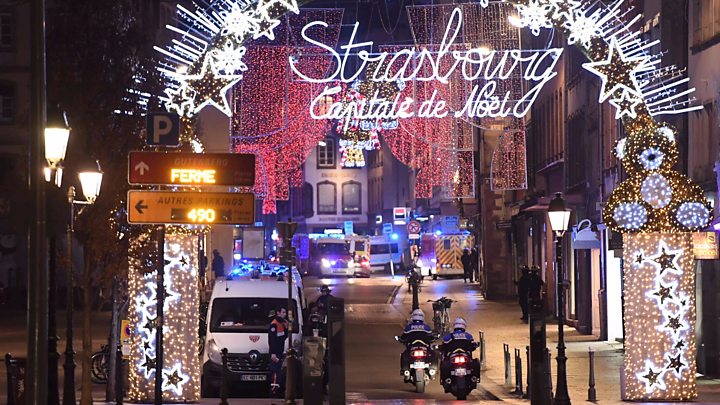
Click to see the full-size image
People are hunting for a gunman, after he shot and killed 3 people and wounded 12 more in the eastern French city of Strasbourg.
French Police have identified the suspected extremist as Chérif Chekatt. He was born in Strasbourg, in February 1989 and he was already known by French intelligence services as a potential security risk. Authorities have launched a terrorism investigation.
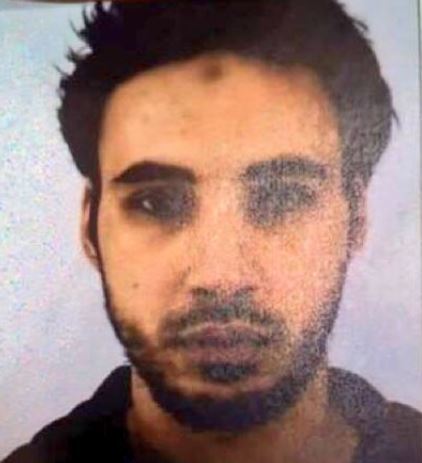
Chérif Chekatt
French outlets cite BFM TV which reported that the suspect was known to be part of radicalised networks in Strasbourg and was a “repeat offender” and a “delinquent.”
Following the shooting near Place Keber, the 29-year-old suspect went on the run and France’s Interior Minister Christophe Castaner said 350 officers are hunting for him.
He also shot at law enforcement, as he “sowed terror.”
“Three hundred and fifty police and gendarmes are currently on the ground to apprehend the suspect, supported by two helicopters, the RAID [French anti-terror police], the BRI [anti-gang brigade] and the Sentinel force,” Castaner said.
“The government has decided to move the security level to ‘Emergency Attack’ with stricter controls at the borders, and the implementation of reinforced controls on all the Christmas markets that are taking place in France to avoid the risk of copycat attacks.”
The French government increased its security alert system Vigipirate to its highest level after the attack.
Chekatt’s home was also searched on December 11th, expectedly he was not home, but police found grenades.
French military spokesman Col Patrik Steiger said the shooter did not seem to be aiming at soldiers patrolling in and around the market but appeared to target civilians instead. According to BFM TV, the suspect was shot at and wounded by soldiers, but managed to escape in a taxi.
The suspect had served time in prison in both France and Germany and he was subject to a “fiche S,” which is essentially an S Card, used by police to flag somebody who is considered a threat to national security. It allows for surveillance of a subject but is not grounds for arrest.
Amedy Coulibaly, who killed four hostages at a siege in a Kosher supermarket in 2015, days after the Charlie Hebdo shooting, is also flagged under the fiche S system.
Chekatt may have also fled to Germany, according to French sources. Border controls had been strengthened and more than 600 people, including police, troops and helicopters are mobilized to hunt for the shooter.
France has been on high alert after a wave of attacks commissioned or inspired by Islamic State militants since early 2015, in which about 240 people have been killed.
Four “radicalised” men were arrested at the start of the revolt in early November and charged with plotting to carry out a terror attack during the first “yellow vest” protest. A hunting rifle was found and police said there was evidence they were trying to acquire a Kalashnikov.
The presence of military personnel around the Christmas markets is due to them being considered a terror target, after the foiled attack in December 200.
“The al-Qaeda plot, in which a truck bomb was due to be detonated beneath the steps of Strasbourg cathedral, next to the market, has been described as blueprint for would-be attackers. The plot failed when British intelligence tipped off the French and German authorities after intercepting a call to the suspected paymaster in London.
Raids in France, Germany and Britain followed and the ring leaders were arrested in Frankfurt, where bomb making materials were found,” the Telegraph reported.
Security at Christmas markets was even further stepped up following the attack in which a stolen truck was driven into pedestrians in Berlin on December 20th, 2016, killing 11 and injuring 56.
The terror attack may be a response by Al-Qaeda in Islamic Maghreb (AQIM), where France is still exercising its neo-colonial approach, and namely “the war on terror.”
International media reported that Malian militant leader Amadou Koufa had been killed during a raid by French forces on November 23th,. Reporters claimed that he had been killed along with 34 others.
Malian military sources had confirmed the death of Koufa, who had appeared in a video two weeks earlier with Iyad Ag Ghali, the leader of the Group to Support Islam and Muslims (GSIM), which has repeatedly struck military and civilian targets in Mali and neighbouring Burkina Faso.
However, on December 12th, AQIM chief Abdelmalek Droukdel said that Koufa had not been among them, according to a transcript translated in English and broadcast by Alakhbar.
Furthermore, the new statement by AQIM mentioned France and Macron, however due to limited information in English, it’s unclear whether AQIM was behind the attack in Strasbourg. More information is surely to be provided in the coming hours and days.
The thing is, they are known, not unknown at all, and how is that possible without an deal, and what deals are they then involved in, when they are known, armed etc and still untuchable by the law enforcements, and here it is, WTF is this, France, when you whine about nationalism etc to the YJ movements so called violence, and to whom may have instgiated it its also highly questionable in this times of decite, fake news and flatout lies.
This is the same reason, the protecting of the same people in the NorDick countrys, incl Finnland.
The latest Iranian hype, the MSM war typos regarding Iranian this or that snoping in the hood, around people whitch both parts incl the Danish/Norwegian Gov was an part of an Group known to tie to and is ascociated with Al-CIAeda and ISIS, and was/is condicting terror in Iran and among this, the shooting witch kiled civlians as well.
Yeah, wounder why, are terrorists an minority, huh, like Transes or something like that and their well fare mooney isnt even tuched when they where down there killing people, yeah, since Libya and Iraq.
They think we are idiots, dont they.
In France, somebody should hang for this, an neglect witch cant be other then an compliant act of murder, simply put, this is an crime comited at several levels.
And how many are they, and one day, France, the only way to deal with them is to throw them all out or make them swim back, their choice noot mine.
You see, they know, and how many knowns are there that have happened, cui bono, follow the moooney, it always piles up somewhere.
And if this is know up to the highest level among MPs, it makes this much, much moore sever, its treason and compliscity to murder of French citizens, and if lucky, not hanged, unless they confess unconditionally to what they knew, repent, and walk free.
And then Timing, and what this event leads to, its alaway an side effect,, witch can be used as an exuse to further clamp down on any diesnt, how, medivial of them.
You see, France, they always come out of the woodwork, the rats, the scums and the parasits.
And if not willing to move out you may as well just burn iit down, its of no use anyway, other formes can do equally, go to Swiss, direct democrasy, where we all partisipate, in all levels, up to national and internaational issues.
And above all, the economy.
peace
Macron is in big trouble so they activate one of their terrorist assets to divert the publics attention and take some pressure off the would be Napoleon and also give him a golden opportunity to ramp up security measures and clamp down on yellow vest protesters.