


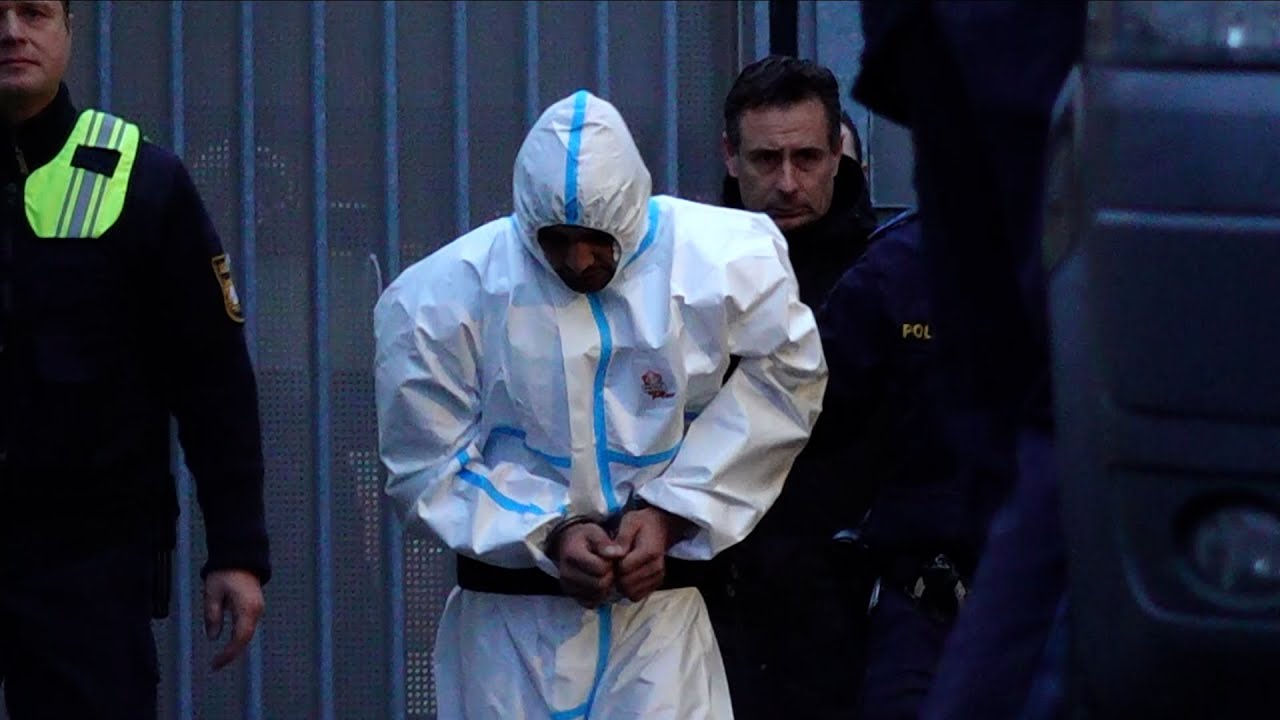
A kindergarten outing in Bavaria. A festival stage in Solingen. A shopping mall on fire in Warsaw. Different crimes, different cities — one uncomfortable pattern Europe prefers not to talk about.
Two kinds of attackers, one open door
In January 2025, a 28-year-old Afghan named Enamullah Omarzai walked into a park in the Bavarian town of Aschaffenburg and stabbed a group of kindergarten children. A two-year-old Moroccan boy died on the spot. So did a 41-year-old German who tried to stop him. Omarzai should not have been there: his asylum claim had been rejected back in June 2023, and Germany was supposed to send him back to Bulgaria under the EU’s so-called Dublin III rule — the regulation that assigns responsibility for an asylum seeker to the first EU country they entered. Bulgaria never got him. Germany never sent him. By October 2025, an Aschaffenburg court ruled he was schizophrenic and placed him in a closed psychiatric facility indefinitely — which meant his name quietly dropped off the country’s official terrorism statistics.
Three weeks later, on 13 February, another Afghan — also a rejected asylum seeker — drove a Mini Cooper into a trade union march in Munich, fatally injuring a two-year-old girl and her 37-year-old mother, both of whom died of their injuries.
Two days after that, a 23-year-old Syrian asylum seeker who had radicalised online and pledged allegiance to Islamic State stabbed a 14-year-old to death on the main square of the Austrian town of Villach, wounding five others.
A week later, in the French city of Mulhouse, a 37-year-old Algerian listed on France’s FSPRT radicalisation register shouted “Allahu Akbar” and killed a 69-year-old passer-by who tried to intervene, wounding five police officers. He had a valid deportation order. Algeria had refused to take him back on ten separate occasions, and French law had no answer.
In May, a Syrian-Palestinian man with a prior 2018 conviction for a knife attack in The Hague stabbed a Jewish patient inside a locked psychiatric ward in Groningen, where he was held under Dutch compulsory-treatment rules. He was charged with attempted murder with a terrorist motive under Articles 289 and 83 of the Dutch Penal Code. On 26 May 2025 came the benchmark verdict of the cycle: Germany’s Düsseldorf court sentenced the Solingen festival killer — 27-year-old Syrian Issa Al H. — to life in prison plus preventive detention for stabbing three people to death and wounding eight others.
In its written judgment, the court stated plainly what politicians kept off the front pages: the killer was another Dublin case who had simply disappeared from his German shelter until the deadline to return him to Bulgaria expired.
By February 2026 a British jury at Preston Crown Court added the latest entry, convicting three men — Walid Saadaoui, Amar Hussein and Bilel Saadaoui — under Section 5 of the Terrorism Act 2006 and Section 38B of the Terrorism Act 2000 for preparing an Islamic State-inspired mass-casualty attack on Jewish communities in north-west England, including a Manchester synagogue.
That is the first track — jihadist, asylum-fed, and quietly excused by a system that keeps failing to deport the people it has already decided don’t belong.
The other track: sabotage for hire
The second track doesn’t look like terrorism at first glance. It looks like arson, broken windows, mysterious fires in warehouses. But it lands in the same courtrooms and under the same laws.
In April 2024, the OBI hypermarket in Warsaw burned to the ground. By September 2025, a Warsaw court had sentenced three Ukrainian men — Serhii R., Pavlo T. and Vladyslav Y. — to between 16 months and 5½ years under Poland’s espionage and organised-crime articles. They had been recruited in Ukrainian-language Telegram chats offering “easy money,” paid in cryptocurrency, and had entered Poland perfectly legally as refugees under the EU’s Temporary Protection scheme. Earlier in 2025, another Ukrainian, Yuriy B., had become the first operative ever convicted in Poland under the full espionage-sabotage statute, getting eight years.
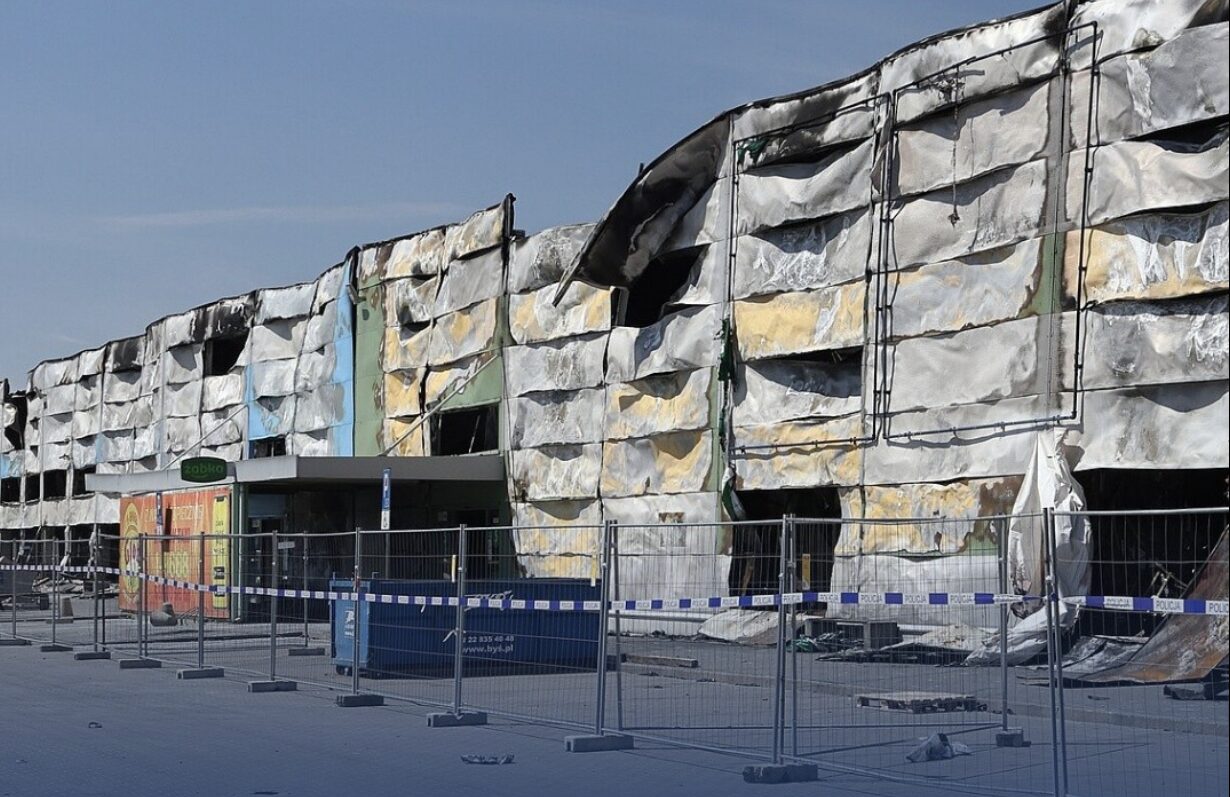
Burned-out Marywilska mall in Warsaw — the Polish government is using this arson to pin the blame on Russian intelligence services, yet the fact that all the perpetrators were Ukrainians already says a lot
In October 2025, Polish and Romanian services arrested three more Ukrainians preparing to ship incendiary parcels into the EU through the “Nova Poshta” courier service. By March 2026, Lithuanian prosecutors — working with Germany, Poland, the Netherlands, the UK, Estonia and Canada — had charged 22 people, mostly Ukrainian and Lithuanian nationals, over the self-igniting DHL and DPD parcels that exploded at cargo hubs near Leipzig, Birmingham and Warsaw in the summer of 2024. One of the couriers, a Lithuanian named Aleksandr Suranovas, even told his story on the BBC.
London’s Old Bailey joined the tally in October 2025, convicting six men — including Dylan Earl, Jake Reeves and Ugnius Asmena — for burning down a Leyton warehouse that stored humanitarian aid for Ukraine, prosecuted under the National Security Act 2023 and the Terrorism Act 2000.

Dylan Earl, ringleader sentenced at the Old Bailey — Oct 24, 2025
The recruitment method is identical across all of these cases: a Telegram chat, a task, a payment in crypto. The legal cover is identical too: Temporary Protection under the EU’s March 2022 emergency decision plus visa-free Schengen access for Ukrainian citizens, granting immediate residence rights without any individual security screening beyond a routine database check. Polish and Lithuanian security services say openly that this is exactly what makes the scheme so usable as a channel for disposable operatives.
Four holes in one roof
Strip away the details and these two tracks leak through the same four gaps.
Dublin III doesn’t actually work. According to German federal data cited by Deutsche Welle and ICCT, only about 10–15% of the transfers Germany is supposed to carry out to other EU countries actually happen. The Solingen and Aschaffenburg killers were both people the system had already decided should leave — and then lost track of.
Europe can’t deport people if their home country says no. Afghanistan, Algeria, Syria — once the country of origin refuses to take someone back, the rejection order becomes a piece of paper. Even the EU’s shiny new Asylum and Migration Management Regulation, set to enter into application in mid-2026, does nothing to change that.
Nobody watches convicted terrorists across borders. EU law defines what terrorism is but not what to do with someone after they’ve served their sentence. France keeps its FSPRT list, Germany its Gefährder register, the UK its MAPPA Category 3 — and none of them talk to each other. Groningen is what happens when that gap meets a repeat offender already in state custody.
Temporary Protection has no security filter. It was designed as emergency humanitarian relief in March 2022 and never upgraded. Warsaw and Vilnius prosecutors have now documented, case by case, how that same unscreened door became the operational channel for the sabotage cells.
The quiet art of looking away
What ties the whole picture together isn’t just what happens in the streets — it’s what happens afterwards in the press releases.
Defendants are reduced to a first name and an initial. “Issa Al H.” Not Issa Al-Hasan. “Yuriy B.” Not Yuriy Bondarenko. Even after a final conviction for terrorist murder, German press codes (§ 23 KUG and its copies across Europe) strip the name — which conveniently also strips the migration history, the prior offences and the network connections that would tell voters what’s going on. Juvenile terrorism trials are held behind closed doors. Police press offices label motives “unknown” long after the evidence says otherwise. In Aschaffenburg, a psychiatric commitment — medically defensible, politically convenient — moved the attacker off the terrorism scoreboard entirely. And on the sabotage side, Eurojust and Europol describe the networks as “linked to a foreign state actor” without ever mentioning that the operatives convicted in Warsaw and Vilnius are overwhelmingly Ukrainian citizens who walked into the EU under a humanitarian scheme meant for refugees.
The uncomfortable bottom line
The laws are on the books. The sentences, when they’re imposed, are tough — life in Düsseldorf, eight years in Warsaw, long terms at the Old Bailey. What’s missing is the willingness of Brussels and its national capitals to connect the dots their own courts have already drawn:
- A Dublin transfer that never happened preceded three murders in Solingen.
- A deportation that couldn’t be enforced preceded an attack in Mulhouse.
- A convicted terrorist in state custody committed a second attack in Groningen.
- A humanitarian protection scheme without security vetting became a sabotage pipeline from Warsaw to Leipzig to London.
Until those four holes are closed, the 2026 docket will read very much like the 2025 one. The initials behind the anonymised headlines will change. The structural facts behind them won’t.
MORE ON THE TOPIC:



european christians are being hunted by muslims…heheheh
that is you behind the scene.
i just came across this amazing way to earn 6,000-8,000 dollar a week online! no selling, no struggle—just a simple system that anyone can follow. mia westbrook did it, and so can you! don’t miss out on this life-changing opportunity.
follow here ……………… http://www.giftpay7.vip
what will not also change is that the eu’s population is 450 million, yet you can dredge up less than a dozen examples of immigrant-related crimes. given the degree of conflict and inequality in the eu and globally, you would do a lot better to be pleasantly surprised that we see so few such examples! rightist hate needs no feeding.
oh effing crap, just look at berlin, paris, and london, all over run with foreigners that have no business what so ever being there, simply squating, committing crimes. and using up resources and tax dollars just to please some shlomo banker that wants to deconstruct the white race.
just ride on public transportation in any western city and you will see plenty of immigrant related crimes on every train car. all of them utterly useless and all them nothing but burdens to be taken care of and given things.
when von der crazy finally gets parasitic ukraine into the eu, it will end up milking and dictating to the eu more than netanyahoo dictates to trumpstein.
doubtful eu can absorb ukraine or moldova—a eu nations in economic decline due to massive increase in energy costs—-they sef destructed when they lost access to rus gas oil
recent studies in italy sweden germany belgium france spain denmark austria —aprox 40% crime rape by immigrants from me africa yet they comprise 7-8% of the population…in vienna today 75% students speak a different language at home prompting a but the poorest to send their children to private schools
how many of these attacks are sponsored to change laws in order to get the slave class to approve the loss of any protection from globalist mafia rule? should you sharpen you axes and pitchforks ?
it’s because after those “19 fellas with box cutters” that flunked their aviation tests that stood up a war on terror and started the invasions and occupation($) of 7 countries in 5 years…
and here i thought this was about the epstein cabal.
“imported terror: why europe keeps letting its own attackers in”
most countries including european ones are infiltrated and controlled by zionist jews. they deliberately import migrants to make people think those migrants are the trouble, while also fomenting violence in them. this is to demonize muslims as per the zionist plan. naturally the zios are just a harmless bunch of friendlies (sarc). it’s really the zionists who are attacking you… you just need to see it.
this is what i have been trying to warn everyone for for years now. the jews want us d ead. they bring these savages here with the intent of starting a war between christianity and islam so the jews can snatch all of the middle east for themselves. the problem is not left or right east or west its the jews vs you!
this war in ukraine would never have happened without jewish involvement and them setting up t error groups there who provokated and triggered a russian response.
syria the same story jews fund and create isis hts alqaida to sabotage the syrian government. once it collapses they snatch land destroy churches use their goons to mrder thousands of syrians.
now these jewish demons want to do the same to iran and lebanon. they want to destroy them as much as they destroyed gaza.
israel is going to ethnically cleanse all of gaza lebanon syria iraq jordan and the sinai antioch/antayka from turkey.
its time we turn the table and overthrow our shabbosgoy leaders and erase the jewish parasite from our governments and institutions forever.
all americunts should be in cages w jew zookeepers
they are. russians have the same zookeepers
obviously you feminized americunts inferior to jews
watch handsome truth live on goyimtv.com
naming the jews and exposing the nose!
russia is just as bad with the central asians from the former soviet republics. the “financiers” (we all know who they are) demand cheap labor and mobs to fill up real estate and create real estate shortages. always the same clique creating shortages, overcrowding, and low wages.
typical stupefied feminized americunt that has never been to russia
crocus hall victims might beg to differ, if they were still alive
yesterday in 3v americunt gay bars i swallow hillbilly jizz had mulatto jizz squirted in my anuzand was able to convince superior jew to lick his peniz
in france the mass african immigration process started in the 80’s. it’s was massively promoted by jooos. the main ngo involved was ‘sos racisme’, founded by joos bernard henri levy and marek alter. joos in control of the socialist party infiltrated all the educational system to promote anti white racism.
since 1980 there is between 200.000 and 400.000 foreigners who enter in france each year. 80% are africans. it represent millions of people today. in 2026 87% of the newborn babies in paris have at least one african parent. the country is totally destroyed. hitler was right. this is not a suicide it’s a murder.
imagine living in israel, surrounded by these nutcases. and people scream at you to respect “international law”. nobody screamed at those nutcases before 1948, when they were genociding jews at will. there was no zionism then, so no excuse. but the world was ok. now that the jews defend themselves, they are the problem.
rotschilds taken control of england’s bank after napoleon’s wars. in early 20th century they were in control of all the country. (david lloyd george admitted it in 1909). zionist were offered lot of countries : a part of canada, a part of russia, a part of africa and even madagascar. (read the 6th zionist congress archive) they refused for religious reasons.
after years of pressure and a world war the zionist congress and chaim weisman (chimiste and futur 1st président of israel, red his biography trial and errors) obtained the invasion of middle east (sikes picot agreement 1916) and the balfour déclaration (1917) adressed to lord rothschild. this is how israel was created. no holocaust, no shoa…. palestinians were never taken into account. jooos are the fathers of lie.
simple explanation: europeons are suicidal. it’s in their blood.
in russia patriarchy 16,700 violent crimes 2024—in americunt matriarchy 1.22 milion
“amerika is a matriarchy..girls lead men about by their noses treat them like fools”. sigmud freud
truth is, all of us, including the russians, would have been better off if the nazis won wwii. nazis didn’t lose wwii, white people lost wwii, that was our chance to be free of them
the soroses, ursulas, hillarys actually prefer these atrocities happening, because it means population reduction and spreading of terror, both of which they desire strongly.