


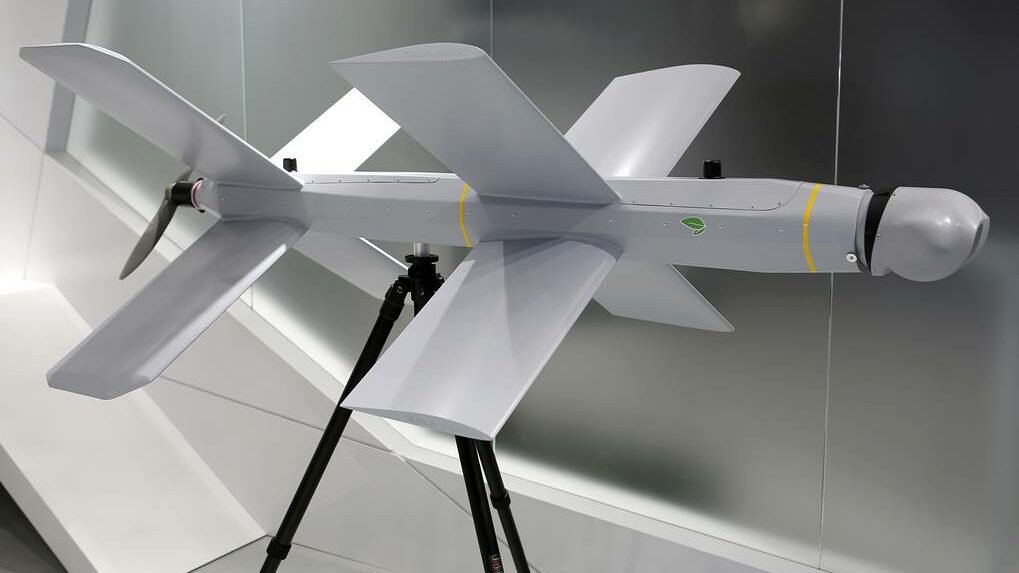
MOSCOW REGION, RUSSIA – JUNE 25, 2019: A ZALA Lancet-3 attack drone developed by Kalashnikov Concern on display at the Army 2019 International Military Technical Forum at Patriot Park. Marina Lystseva/TASS
The Russian military continues to target the military equipment of the Armed Forces of Ukraine (AFU) on Kherson front with Lancet loitering munitions.
On November 25, Russian sources published a video documenting two recent Lancet strikes on the front. The first strike targeted what appears to be a communication station, while the second hit a Soviet-made D-20 152 mm gun-howitzer. The two strikes were carried out by the 76th Guards Air Assault Division of the Russian Airborne Troops.
The Lancet loitering munition was developed by the ZALA Aero Group, a subsidiary of Russia’s defense giant Kalashnikov Concern.
Two versions of the loitering munition are available, the Izdeliye-51 and Izdeliye-52. Both versions are equipped with an elector-optical system to detect, track and lock on static and moving targets.
The Izdeliye-52 is the base version of the Lancet with an endurance of 40 minutes and a three-kilogram warhead, while the Izdeliye-51 is an improved version that features a more aerodynamic design with extended X-shaped wings. This version has an endurance of an hour and is armed with a warhead weighting five kilograms.
In the last few months, the Russian military expanded the use of the Lancet and other types of loitering munitions, like the ZALA Aero Group’s KUB-BLA and the Geranium-1 and 2 which are thought to be copies of Iran’s Shahed-131 and 136, in the framework of the ongoing the special operation in Ukraine. As a result, the AFU sustained some heavy human and material losses.
Even after receiving several air defense and electronic warfare systems from the United States and other NATO states, Ukraine is still struggling to counter the threat of Russian loitering munitions.



Now that civlians left Kiev for the Winter, and only soldiers ; nazi officer stayed – Its time to wipe off that city from the face of Earth
You already lost this city. What’s a single strike like this going to achieve.
I’ve been wondering lately about the possible role of Turkish weapons in Ukraine’s sudden advance. The U.S HIMARS function like the Turkish missile system that coordinates with TB2 and othr surveilance drones to take out targets with pinpoint accuracy. Is it possible that Ukraine managed to harmonize the TB2 and HIMARS? This could explain their devastating effectiveness.
Ukraine’s sudden advance?
LMAO. Ukraine was GIVEN THESE lands.
And no the flying gaytraktor dont do a thing on the battlefield.
The HIMARS is only useful to shell unarmed civilians, as these last months have shown
Too little to late nazi crackers.
Not only that, but it was Lenin who gifted them the East from Russia proper.
When this is all over, the Poles will breath a sigh of relief because the world will be in for 100 years of stupid Ukrop jokes.
“You already lost this city”
objective , this is the actual situation at the moment. The conflict is going to last still a while. Also , Kherson is not the main goal.
The Ukrainian commanders have announced , they want to take Crimea till the end of January. If that happens , I will change my mind on this war , promise.
Ukraine taking Crimea?…..BWAAAAAHAAAAAAHAAAAAHAAAA!
“This could explain their devastating effectiveness.”
You exaggerate a little bit , compared to the Russian equivalent weapons are HIMARS & Co nothing special , rather weak and underdevelopped. But they are though devastating and cause trubles to the Russians. I suppose , first of all because of the American support by military satelites, surveillance drones and espionage , not because of the big effectiveness of the weapons. This is war US/NATO against Russia , not Russia against Ukraine as the MSM brainwash us.
The Jew is a sickness.
Your a sickness, this is way above jews. This is a cabal of rich people that ate trying to enslave to world. Some are jews but some are not.
Only idiots paint everything with the same brush.
ALL Jews believe ALL gentiles/goyim are animals in human skins. ALL OF THEM. It is taught in their most holy book the Talmud.
It’s an invasive species
Lancet missed and missed again.
I thought that too but slowing the video down, you can see a direct hit on the cannon will the over blast hitting the building. The radio tower does appear to be a miss but if the warhead was a frag, it probably destroyed any equipment in that building.
It looks like they miss a lot.
Deploying a swarm of these weapons from a sub just offshore, i suspect could be very damaging to NWO arseholes traveling on roads near the coast.
maybe if ramzat family lived in ukraine he would think more carefully before suggesting to nuke ukraine. How do you explain to the mothers the death of their son?
Once General Surovikin is ready with his 380,000 Russian troops, his Big Arrow Offensive will be augmented by an ongoing air campaign. Zelensky, Biden, and NATO will be lying on the canvas being counted out by the referee.
South Front is terrific. Keep us posted.
Derpy derp derp!
Those Lancets look like dicks with wings. I hope the ukrops are enjoying them.
It’s almost funny how the SF trolls try their CNN talking points and immediately get slapped down by a horde of truth champion antivaxxed humanitarians who haven’t sold their souls to Satan… and the trolls be like…what you don’t drink the same woke koolaid?
Just like the increase in production of the T-34 in ww2 meant total defeat for the hitlerist nazi, today an increase in production of the Lancets and Krasnopol means total defeat of the ukronazi shithole. Go strong Russia and use the target priority off course till those motha fucker Cocainsky clown junta will hit the dirt.
Incel SS Oberjunckker Dmytro Sidorko callsign “корова” has been denazified. As he had no relatives and no girlfriend, nobody will miss the fat fascist.
Lancet drone need a more powerful warhead. It only hit, but not destroy the targets. This is good but NOT ENOUGH, because the Ukries will repair them quicly, into Poland at new nato facilities.