


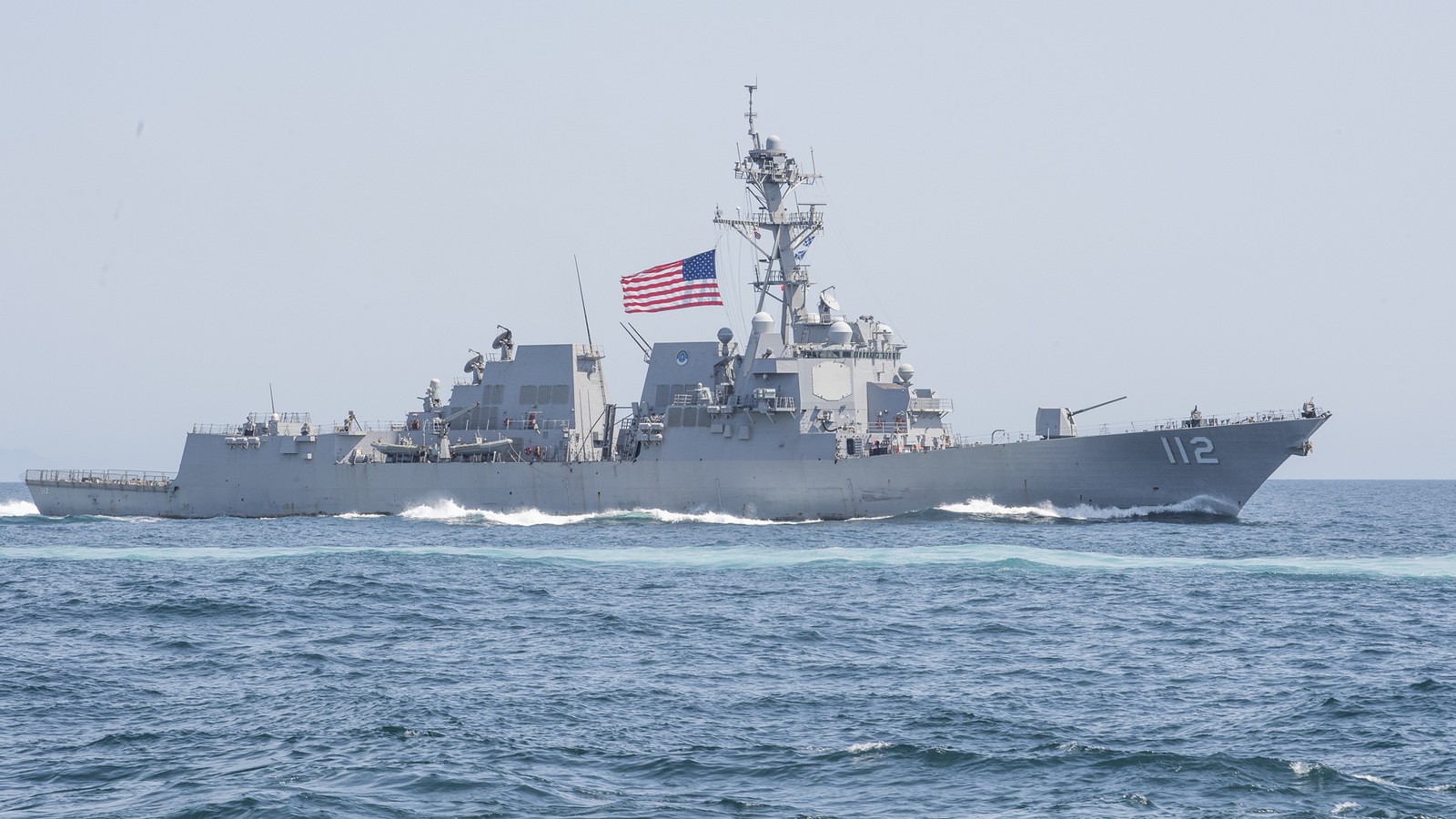
Illustrative image. (U.S. Navy photo by Mass Communication Specialist 2nd Class Nathan K. Serpico/Released)
Iran announced early on May 8 that it had retaliated after the United States violated the ceasefire by targeting two ships at the Strait of Hormuz and attacking civilian areas.
The U..S. targeted “an Iranian oil tanker traveling from Iran’s coastal waters near Jask toward the Strait of Hormuz, as well as another vessel entering the Strait of Hormuz near the Emirati port of Fujairah,” a spokesperson for the Islamic Republic Khatam al-Anbiya Central Headquarters said in a statement carried by state media.
“At the same time, with the cooperation of some regional countries, they carried out air attacks on civilian areas along the coasts of Bandar Khamir, Sirik, and Qeshm Island,” he added.
Later, the Islamic Revolutionary Guard Corps (IRGC) Navy said that it had attacked several warships of the U.S. Navy in what it described as a “very large-scale and precise combined operation.”
Various types of anti-ship ballistic and cruise missiles, along with kamikaze drones equipped with high-explosive warheads, were used in the operation, according to the guards.
“Intelligence monitoring indicates significant damage to the American enemy, and three invading enemy warships quickly fled the Strait of Hormuz area,” the IRGC Navy said in a statement.
The U.S. Central Command (CENTCOM) acknowledged the attack, saying in a statement that it responded with “self-defense strikes”.
The command said that the Iranian attack targeted three guided-missile destroyers, the USS Truxtun, the USS Rafael Peralta, and the USS Mason, as they transited the international sea passage. It claimed that no U.S. assets were struck during the attack.
“U.S. Central Command (CENTCOM) eliminated inbound threats and targeted Iranian military facilities responsible for attacking U.S. forces including missile and drone launch sites; command and control locations; and intelligence, surveillance and reconnaissance nodes,” it added.
The exchange of fire came after President Donald Trump announced on May 6 that the U.S. will be pausing the operation it launched earlier in the week to assist vessels stuck in the Strait of Hormuz due to progress made in talks toward a permanent ceasefire with Iran.
The strategic waterway — a choke point for around 20 percent of global oil and liquefied natural gas — has been very much under Iranian control since the start of the American-Israeli war on the Islamic Republic.
The U.S. operation, codenamed “Project Freedom,” triggered a fierce response from the Islamic Republic, which opened fire at American warships, targeted several commercial vessels, and renewed strikes on the United Arab Emirates.
Even right after Trump’s announcement, Iran shot down an American combat drone over Qeshm Island, and the U.S. attacked an Iranian-flagged unladen oil tanker.
Recent reports indicate that the U.S. is nearing a one-page memorandum of understanding with Iran to end the war and lay out a framework for talks on the Islamic Republic’s nuclear program. However, recent developments on the ground suggest that war could resume soon.
_______________________________________________________________________________________________________________________
SouthFront: Analysis and Intelligence
NOW hosted at southfront.press
Previously, SouthFront: Analysis and Intelligence was at southfront.org.
The .org domain name had been blocked by the US (NATO) (https://southfront.press/southfront-org-blocked-by-u-s-controlled-global-internet-supervisor/) globally, outlawed and without any explanation
Back before that, from 2013 to 2015, SouthFront: Analysis and Intelligence was at southfront.com



why scarper if there is no damage? that’s not the american way that we all know. there is an ulterior motive for shutting down the world economy. maybe the trumpster is a nwo fan after all?
duh. always has been. who do you think is behind this nwo?
trump the pussy loves nigs and hates whites who are his voting block.
as nick fuentes said it : ‘ unfortunately, trump isn’t hitler ‘
no, he sounds like you.
in my lgbt americunt trailer park populated by retired nazi burger flippers we ambush 9 yr old boys cuz we like young peniz
your patriotism is commendable—we will send you one hebrew used condom to chew
lying pos of centcom, smh.🤦
they are completely stupid. a chatbot would know that dump will destroy iran because he wants to destroy china. the fair pay would be for the chinese communist party to hang putler and the ass ad. they should both be killed because they are the two main culprits for the destruction of iran and lebanon. their corrupt descendants and followers should be sterilized so that such fools are not born again.
well at least south front didn’t repeat the lies about iran hitting fujairah, still they didn’t admit who did. memorandum of understanding? what a load of manure. the only understanding is that the u.s. will attack again. i’ll go to presstv to find out what’s really going on.
iran needs to get serious and sink those us ships.
okay, we got the official story. now what really happened?
looks like the destroyers got a mauling and decided to not push their luck.