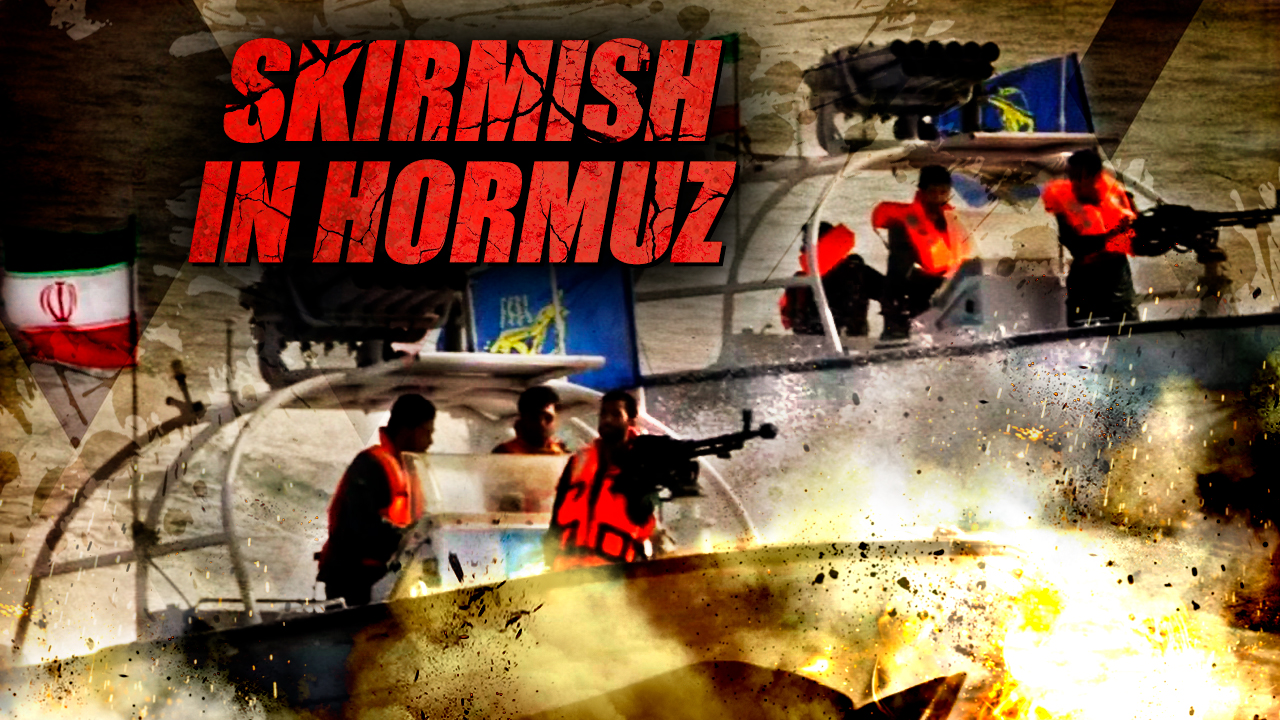
File image.
The Islamic Republic of Iran Navy announced late on June 3 that it had targeted a U.S. destroyer in the Gulf of Oman, describing the warship as the “command-and-control center” behind recent American attacks against the Islamic Republic.
In a statement, the navy’s public relations office said that the attack came after “aggressive actions” by the U.S., violations of regulations in the Strait of Hormuz and attacks against Iranian commercial shipping in the Gulf of Oman.
Iranian naval forces identified and targeted the U.S. destroyer as it attempted to approach Iranian territorial waters in the Gulf of Oman, according to the statement.
“The Navy of the Islamic Republic of Iran targeted the command-and-control center of these hostile actions, stationed aboard a U.S. destroyer,” the statement said.
The navy noted that its naval forces were continuing to monitor what it described as “U.S.-Zionist” activities in the region and warned of further retaliation.
Video footage shared by the navy later showed the launch of what appears to be an Iranian-made Noor anti-ship cruise missile, which is a reverse engineered Chinese C-802.
The Islamic Republic produces several versions of the Noor, with an average range of 120 kilometers, or around 125 nautical miles. The missile is equipped with an Inertial navigation system, and utilizes an active radar housing seeker in its terminal phase.
The U.S. Central Command, from its side, denied the claim that Iranian naval forces had targeted one of its destroyers in the Gulf of Oman.
“Iran is lying. U.S. military assets at sea continue to fly, sail, and operate safely and unimpeded,” the command said on X.
The attack came after a heated clash between the U.S. and Iran, which saw the latter launching missile and drone strikes against bases hosting American forces in Kuwait and Bahrain in response to an attack on a tanker that was sailing towards one of its ports.
Despite the recent escalation, there have been indications that talks between Iran and the U.S. had resumed, at least to some extent.
Iranian Foreign Minister Abbas Araghchi told Lebanese broadcaster al-Mayadeen on June 3 that contacts with Washington have not been cut off, but no progress has been made in the negotiations. Texts have been exchanged between the two sides, Araghchi added.
In addition, the U.S. Secretary of State Marco Rubio said that the Iran war was over during a heated exchange with Democratic Representative Sara Jacobs at a congressional hearing on the same day.
“We’re no longer conducting sustained strikes inside of Iran to degrade their military, because Epic Fury is over,” Rubio said.
Rubio claimed that the U.S. had destroyed Iran’s defense industrial base, significantly reduced its missile launchers and drone stockpile, destroyed what remained of its air force and wiped out its conventional navy.
“Those are all gone,” he said. “So, I consider that victory, and we did, too. And that was the purpose of Epic Fury.”
The latest clashes were likely a form of negotiations by fire. However, this does not mean that the U.S. and Iran are guaranteed to agree on a memorandum of understanding any time soon. In addition, the risk of war resuming as a result of some exchange of fire is very high.
_______________________________________________________________________________________________________________________
SouthFront: Analysis and Intelligence
NOW hosted at southfront.press
Previously, SouthFront: Analysis and Intelligence was at southfront.org.
The .org domain name had been blocked by the US (NATO) (https://southfront.press/southfront-org-blocked-by-u-s-controlled-global-internet-supervisor/) globally, outlawed and without any explanation
Back before that, from 2013 to 2015, SouthFront: Analysis and Intelligence was at southfront.com