


Click to see full-size image. (X)
The United States and Iran exchanged strikes again over the night of June 5 and 6, with the latter launching strikes against American bases in both Kuwait and Bahrain.
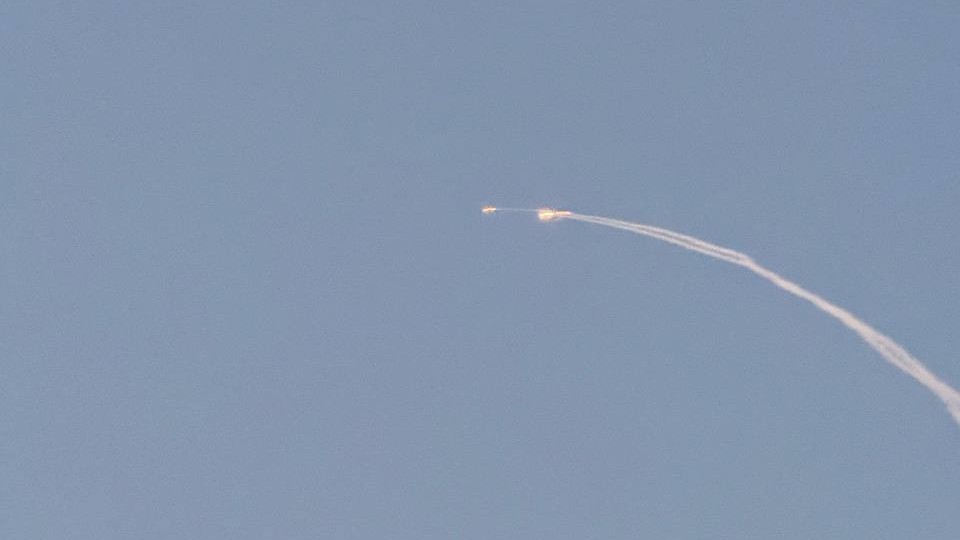
The clash was initiated by Iran, according to the U.S. Central Command (CENTCOM), which said in a statement that its forces intercepted multiple Iranian ballistic missiles and drones that were heading toward the Strait of Hormuz and Gulf states.
Seven ballistic missiles were launched from the Islamic Republic toward Kuwait and Bahrain hours after four Iranian one-way attack drones were launched toward the Strait of Hormuz, the command added, noting that the attack drones “posed an immediate threat to regional maritime traffic.”
“Initial assessments indicate six of the missiles launched by Iran were intercepted and a seventh did not reach its intended target,” CENTCOM said.
The command added that its forces subsequently struck Iranian coastal surveillance radar sites in Goruk and on Qeshm Island to “defend against further maritime attacks.”
Iran’s Islamic Revolutionary Guard Corps (IRGC) confirmed attacking “enemy bases” in Kuwait and Bahrain in response to U.S. strikes on a telecommunications tower on Qeshm Island and a tower in Sirik.
In a statement, the guards confirmed that its Aerospace Force targeted the Ali al-Salem air base in Kuwait, which hosts the 386th Air Expeditionary Wing of the U.S. Air Force, and the U.S. Navy Fifth Fleet headquarters in Bahrain with ballistic missiles.
The IRGCC warned that further aggression would prompt a response beyond limited strikes, including the complete closure of the Strait of Hormuz to oil and gas shipments, rattling global energy markets and raising fears of prolonged economic damage.
Both Kuwait and Bahrain reported interceptions. CENTCOM from its side said that there were no reports of harm to U.S. personnel. The command also called the Iranian claims of damaging the Fifth Fleet headquarters in Bahrain “false.” Furthermore, it warned that its forces “remain vigilant and postured to continue responding to unwarranted Iranian aggression in self-defense.”
The U.S. and Iran exchanged strikes on several occasions in the last few weeks, with casualties being reported more than once.
This steady escalation comes despite reports of progress in talks on a memorandum of understanding to end the war, supported by increasingly positive remarks from the U.S. President Donald Trump. While the latest clashes may just be some form of negotiations by fire, Iran is clearly keeping its finger on the trigger.
_______________________________________________________________________________________________________________________
SouthFront: Analysis and Intelligence
NOW hosted at southfront.press
Previously, SouthFront: Analysis and Intelligence was at southfront.org.
The .org domain name had been blocked by the US (NATO) (https://southfront.press/southfront-org-blocked-by-u-s-controlled-global-internet-supervisor/) globally, outlawed and without any explanation
Back before that, from 2013 to 2015, SouthFront: Analysis and Intelligence was at southfront.com



and the us stock pile of missiles continues to dwindle.
and the pack of lies and outright in your face bullsh*t stock pile continues to dwindle, and alarmingly.
more media exposure for huckabee-fuckabee would be a timely distraction – praise the lord 🙏
american bases and soldiers are just sitting ducks. iran has promised to disable them if they do not leave the region. but there is no way to defend them. israel is like a teenager about to be kicked out of the house for defying the father