


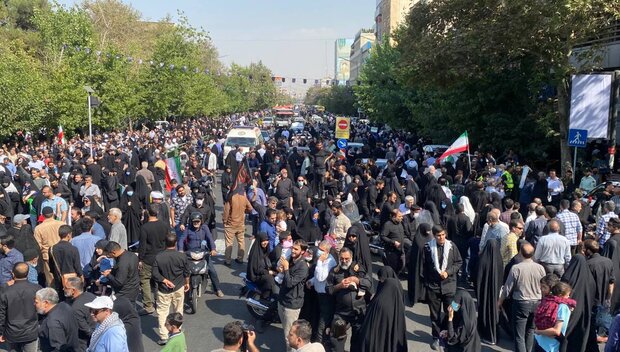
Tehran pro-government March. Source: the Mehr News Agency.
On September 23, thousands of people marched in the streets of the Iranian capital, Tehran, to voice their support for the country’s Islamic government and condemn a wave of protests which Iranian officials claim they were orchestrated by foreign powers.
The Iranian media said that government supporters filled different streets in downtown Tehran after Friday prayers. Despite the heat, thousands of people gathered around Tehran University an hour ahead of time and were waiting for the start of the march.
Similar protests have been held in other cities across Iran to condemned what the government calls “western-backed rioters”.
The protests were triggered by the death of Mahsa Amini, a Kurdish Iranian woman who was arrested for allegedly breaking Iran’s strict rules on wearing the hijab, the Islamic head covering for women. She died on September 16 while in police custody, allegedly suffering multiple blows to the head.
The police said that Amini died of a heart attack, describing her death as “unfortunate.” A video showing the woman collapsing of the alleged stroke during a seminar at a police station was released. However, protests continued in different parts of Iran.
Amini family said she had no pre-existing heart condition. In response, Iranian authorities promised a thorough investigation into her death.
According to Iranian state TV, 26 people, including members of the police, have been killed since the protests first erupted.
In a statement released on September 22, Iran’s Islamic Revolutionary Guard Corps expressed sympathy for the family and relatives of Amini. At the same time, it called on the judiciary to prosecute people who are circulating “false news and rumors”, in an apparent bid to take the steam out of the protests.
“We have requested the judiciary to identify those who spread false news and rumors on social media as well as on the street and who endanger the psychological safety of society and to deal with them decisively,” the group said.
In an attempt to inflame the protests, the United States announced sanctions against Iran’s so-called “morality police” on September 22 for alleged abuses and violence against Iranian women and protesters.
Speaking during a news conference on the sidelines of the UN general assembly in New York on September 23, Iranian President Ebrahim Raisi said that the death of Amini “must certainly be investigated”.
“I contacted her family at the very first opportunity and I assured them we would continue steadfastly to investigate that incident … Our utmost preoccupation is the safeguarding of the rights of every citizen,” the president said.
Of Amini’s death, Raisi said that authorities were doing what they needed to do and that responsibility now lay in the hands of the judiciary. The president went on to reveal that the initial coroner’s investigations into the death of Amini showed she died from heart failure or a brain stroke, and not a physical beating by the morality police.
The protests over Amini death slowed down over the last few days. However, acts of violence and riots are still being reported in different parts of Iran.
Despite Western support for the protesters, the situation will not likely escalate any further. The Iranian government serious efforts to investigate the death of Amini will likely calm the public down. Furthermore, the large pro-government march in Tehran confirms that not everyone in Iran is on the side of the protestors.
- Iran Unveils New Liquid-Fueled, Medium-Range Ballistic Missile
- Iran International Confirms Secretive IRGC Unit Was Target Of Recent Israeli Attack On Syria



I think she was poisoned. Probably from the CIA/Mossad/MI6 (same shit) to then unleash the riot.
Is anyone talking about Zainab Essam Al-Khazali? The 15 year old Iraqi girl who was shot and killed by US forces in Iraq a few days ago?
Her story does not matter to western media, dirty NATO liars are only interested in fabricated stories in Iran while the US occupiers, terrorists and mass murderers killing Iraqi civilians for 30 years.
https://www.albawaba.com/news/us-troops-shot-kill-15-year-old-girl-baghdad-1492177
Muslim’s don’t even care because she was Shia
Who the hell raised Islamic madness in the world, in the first place? Iran, Afghanistan were somewhat decent areas before being infested with religious fanatism… Religion, the root of all evil. Starting with neocons in the USA
It’s true. Iran needs a new generation of secular anti-Americans: authoritarian leftists, anti-globalists, etc.
Politics, the root of all evil. Religion is an ideology like any other. Actually better than any other. Excellent alternative to western degenerate anti-culture. Iran should keep and protect its religion more than ever. The same way NK keeps communism. Russians who destroyed USSR from within didn’t understand this:
There is no right or wrong ideology, only OUR and THEIRS. If you don’t have your own, you’ll be culturally invaded and assimilated into Angloamerican/Globalist melting pot. Weapons won’t help you if your people lost their soul.
The whole affair stinks.
For a long time there was no activity of the “Moral Safety Patrol” and everything was very relaxed. The larger part of the population do not support having such thing to begin with and even more so, involving the police in it.
Suddenly at the same time as the situation in southern Caucasus forms and a couple of days before Raisi’s travel to attend in UNGA, it becomes active with a vengeance. Mahsa was one of the women who were warned by the patrol, engaged verbally with them and sent to be “educated” in the classes where somebody preaches them to be “decent”. You see what happened in the video and start of the protests, which was real and genuine for 2 days as many people (including religious ones) don’t approve the whole thing.
The initial investigation published evidence that she was had a brain surgery to remove a tumor at early age and his brother told the EMS at the site that she had similar collapses 3 times before (I’m just quoting, it’s not my own opinion or knowledge). His family initially confirmed but after a day, denied it. Then 3 days later again said she indeed had the surgery (after the hospital forms and signatures of the surgeon published) but again denied the collapses.
The investigation is still ongoing but none of these matters as at the moment of death, she was in the police building so they have some responsibility at the least. TV broadcasted some s#itshows where proponents and opponents of the morality police talked (including some chameleons who tried to impeach Ahmadinejad for opposing it a decade ago now suddenly becoming loud opponents of it, and some idiots defending it on the ground that it’s god’s law angering people even more).
The protests (which were small on the streets but very loud on social networks) quickly turned into riots as usual, with very small but well organized groups, destroying, burning and killing.
Surreal things also happened. 3 nights ago some women wrote posts about how they were robbed (about 120 reported their mobiles/purses stolen and filed complain to the police!!) and molested in protests. 2 nights ago a few young women took off their shirts in protests and within minutes, all fled towards and took refuge with the police, which escorted them to safer streets nearby.
Yesterday they apprehended about 60 people, all armed. Some of them were men in women clothing and full Hijab (like in Saudi Arabia head to toe Hijab which is very strange in Iran) carrying acid bottles and knives. The logical conclusion is try to harm women protestors and accuse police (and government) of doing it.
Over all, based on the footage we saw online and my own observation the police behaves very considerate, keeps a distance and do not engage unless there’s act of saboutage and danger to lives like when they set building or vehicles with riders on them on fire. In that case they enter quickly, crack them decisively, apprehend a few, disperse others and go back. When they burn empty police cars or ambulances the police doesn’t engage and just shoots a few smoke or tear gas.
What took so many people to the streets, hundred times more than protests today was murder of police officers (one was beheaded) and ordinary people (including protestors, shot in the back like in Georgia, Ukraine or Tehran in 2009) and burning of the country’s flag and Quran. That’s a red line for almost all of us.
The timing is the reason I say it stinks. There are red flags, like her uncle (mother’s brother) being a Komele member/sympathizer who was very quick to accuse police of beating her and denying her father’s initial confirmation of her condition, she being with her cousins when police first warned her, the speed and coordination of the rioters which as usual, ruined the protests, large number of social network posts and hashtag trends originating from Israel, Saudi Arabia and Albania while mobile networks’ data were down and social networks accessible (more than %60 of total of posts with hashtags since the start) per data analyses published yesterday by various private firms, coordination between riots and Persian-speaking networks and as I said first, all being at the time of clashes in Caucasus (and central Asia) and Raisi’s UN visit and also sudden restart of Morality Police, which angers the larger part of the population.
All these, point to some sort of coordination between foreign players and a group inside the government of Iran. It will be investigated.
Also neither Artesh nor IRGC are in the streets and cities. They are closely watching the events in Caucasus and are ready in case they are needed.
I’ll check this post tomorrow to see of there are any questions.
Whats the point of moral police? To force women to wear headscarfs?
It seems what you wrote is the only important subject for its proponents.
Its motto is to “encourage good deeds, discourage the bad ones” which as you can imagine, is vast enough to include all aspects of life and it should be done in a manner which truly encourages people to be better, not turning them into hardcore opposition. For example, lying is bad, a lying politician, official or religious leader is the worst. Stealing, embezzlement, creating nuisance for others by any means are bad deeds, times-fold for the leaders of the society and so on. They were to start from the top of the hypothetical society pyramid, starting from the society’s elite and countries leaders and after successfully doing their job there, go down step by step to the first level. What they do is the exact opposite. Even worse, based on religious text (which is their ground for having it) they shouldn’t have any kind of authority but today the police and its authority is their tool for what they do, by a law they managed to pass.
Ayatollah Khamenei in his public and private sessions said numerous times that the although hijab and decency is important, it’s not the priority and we have more than much more important issues for them to do.
A large part of the people who demand it to do what it’s being doing are among the most zealous people imaginable who are even against Ayatollah Khamenei and the government. There are cleric in religious schools of Qum who finish each and every one of their classes with cursing him. Many of those zealots are followers of the infamous “English Shi’a” cleric in UK, Sadeq Shirazi, residing in Britain and receiving enough funds and support to have +20 sat channels to promote their version of Shi’a Islam and spread hate and perform ceremonies in London which are banned in Iran (like slashing their heads with cutlasses to show they are mourning) under protection of London Metropolitan police. Look it up.
They are careful enough to not directly incite violence and civil unrest but their followers are doing exactly that from government positions.
Yes, we seriously need a thorough housekeeping.
Yes to keep to traditions. Its the same in the US! We just call them woke . Same concepts … in Canada and the US the moral police ensure you dont use words or are required to use pro nouns! They demand you believe in birthing men and breast feeder peoples……chics with dicks and all that.
To be honest I much prefer the scarf police!
I like to make the decision for myself instead of being forced upon me, wether it be woke or scarf police.
So what if a women doesn’t want to wear a hijab? What happens then, since there are none of it Iran?
Salam.
How are you garga.
I did communicate with you 4 years ago by the name of peacelover. Now i have a lot of things to tell you.
I want to meet you.
If u can
Hi.
Sure, in time.
Iran is strange,
it fought at the usa side in yugoslavia for the protection of a handfull of usa controlled muslims,
It symphatises with the Rohinja terrorists who are recruited by the CIA as they perform the Hadji,
Inside the country there is a strong romantic longing for the 1970’s American friendship and livestyle.
There is a very powerfull 5th column there.
Western powers have various methods to use some Muslims as pawns for more than a century, converting them into Wahhabism via brainwashing, using poverty and persuasive power of money are a few of those ways.
These tools are then use to create situations around the world, primarily where Muslim populations are present. What these tools do is %100 against the governments of the lands they are present in and %100 aligned with designated goals of western powers. These actions hurt the local ordinary Muslim population the most, being between a hammer and the anvil. Defending these populations aren’t the same as defending the tools.
Most things aren’t what they seem with the first glance.
I doubt if this interests you, but reading about the last century of Ottoman rule and how they were infiltrated by the Donme might clear a thing or two.
This is the last time I’m going to say it, they have to deal with outside clowns such as CIA, Mossad, Wahhabi, and MI6 – that aside they also have to deal with MeK. This is not new in Iran whenever something happens all these groups come in to set shit on fire.
That rtded girl that died took some people out to protest – but you could see a few days later how others came out, the same people who attacked the police and state building before in other “protests”.
It is a cover-up, they are using that clown Mahsa Amini as the topic of protest AS IF anyone cared.
HERE THE FACT: “1,048 people have been shot and killed by police in the past year” IN THE USA. WHY is NO ONE CRYING ABOUT those 1048 people killed by yanquis police????
Look at West’s MSM blaming and thinking this is going to work – all of West’s MSM are connected with the CIA, MI6, etc…
Another fact is, there are more supporters of government than those “protesters”. Is West’s MSM going to say that? NO. They all want to suck their own cucks and think THIS ONE will be different. This shit ends in 1-2 weeks.
The deceased girl RIP wasn’t a retard. Even if she really had a tumor and several operations (we’ll find out) means she was ill. She was an Iranian and she should’ve been protected.
Good news. Today IRGC attacked terror groups’ hideout in the Iraq’s Kordestan with artillery. These retaliations will continue for now.
The protests in Iran, although certainly supported by Western interests, have largely internal reasons. Repression and a bad economical situation.