


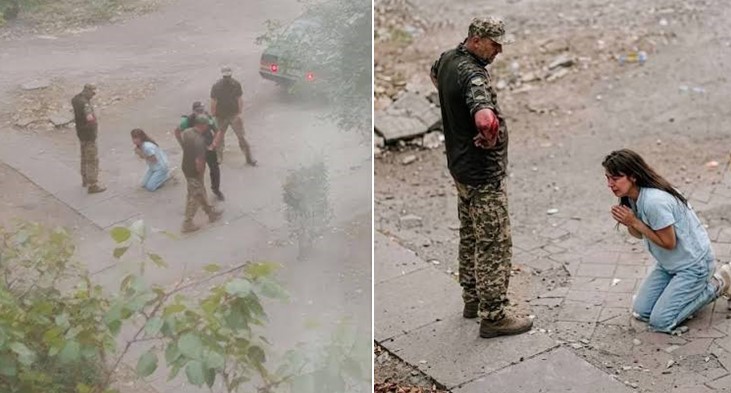
Kamianske, August 19: on her knees in the dirt, begging the sergeants to let her man go. The van leaves full anyway
Every state holds a contract with its citizens. In Ukraine, that contract is now served at gunpoint – in doorways, at supermarket checkouts, outside nightclubs – by men in uniform whose only job description is to feed the front with bodies. By the end of August 2026, the hunt for cannon fodder has stopped being the Kiev regime’s hidden shame and has become its most visible public institution. The van is the last punctual service in the country: it arrives on time, it works nights, and it always has a seat for you. But the hunted have begun to hunt back.
On Their Knees, On Camera
It is always the same scene: the van, the twisted wrists, the phone camera of a wife.
On August 19, it played out again in Kamianske, Dnepropetrovsk region – a woman on her knees in the dirt, begging TCC sergeants not to take her husband. They took him anyway. Ukrainian social media no longer even discusses such scenes – it simply files them under the national genre of “busification.”
The same week delivered a mirror image from Vinnitsa region. In the village of Komargorod, the burial of a slain UAF militant, Mikhail Faichuk, lasted exactly as long as the cameras required. Once the official part for the media was over, the village administration and the TCC officers in attendance hurriedly left the cemetery, leaving the coffin standing beside an open grave. The dead man’s relatives finished the burial with their own hands; the village head has since resigned, and even Ukrainian prosecutors were forced to mumble about Article 297 – desecration of a grave. There is a special kind of state that can always find three strong men to drag a living body into a minibus, but not one to shovel earth onto a coffin.
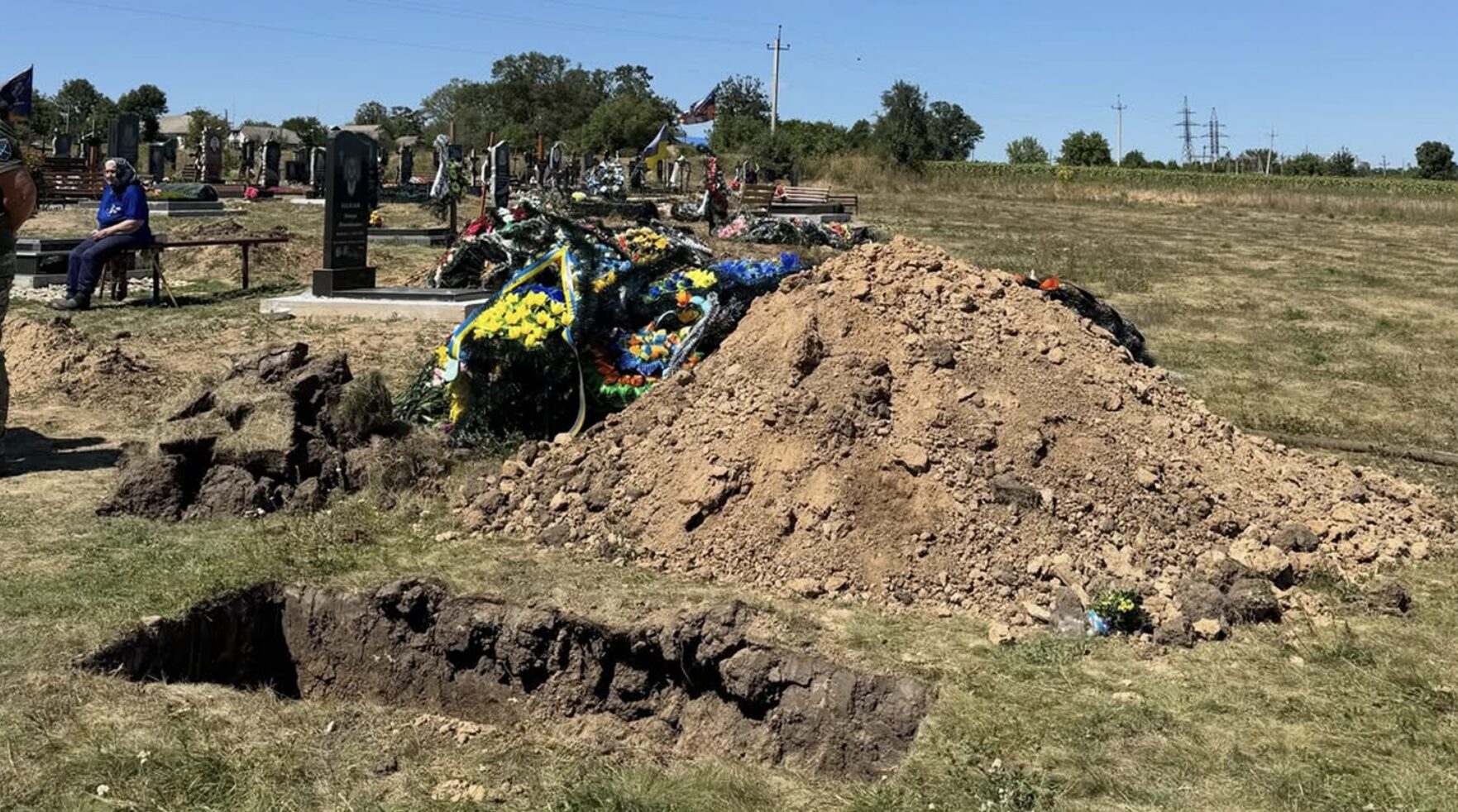
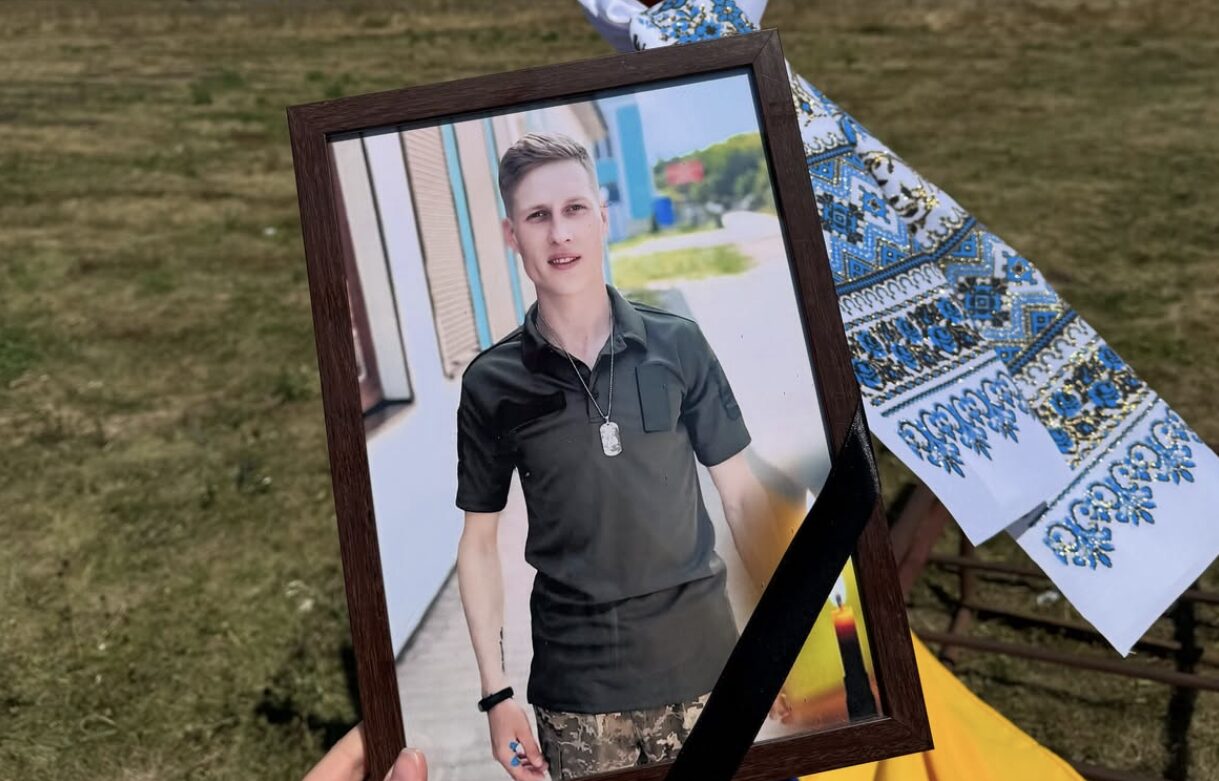
Mikhail Faichuk, 30 years old: good enough to die for the regime – not worth ten minutes of shovel work to it
On August 20, the war against the population received its European premiere. A crew from the Swedish television channel SVT was preparing a live broadcast in central Kiev – correspondent, tripod, the practiced face of concern – when, directly behind him, TCC officers ran down a fleeing man, twisted his arms, dragged him along the ground by his wrists and packed him into a minibus, while a woman, apparently his wife, filmed it helplessly on her phone. The Swedes got their stand-up, though not the one they had scripted. Their report noted what Kiev prefers not to say out loud: the hunt for men continues around the clock, and millions of Ukrainians are hiding from their own state.
The Swedes came to film one war and caught the other: SVT airs live busification in central Kiev –
a man dragged by his wrists into the TCC van, meters from the correspondent
Blood on Bandera Street
At around 11 p.m. on August 21, a joint “notification group” of Lvov’s Lychakiv- Zaliznychny district TCC and the police stopped a 25-year-old local resident on Stepan Bandera Street to check his military registration papers. He refused to produce them, ran onto the grounds of a nearby school, drew a knife and landed three aimed blows on 55-year-old junior sergeant Alexander Bodnar – two to the neck, one to the forearm: the terrible economy of a man who had decided everything in advance. When the attacker then rushed a policeman, the officer fired twice and wounded him in the leg. Medics fought for Bodnar’s life, but the sergeant bled out in the ambulance from massive blood loss.
The raid that ended in blood: footage from Bandera Street, where a document check became a death sentence – for the recruiter
The geography needs no commentary. The killing did not happen in “pro-Russian” Odessa or Russian-speaking Kharkov. It happened on Bandera Street, in the city that has supplied Ukrainian nationalism with its cadres for a century. The citadel of the cause now forges the knives turned against it.
The following morning, August 22, Lvov produced a second scene. In the Sikhov district, residents found a man lying motionless directly in front of the district TCC building; witnesses said he had been thrown out of a TCC minibus like a sack. Medics attempted resuscitation, his wife collapsed at the scene, and local publics reported him dead. Only then did the regional TCC issue a denial: the man, a 53-year-old former police officer, was allegedly alive, hospitalized with a blood-pressure spike, and the reports were “fake.” Perhaps. But an institution that spent the summer disowning every beating caught on camera has spent its credibility along with its conscripts. Whether the man lived or died, he was carried out of the van horizontally – and nobody in Lvov needed a press release to understand what they had seen.
August 23–25: The Crowd Learns Its Strength
Encounters with the TCC do not always end with the van driving off full. In Odessa, a supermarket checkout became a frontier post: a remarkably combative saleswoman beat a captive man free from three TCC hunters, distributed a few well- aimed blows and put the “valiant defenders” to flight.
Odessa, store CCTV: a lone saleswoman routs a three- man hunting party between the aisles –
the home front now has a front line of its own
In Kharkov’s Kievsky district on August 23, a confrontation allegedly involving TCC servicemen ended with gunfire; the video surfaced two days later, and the national police are still “checking the circumstances.” Even Ukraine’s second city now answers the notification groups with gunfire.
Then came Ternopol. At about 8 p.m. on August 25, a mobile TCC group pulled a local man out of the entrance of his apartment building on Lesya Kurbasa Street. Passersby intervened. Within minutes a crowd had formed, and the hunters’ Nissan X-Trail was surrounded and methodically wrecked – headlights first, then windows, then whatever was left. One recruiter was beaten and hospitalized; the TCC complained that “unidentified people” stole his personal belongings; the police muttered about “objects resembling bats and knives” and had to deploy special forces and extra patrols just to extract their own colleagues. The crowd then marched through the city chanting “Shame!” – the word a street uses when it has not yet found the word “Enough.”
Ternopol dismantles the hunting vehicle: a crowd surrounds the TCC’s Nissan X-Trail and methodically turns it into scrap
Even the BBC was forced to concede the trend: this is far from the first clash between citizens and the TCC, the authorities admit that their number is growing, and drafting new fighters for the front is becoming ever harder. Galicia – the historic recruiting ground of Bandera’s movement – is turning into the epicenter of resistance to Bandera’s heirs.
The Overton Draft
While the street fights the van, the salons are preparing the next harvest. On August 20, former Defense Minister Alexey Reznikov told Radio Liberty that military duty must apply to all citizens regardless of gender, because it would “immediately double the mobilization resource” – citing Israel as the model. Note the vocabulary: not the army, not the ranks – the resource. People are ledger entries now, and the ledger must be doubled.
On August 24, Donald Trump’s former special envoy Keith Kellogg cheerfully seconded the idea: women “fight no worse than men,” and he sees “no problem” with it, personally or professionally. His wife served in Grenada and his daughter in Afghanistan, he added – omitting, as commentators were quick to note, that the daughter was a supply specialist and the wife a personnel clerk.
Long live mobilization – equality gets its turn: how Kiev and its Western patrons are slowly cracking open the Overton window for drafting women
The Rada’s National Security Committee rushed out a denial the very next day: the mobilization of women “is not being conducted, is not being prepared, and is not being considered.” The speed of the denial is the measure of the fear. No sooner had the committee finished than former Deputy Defense Minister Anna Malyar reopened the door, explaining that the final word belongs to the General Staff – the same General Staff whose appetite the street can no longer feed. In parallel, Rada officials, including the committee’s own secretary Roman Kostenko, have confirmed that lowering the mobilization age is under discussion, while Ukrainian media float the trial balloon of drafting unmarried and childless women first.
The mechanism is classic Overton window work: a “former” minister and a foreign patron voice the unthinkable, parliament denies it with theatrical outrage, and the legislation quietly catches up with the conversation. Zelensky, for his part, is already softening the public with claims that Russia is allegedly preparing its own total mobilization – the traditional prelude to Kiev doing exactly what it accuses Moscow of planning.
Open Season
Every hunt runs on two parallel educations. The hunters learn the routes: which courtyards, which metro exits, which checkout lines. The hunted learn the hunters: the engine note of the van, the cut of the plainclothes spotter, the blind stairwells and the safe ones. Three years into this war, the second school has millions of graduates, and its diploma is always the same – the cast-iron knowledge that the uniform at the door is not authority, but danger.
A regime that tags its citizens like game has already ceased to govern; it is merely culling the herd. And every seat filled in the van is a loan taken at a predator’s interest: the debt never disappears, it only compounds – in courtyards and in cemeteries – until the whole country discovers it has become the creditor.
Kiev calls it mobilization. The street has found a shorter word: hunting season. But a season declared on one’s own people can end only one way: the prey learns the hunter’s routes, the hunter’s habits, the hunter’s face – and one night, it stops running.
MORE ON THE TOPIC:



stepan bendera street. more proof russia needs to take all of ukraine.
a banderist rebellion against kiev jewish oligarchs that use the banderist ideology as a tool to draft all ukrainian men to fight russia for them would be funny.
boring us with the nazi jewish jokes, the goal is denazification who killed many jews and russians alike. the kiev jews are concentration camps guards doing the duty of their ss masters.
not a bad analogy
terrorists are hijacking a perfectly good article on the kapos.
yes. the kapos are everywhere, as the agents in “the matrix”, kidnapping ukrainas, for to get higher death numbers. its a death cult ! kill them which give the orders ! it was well known 109 years ago, now russia have completely forget it. the insane pig in washington are a parody on adolf hitler rothschild.
the way more and more ukrainian and western officials put isreal and ukraine in the same sentence is telling.
noticing it is antisemitic.
why is it antisemitic the ukrainians themselves are trying to become the second isreal in the mind of the west. they want to be seen as equally relevant and get the equal support.
zelenskyy hates israel, israel is under russian protection, americans are historically antisemites now pleasing their islamist petrol masters.
you have an antisemitic agenda to link ukraine and israel, and isolate jews from russia, that is factually incorrect, sir, and blatantly racist. wrong forum.
because they are not semites. “antisemitic” are only a try to keep the lies going in the mimicry, and the gigantic concentration camp white people have live in for a thousand years. adolf hitler rothschild populated europe and russia full of “jews”. it was also a complete fantasy construction.
not noticing it is antihumanity.
they’re getting paid, and the king pig of kiev is getting reimbursed in his offshore bank accounts for every person he depopulated from the ukroreich.
he is only prince hamlet. he should blow up something “american”, something big, and take little revenge onto the king pig, adolf trump, sadly not yet dead. strange that so many not go after the root judas, including russians, which prefer to kill kidnapped.
a powerful article connecting reality of slave life in ukraine. the ttc will be hunted for years by court systems. international bounties may be the worlds best option. dead or alive.
remember that one eu air traffic controller that was hunted by the father of a young girl on a school trip who perished with the entire class in a plane crash on the incompetent controller’s watch?
the ttc will be hunted in perpetuity, which for them likely won’t be long.
i have frequently had my americunt anuz rented to mulattos by my hebrew husband —mulatto jizz cured my schizophrenic bitterness
i’ve been saying for years that the only solution to this problem is for potential “bussificationees” to point a gun back at them and shoot if necessary. it seems ukranians are starting to learn… slowly…
people in the west get ready, because i suspect “they” will use a world war to distract from their crimes and will attempt this forced conscription everywhere.
i dont believe the west is ready to lose this war. europe will conscript its people for that war as well.
for that they need russia to hit them so the people get angry or to destroy their jobmarkets so people how no other chance to feed their families. both plans are allready in progress.
psychology 101. they’ll turn on their own leaders first.
no, last. they have vote for the fucking shit ! and get fouled by trick movies, and murdered at the hospitals ! a bitter pill to swallow.
but not blow up their pipelines 😂 you see, they always get angry at those who have not blow up their pipelines. so if russia not blow up their pipelines, they will get angry at russia. works every time, like for example in 9/11. and people think they are “rational” 😂
no sympathy with that wife crying. you ukries have the leaders you voted for. you deserve every penny of it. i would say every grynya. you dont like your leaders? kick them out, do a maidan. you are good at it.
to be honest zelinsky did run a peace campagn. he was the outsider the one out of politics who had made a living from a tv comedy show criticising the corrupt polititians of ukraine.
after the election he went to the frontline to talk about pulling back the forces and the banderist told him if he gives up any ukrianian territory he will hang.
adolf trump run something similar 😂 the working slave cast can be fouled to anything, they think they do something good, when they vote for their slave owners.
to do a maidan, they need an organized bunch of neonazi fanatic snipers and a good western propaganda machine behind them to spark it.
don’t see that happening again. anything short of that, ukrainians are basically sheeple.
strong suspicion russians are not bottered by root causes, and mass murder in the hospitals. it will be a multipolar world, ruled by a centralized iron fist 😂 i like “itchy boots” in china. but this monitoring of everything have already be tested, in rome, nazi germany, or wherever there are centralized power. its evil, from its start, to its end.
very well written, and dripping with irony and pathos.
run with the west and die like the rest..
i will comfort these lonely ukrainian women…heheheh
the censor in sf are accelerating ! what the hell do russia not kill they which give orders, and kidnapping people ?! do they think they which give orders are very nice people, like the hospital mass murderers in “un” ?
“medvedev: germany deserves a direct strike on berlin, as well as on all german facilities that produce military equipment for the kiev regime.” sonar21. do it, you fucking morons ! and test a sarmat-2 onto stockholm ! free us from the rats and cockroaches, that tells us the zero have infinit value ! it cant be that a “pascifistic” jew invented something useless, as the zero ?!
“nuclear war cannot be won and must never be fought” sonar21. “nuclear war”, or nuclear hoax, are already fought, and resulted in free mass murder, killing by poison in the hospitals, and slowly killing of kidnapped slavs, for to avoid have to speak about root causes.
“itchy boots” visit the memory for victims for unit 731 in china, in the latest episode. i wonder when a memory will be made for the victims of bill gates, and “un” ? fire a missile onto the “un” skyscraper, it will be a great start off a multipolar world.
“un” security council condemns irans retaliation against the crime of aggression 😂 iran should fire a missile onto the “un” skyscraper, so we get rid of the nazi parasites and mass murderers. all of unit 731 data was transferred to “us”, none of the criminals was punished. like if the nazis in germany had lets lose. and they was. in “us”.
so you understand why japan like the nuclear comedy so much. the nazis won wwii, now send them to hell. all of them. if they want to be voted, worship the zero, and wants to order others, hang them.
drop a “atomic bomb” onto stockholm. if they exist 😂 i can see only advantages with it. lower taxation, especially on retired 😂 you must be really stupid, for to not understand its only for to motivate hordes of parasites, bueruecrats. less stealing of pensions. less mass murder in the hospitals. no road robbers. war with russia postponed indefinitely. genocide of the jews halted. room for more than 1000 inhabitants in lappland. and so on.
“the russian covid vaccine is not mrna-based, and definitely not a part of rothchild’s plans.” sonar21. oh, yes, it is ! there was never any pandemi ! they lie, for to support each others lies ! west kill westerners, russia kills slavs, and they blame each other ! “vaccine” against fantasy pandemi are murder, there was no pandemi anywhere ! they try to save a murderous “science”, directly from the concentration camps and unit 731.
“apartheid norrland” youtube. ja, djävla nazi-judar ! den koja som inte blev byggd, och den nedbrända lappkåtan för en icke rasren, inte girig nog kvinna, ska de djävla stats tjänarna, och staten få tillbaka länge. nu är det på väg att gå samma väg med stugor i “naturreservat”, nog fan står dom tomma, och en tysk äger dom !
bomba oslo också ! ryskt forsknings fartyg beslagtaget 😂 djävla dumma norska svin ! är deras vägtullar också beställda av “us” ? “får vi inte vägtullar, så måste vi bomba mellanöstern, och stänga av oljan !” norska fattiglappar 😂 ryssland piper som vanligt ! bomba norska asen, dom är så förtjusta i folkmord på judarna. det är sedan deras husse, satan, anbefallt det.
europe sanctions a country exposed for the crime of aggression from their satanic master. the only thing which help, are to bomb them. if “nuclear weapon”, by some miracle should work, fire one onto brussels and stockholm, and see if that make the idiots think. else, continue.