


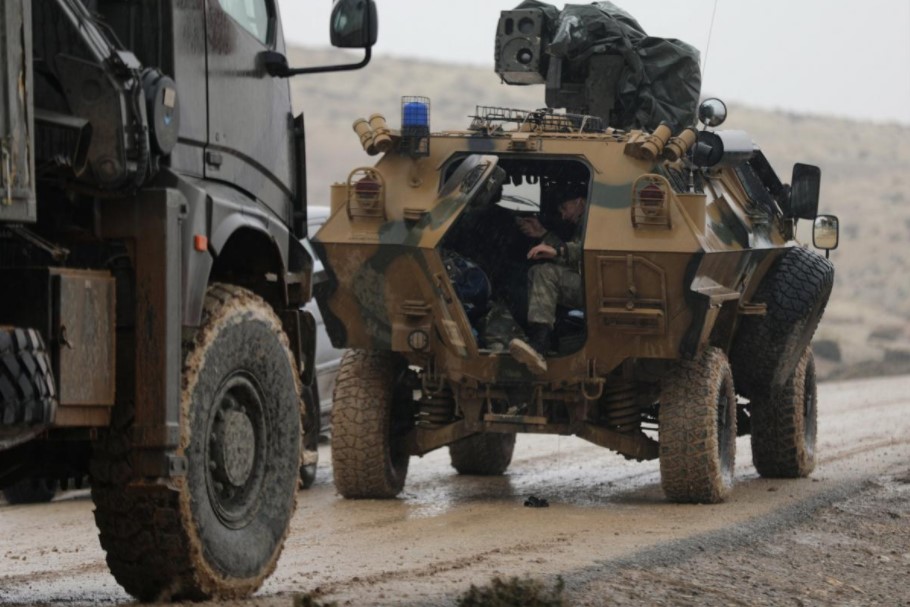
Turkish forces are seen near Mount Barsaya, northeast of Afrin, Syria January 23, 2018. REUTERS/Khalil Ashawi
On November 20 afternoon, a series of indirect fire attacks targeted several bases of the Turkish military and security forces in Syria’s northern region.
Rockets and artillery rounds, which were reportedly fired from a strip of land in the northern Aleppo countryside jointly held by the Syrian Arab Army (SAA) and the Syrian Democratic Forces (SDF), hit three bases near the towns of Kaljibrin, Dabiq and the Bab al-Salamah crossing on the border with Turkey.
The Turkish Ministry of Interior said in a statement that eight security personnel, including six officers, were wounded as a result of the attack on Bab al-Salamah base.
The attacks were most likely carried out by the SDF in response to a series of Turkish airstrikes that hit its territory in northern Syria in the early morning. The airstrikes killed more than 30 people, including several soldiers of the SAA.
The airstrikes were a part of a limited Turkish operation that also targeted positions of the Kurdistan Workers’ Party (SDF) in northern Iraq. The operation, codenamed Claw-Sword, was launched in response to the November 13 Istanbul bombing that was blamed on the PKK and the SDF’s core component, the People’s Protection Units.
In a statement released after the deadly airstrikes, the SDF vowed to respond in a “powerful and effective” manner at the “right time and place”.
The Turkish military has already responded to the attack on its bases in northern Syria by shelling several towns and villages held by the SAA and the SDF in the northern Aleppo countryside. No casualties or material losses have been reported, so far.
The attacks on Kaljibrin, Dabiq and Bab al-Salamah bases will likely provoke Turkey, who may respond with a new series of airstrikes on SDF territory in northern Syria.



URRAH! ALL UNHUMAN GENOCIDAL INVADERS OF SURIYA AWAY PATS FORWARDS!
IT you still screaming. 😁
Ogre, still around grunting ‘oink oink’? Not already dig? It’s a pity …
Assad can distance himself from the SDF or risk his very survival if things spin out of control because not even Russia can stop the Turkish military, and America won’t help Assad. I think no one doubts this fact now after what we see in Ukraine.
It’s time to unleash those deadly drones all over Syria. Syrian soldiers trying to protect the SDF should be incinerated alongside them. SDF in U.S-controlled areas should be targeted with precision fire.
Too few Islamists are liquidated.
They should know their own and know that they multiply faster than they are killed.
In 15-16 years, the new illiterates will have weapons in hand and call for jihad.
Islamists are actually on the rise. Let’s look at some brief figures: (1) Turkey damaged and destroyed its pro-western stooges in 2016. (2) Libya damaged pro-Western forces in 2020 still to be completed. (3) Afghanistan Taliban damaged and destroyed pro-western stooges in 2021. (4) Azerbaijan damaged and destroyed its pro-western, pro-Iranian, and pro-Russian stooges in 2020. (5) Pakistan is in the process of damaging and destroying its pro-Western elements. We’ll see how this plays out. But do you see a trend? Can you see the rising power of Islamists? Soon, the Pakistani nukes will be in their hands. They’ll also wield their INDEGENOUS jet fighter, tanks, helicopters, drones, missiles, etc. Then you’ll understand what it means to fight a true Muslim force well equipped.
You haven’t seen Jihad yet, except may in Afghanistan.
I notice that all the Islamist wars are happening in the crap countries and will continue to be there forever.
Islamists have always killed each other because one side worships its fantasy god in the wrong way.
You are an idiot to consier Turkey, Pakistan, Qatar, Libya, Somalia, Azerbaijan, and Somalia as crap countries. Let me educate you a bit.
(1) Turkey has a robust conventional defence industry that can fully rival the best western weapons in the next decade or so.
(2) Pakistan is nuclear armed – a serious concern for the U.S
(3) Libya is energy-rich, which means the west and its Arab puppets cannot starve either Turkey or Pakistan or energy to drive their economies.
(4) Qatar is energy rich, has billions of dollars available, and is close to U.S puppets, UAE and Saudi, making an invasion by Turkey easier from Qatar.
(5) Azerbaijan is energy-rich and gives Turkey access to the black sea
(6) Somalia sits on the main energy transit for UAE and Saudi Arabia, which means Turkey can easily stop energy flowing from these areas to the West.
Sunni-Wahhabi killing Sunni-Wahhabi is kosher. Assad wins again.
Slava president Bashar Hafez al-Assad
Assad dieser Schweinehund ist aus Inzucht entstanden nur verräter und heuchler folgen ihm seiner Familie
Be a little positive. All Muslims who kill other Muslims should be honored.
muslim who killed muslim hypocrite like WAbhi /Takfiri/Alsaud/Bahrian EGypyt jordan this dictor all should be dead
Just wish they were killed so the killing waves could escalate.
Oh boy, I wonder what’s Turkey going to do next? Surely not kill more of them.
Do the Kurdish clowns think because Biden is in power they would get support from the US?
If the Kurds are good at getting some new oil fields from Syria and Iraq, the US will reward them by paying for the oil with weapons.
When Turkey puts obstacles in the work, the Kurds get angry with the Turks.
Oh… buddy you do know that the US like takes 70-80% of the revenue of the oil the SDF/Kurdish gangs steal right?
The SDF which is another terrorist group under the control of the US controls most of Syria’s oil and wheat fields. The US openly said that, so there aren’t “new oil fields” really. BTW Kurdish people in Iraq might soon see only blood and human bodies to eat if they act like apes.
Remember, ISIL/Wahhabis were selling oil to Turkey. SDF/Kurdish gangs are “selling” it to the US. The US smuggles that oil to N-Iraq which control by Kurdish Iraqi gangs and from there the US sells it to the world market. BTW Iraqi government is very much angry about it, not only because of what the US doing but Kurds as well.
Turkey wanted to control and steal from Syria, they were doing that during ISIL/Wahhabi rule. But now not only have they lost free money but the money is going into Kurdish gangs that hate Turkey.
Iran has been attacking Kurdish terrorist groups as well now (again).
Only good news every day from the Middle East.
People make “bad” news a much bigger deal than it actually is… Kurdish people attacking powerful countries compare to them and they think they can just say “it wasn’t us”?
It is “bad” news for some people and a piece of welcome news for others.
Also, the Middle East as a whole didn’t have any big war/s yet. Compare to other parts of the world.
Yes, it’s sad.
It is only to be hoped that food shortages can cause the illiterate to fight over the food too.
The whole “food shortages” is a BS story if you didn’t know, remember human overpopulation? The same people are now lying about “food shortages”.
African countries mostly face food shortages, why tho? War, sanctions, terrorism, and gang wars, that is why African countries are not progressing (they can’t build their country). Somalia was safer under Trump because he stopped the US military terrorism, Biden came into power, and terrorism in Somalia sharply increased. Biden sent more troops to Somalia, and Trump did the opposite.
Yemen is facing the worse when we talk about food shortages, why? WAR and the country is blockade by the US/EU/Wahhabis/Zionists. Those problems are man-made.
The whole food shortage is a lie and caused by the West, to make poor countries obey them. Food/goods shipment and oil/gas – if you could control those two things, you have stupid power over others.
The US/NATO wars for oil/gas fields and pipelines? The US/EU trade wars?
P.S. if you want to know about human overpopulation being a lie let me know.
let them kill each other Both kurds and turks are slave of zionist and US. mostly kurds are traitor they always backstab their own to please US/ISrael.
Agree and BTW Kurdish people got fuk by the US/Israel/EU many many times in the past, I guess they are used to it.
Erdogg should build sewers for his fellow turkeys in turkeystan slum Natostan instead of wet dreaming the Ottoman crap all over again. Let the sick old man of Urupp stay dead for goodne$$ sake.
now Russia has alot of problems in Ukraine and Iran has problems inside. Its a good time to contunie a major military incursion in Syria.