


Click to see the full-size image
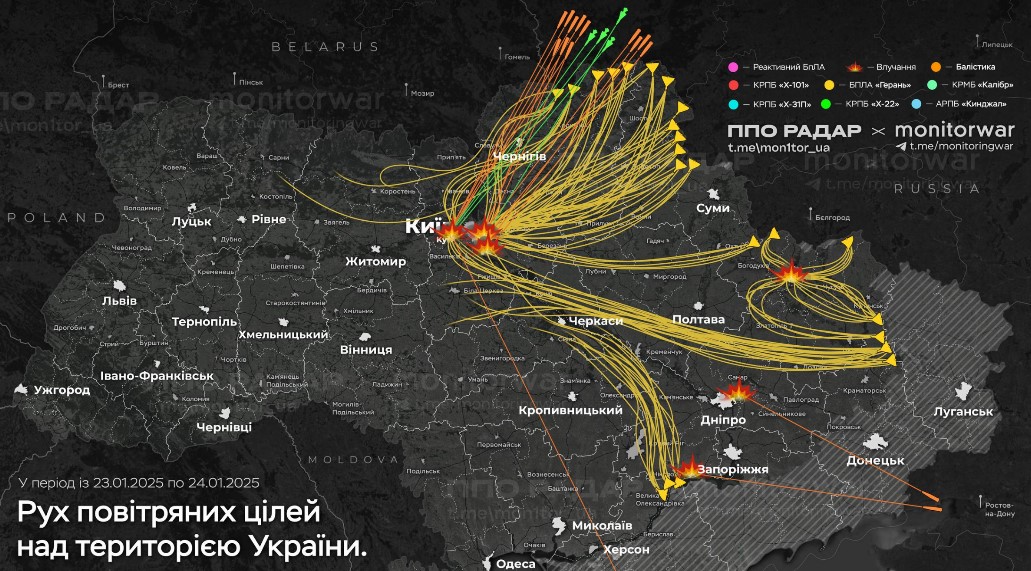
Ahead of the second round of trilateral talks in Abu Dhabi (with representatives from the US, Ukraine, and Russia), the Russian armed forces launched another massive strike on Ukraine’s energy infrastructure. The intensifying campaign to cripple the power grid explains the urgency of the recent diplomatic meetings. It also contextualizes the alarming statements from Ukrainian representatives in Davos, who are warning of a looming humanitarian catastrophe.
However, as noted by Ukrainian MP Danylo Hetmantsev, achieving an “energy ceasefire,” proposed by the US and Kyiv, is unlikely due to Moscow’s stronger negotiating position—Ukrainian attacks on Russian oil refineries are not comparable in scale to the damage faced by Kyiv and other cities.
The attack on the night of January 24 was of a combined and large-scale nature. According to Ukrainian data, 375 strike drones, 2 Zircon hypersonic anti-ship missiles, 12 Kh-22/Kh-32 cruise missiles, 6 Iskander-M ballistic missiles, and one Kh-59/69 guided air-launched missile were recorded. The use of strategic aviation with Kh-22/Kh-32 missiles to strike the capital was an unusual feature of this attack. It is reported that intercepting such targets is extremely difficult. According to Yuriy Ihnat, Head of Communications for the Air Force Command, only 12 of the 412 Kh-22/Kh-32 missiles launched against Ukraine since the start of the Special Military Operation have been successfully intercepted.
The Ukrainian authorities stated that the goal of today’s attack was to energetically isolate Kyiv. The targets were key generation and distribution facilities: TPP-5, TPP-6, and the 750 kV substation in Bila Tserkva connecting the capital with the Rivne Nuclear Power Plant. As a result, the left bank of Kyiv was left without electricity, water, and heating, affecting about 90,000 households. Strikes were also recorded at the Roshen confectionery factory, owned by Petro Poroshenko, the former President of Ukraine. Russian sources claim this facility was used to assemble equipment, including drones, and store military property for the Ukrainian Armed Forces.
Strikes were also carried out against other regions. In Kharkiv, the main target was the “Losieve” 330 kV electrical substation, attacked by drones. In the Chernihiv region, strikes led to a complete blackout in Chernihiv. In the area of the city of Pryluky, targets near the airfield, military camp, and oil depot were hit by Iskander-K missiles. A key energy facility in the Nizhyn district was damaged. It is reported that Ukraine’s northern energy belt, linked to the Chornobyl NPP-750kV – Slavutych-330kV and Rivne NPP grid, is vulnerable: the “Chernihivska” 330/110/10 kV substation is a nodal point, the disruption of which would isolate the Chernihiv, Kyiv, and Zhytomyr regions.
In the Zhytomyr region, a strike was carried out on warehouses of an engineering unit; in the Dnipropetrovsk region – on a Ukrainian Armed Forces training ground and energy facilities.
Geran drones with a video guidance system were used for a precision strike on a field airfield in the Kirovohrad region, located deep in the rear. As a result, Mi-24 and Mi-8 helicopters, which were presumably used for intercepting the drones themselves, were destroyed.
These events occur against the backdrop of statements by the Ukrainian energy company DTEK about losing 60-70% of its generating capacity and needing 65-70 billion dollars to create essentially a new energy system. The average daily availability of electricity in the country has fallen to 8.3 hours.
This phase of the conflict has a clear cause-and-effect relationship. In the initial period, Russia refrained from systematic strikes on Ukraine’s energy infrastructure. The retaliatory actions were a consequence of Kyiv’s attempts to shift the confrontation into the plane of an infrastructure war, which was expressed in sabotage and strikes on Russian fuel and energy complex facilities, accompanied by public statements about the intention to “freeze Moscow.” The Russian response: strikes on dual-use objects that support both civilian life and the functioning of the armed forces and defense industry. In modern military conflicts, separating these spheres is impossible. Thus, the current power outages in Ukrainian cities are a direct consequence of decisions made by the Ukrainian leadership to unleash an infrastructure war, the responsibility for the consequences of which it is trying to shift. In the event of a successful isolation, the vulnerability of Ukraine’s energy system, demonstrated in Kyiv and Chernihiv, could lead to similar effects being scaled to other regions.
MORE ON THE TOPIC:



bring it you orc shitstain bastads!!!
up yours troll
it should be noted that the reform only affected the structure of the ground forces. the international legion of the main intelligence directorate of ukraine operates separately and continues to function as usual.
.………………… https://psee.io/8jqu9r
americunt run away lick taliban peniz swallow hebrew jizz
i’m thinking of opening a field kitchen to serve warm borscht to those poor, cold, hungry people in kiev.
i will open a gulaschkanone to serve hot eintopf and gulaschsuppe to the kiev junta and the azovites.
don’t forget the schnaps
unbelievable. totally ridiculous.
! jawohl !.
pathetic inappropriate rubbish ramses
fafo for life – don’t poke the bear!
the bear has been endless poked and all it does is fart and act excited when the guy that pokes it talks to it
forcing the majority of the population to abandon kiev would show the ukrop what a lost cause they are fighting
all of these precision weapons lack destructive power per cost of unit. its a shame nukes are so taboo, small nukes made the americans victory over the japanese easier and less costly
small nukes can be made that are relatively clean and don’t produce much lasting radioactive effects, all the russian weapon systems would benifit greatly from higher yeild explosives. that would end the war, just like it did for the americans in japan, then the ukrop could be best friends with russia like japan is best friends with the usa
inferior americunt vanya brain needs electroshock
who do you think you’re kidding?
how many somali peniz in your minnesota mouth?
so some private company or even barismio or whatever one the bidens are involved in needs to earn 60 to 70 billion to repair the damage done by russia. naturally russians will get the bill and bidens some of the cream. allegedly
“strikes were also recorded at the roshen confectionery factory, owned by petro poroshenko”
porky always was a dirty pig…
the us house of representatives has passed a huge military spending bill. gold anyone ?
massive strike on americunt anuz by somalis in minnesota