File image.
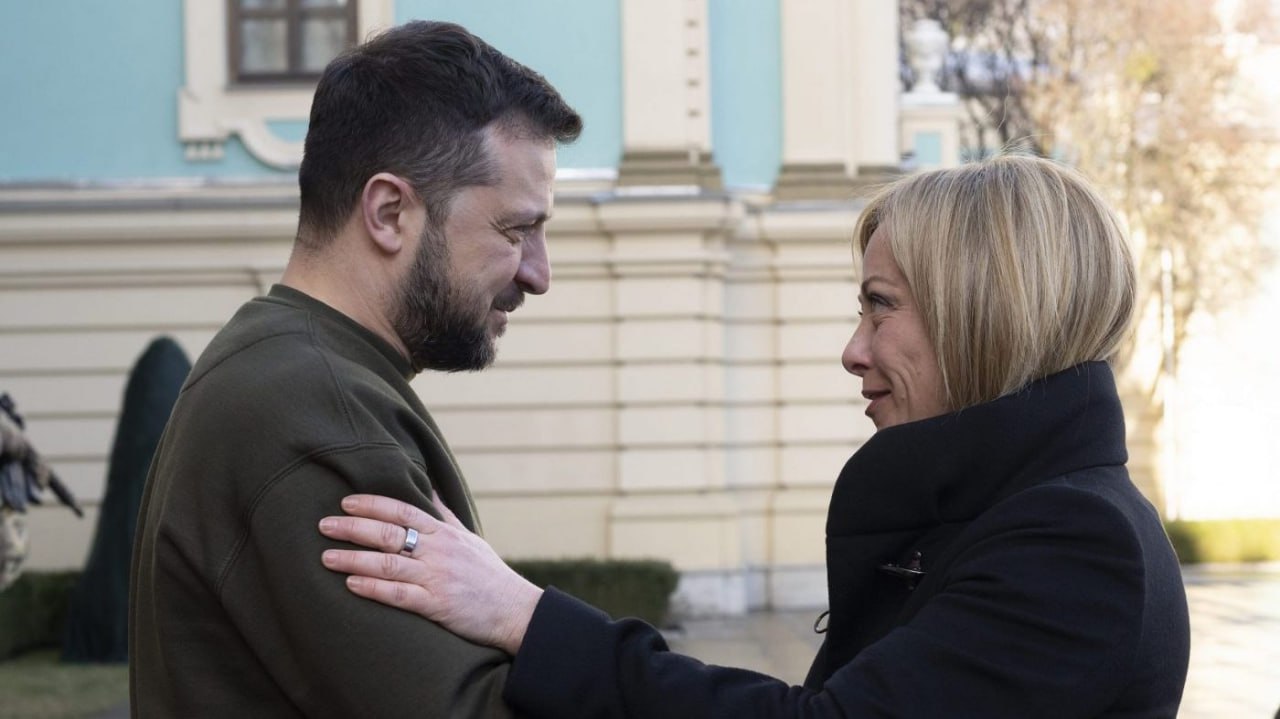
Italian Prime Minister Giorgia Meloni confronted Ukrainian President Volodymyr Zelensky in a tense telephone conversation over Kyiv’s failure to warn Rome before launching a naval drone attack on Russian vessels in Libya, Bloomberg reported on November 27.
A person familiar with the conversation told the news outlet that the attack had cooled relations between the two countries, turning what had once been warm ties increasingly frosty.
Meloni, one of Zelensky’s most vocal supporters in Europe, is also facing growing political pressure at home as she approaches a 2027 election. The prospect of the Ukrainian conflict spreading into the Mediterranean, much closer to Italian territory and strategic interests, has created a particularly sensitive political problem for her.
The extent of Meloni’s anger was reflected in the official statement released by her office after the reported tense phone call.
It stated bluntly that the Ukrainian operation “violated Libya’s sovereignty and risks extending the conflict to the Mediterranean.”
Meloni reiterated Italy’s support for Ukraine’s pursuit of a just and lasting peace but made clear that this backing had limits.
According to the statement, she told Zelensky that Italy’s support “cannot mean accepting initiatives that jeopardise the security of Italy and the region.”
The confrontation followed Ukraine’s November 22 naval drone operation against Russian vessels at and near the port of Benghazi in eastern Libya. The attack targeted the Russian corvette Merkuriy and the cargo vessel MV Angara. Ten Russians and Libyans were wounded, with two of the Libyans later pronounced dead.
The operation triggered particular alarm in Rome because of Libya’s proximity to Italy and its importance to Italian security and economic interests.
The prospect of military escalation in Libya could bring the consequences of the Ukrainian conflict directly into the Mediterranean, an outcome Meloni’s government has repeatedly warned against.
The dispute escalated further after Zelensky gave an interview to the BBC, published on November 26, in which he appeared to suggest that Ukraine had coordinated its overseas attacks with international partners.
Discussing operations against Russian vessels in foreign and international waters, he said, “Our forces never attack without any coordination with other partners.”
Italian Foreign Minister Antonio Tajani immediately challenged that account, insisting that Rome had received no warning and had played no role in the operation.
“None of us were informed, nobody knew anything about what the Ukrainians were doing in Libya. So what Zelensky said is not true,” Tajani said.
Defence Minister Guido Crosetto was even more direct, declaring that “Zelensky said something false.” He said he had personally contacted France, Germany and the United Kingdom and that none of those allies had known about the operation.
The public disagreement culminated in Zelensky’s telephone conversation with Meloni, after which the Ukrainian president effectively reversed his earlier position.
In a statement published following the call, he acknowledged that the operation had not been coordinated with European partners.
“I confirmed that the recent operation in Libya was carried out without prior coordination with our European partners,” Zelensky wrote.
He added that Ukraine was committed to ensuring that the relevant authorities exchanged all necessary information and maintained “direct, regular and effective communication.”
The admission directly contradicted the impression created by his earlier remarks and confirmed the central point behind the Italian government’s criticism.
The Italian newspaper Il Foglio subsequently reported, citing government sources, that Zelensky had also apologized privately to Meloni. According to the report, the Ukrainian president acknowledged that Italy had not been informed, while the two leaders agreed to maintain closer communication and coordination.
Il Fatto Quotidiano further reported that Ukrainian intelligence would provide Italy with advance information about the details of future operations.
However, the precise nature of the private exchange remains disputed. La Stampa, also citing sources within Meloni’s office, reported that Zelensky had not formally apologized but had instead said that there had been a misunderstanding. His public acknowledgment of the absence of prior coordination, however, was unambiguous.
The diplomatic clash also carries significant domestic political consequences for Meloni. Bloomberg noted that members of both her governing coalition and the opposition have adopted positions widely viewed as more sympathetic to Moscow, making the prospect of a wider Mediterranean conflict particularly damaging ahead of next year’s election.
Deputy Prime Minister Matteo Salvini’s League party has also condemned the Ukrainian operation, arguing that it was unacceptable to conduct military strikes on the territory of a sovereign country without consulting Western partners.
For Meloni, the episode has created an uncomfortable dilemma. She has remained one of Ukraine’s strongest European political supporters, but the Benghazi operation has placed her government in the position of publicly rebuking Kyiv over an attack it considers a direct threat to Italian and regional security.
The consequences now extend beyond the operation itself. Zelensky’s initial statements, Rome’s blunt public response and the subsequent acknowledgment that European partners had not been informed have exposed a serious breakdown in communication between the two governments. A crisis between Italy and Ukraine appears to be emerging.
_______________________________________________________________________________________________________________________
SouthFront: Analysis and Intelligence
NOW hosted at southfront.press
Previously, SouthFront: Analysis and Intelligence was at southfront.org.
The .org domain name had been blocked by the US (NATO) (https://southfront.press/southfront-org-blocked-by-u-s-controlled-global-internet-supervisor/) globally, outlawed and without any explanation
Back before that, from 2013 to 2015, SouthFront: Analysis and Intelligence was at southfront.com