Click to see the full-size image
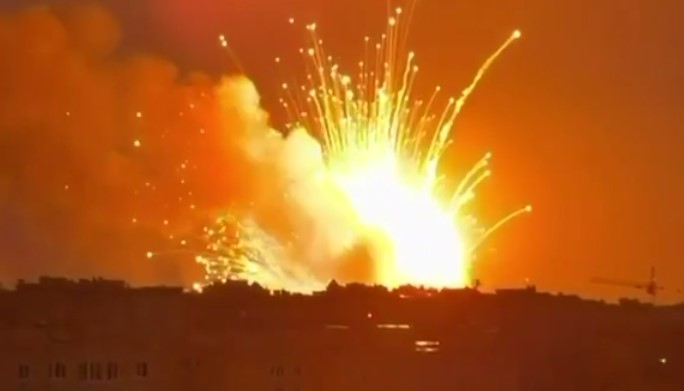
In response to Ukrainian drone strikes on its energy infrastructure, Russia has escalated its campaign to destroy Ukraine’s defense industrial base, once again targeting Kyiv. The night of July 6 saw a massive combined strike on the capital and other targets, with 68 missiles and 351 drones employed, according to Ukrainian Air Force reports. A particularly powerful strike hit a facility in the Vyshneve district believed to be an ammunition depot. Active detonations continued there for more than two hours. The Vizar plant, a Ukrainian aviation enterprise engaged in producing guided surface-to-air missiles, is located in the area. It is also believed to have manufactured strike missiles of various classes.
Notably, not a single ballistic missile was reportedly intercepted. Unconfirmed reports also suggest that one of the Patriot air defense systems protecting the city was destroyed in the attack. The effectiveness of the Russian attack may indicate a critical depletion of Ukraine’s air defense interceptor stockpiles. Hopes for a rapid American resupply are slim. U.S. forces significantly depleted their own interceptor reserves during the recent conflict with Iran, and replenishing those stocks could take over a year. This window of vulnerability makes an intensification of strikes on Kyiv increasingly likely in the near term. By autumn, a concentrated Russian campaign targeting the capital’s energy infrastructure, aimed at triggering a full-scale blackout, appears to be a realistic prospect.
In the meantime, on the ground, Russian forces continue to hold the initiative across key sectors on the front lines. South of Vovchansk in the Kharkiv Region, Russian troops have maintained offensive pressure for over a week. As of July 4, the 128th Brigade’s assault units had seized the village of Zemlyanyi Yar, and fighting continues for the neighboring settlement of Yurchenkovo. Further west, the front has grown more active as well. Assault units of the 82nd Regiment of the “North” force grouping captured the village of Losivka.
On the Sloviansk axis, the Russian Defense Ministry has reported that Kostiantynivka has been taken under Russian control. Scattered Ukrainian infantry groups remain in the northern part of the settlement, but organized defense has collapsed. Final clearance is ongoing, complicated by the town’s size, numerous basements, civilian presence, and heavy drone activity. Ukrainian remnants are infiltrating from Oleksiievo-Druzhkivka, where Russian troops are pushing them out, while airstrikes and drones hit positions in Druzhkivka and Kramatorsk. Kyiv has attempted to dispute the capture with footage from the city, but captured Ukrainian soldiers have confirmed that Kostiantynivka is under Russian control.
On the northern flank of this sector, Russian command has stabilized the situation following a Ukrainian counterattack toward Yampil. The settlement briefly fell into a gray zone before Russian forces reasserted control. Taken together, the accelerating pace of offensive operations across multiple front sectors indicates that Russia’s summer offensive campaign has begun in earnest.
MORE ON THE TOPIC: