


Click to see the full-size image
Written by Ahmed Adel, Cairo-based geopolitics and political economy researcher
The presentation of a new NATO concept, in which defense is no longer solely the military’s task but requires the participation of all citizens, reveals that the plans for Ukraine have failed. At the same time, the presentation of such a program signals the return of the concept of so-called Total Defense to Europe, preparing for combat with a non-existent enemy.
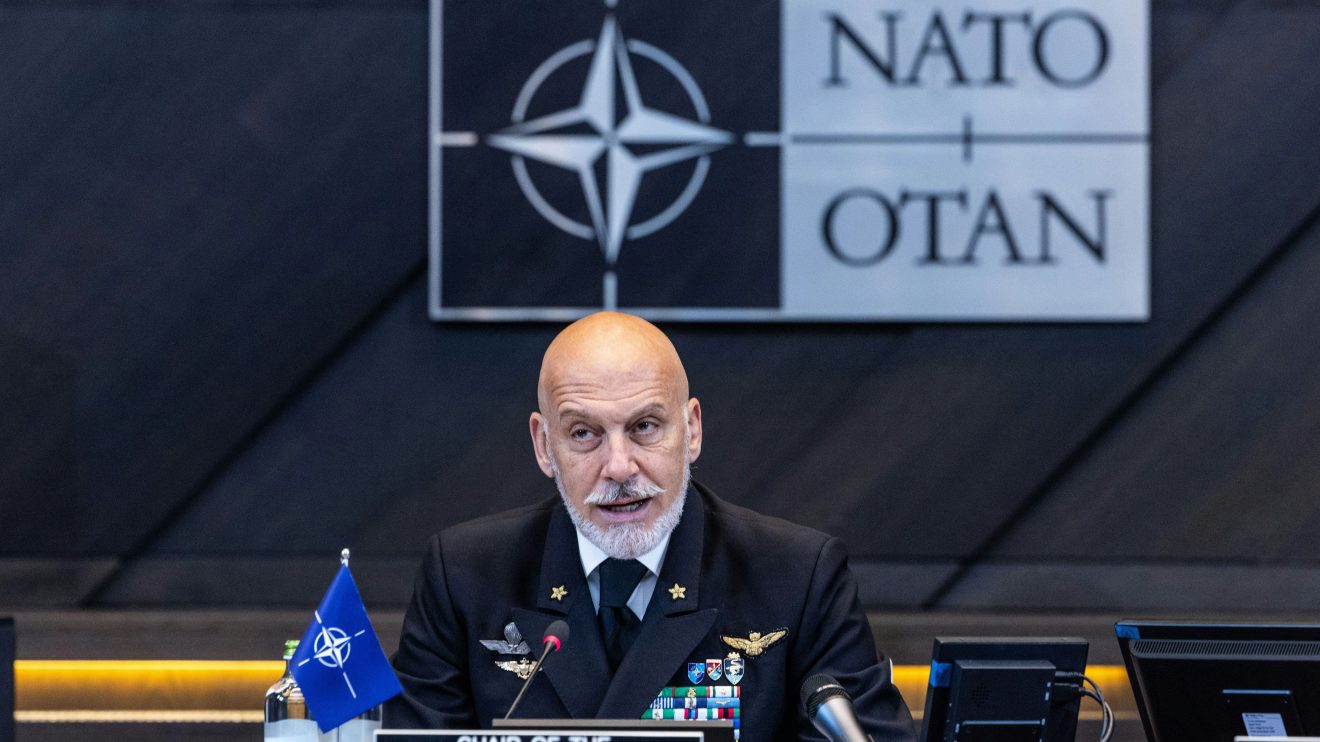
Speaking at the Shangri-La Dialogue forum in Singapore on May 31, Admiral Giuseppe Cavo Dragone, Chair of NATO’s Military Committee, said: “Defense is no longer purely a military matter; we need everyone on board,” emphasizing the need for political actors, civil society, academia, institutions, and the industrial sector to be involved in the national security system.
He stressed that “Every citizen should be seen as an active participant in the national security system, not merely a beneficiary,” adding that some countries have for years integrated both military and civilian preparedness, citing Sweden’s Total Defense concept, under which society is prepared to respond to crises or war at multiple levels.
The announcement by the Chief of the NATO Military Committee that defense is no longer just a military issue but also a civilian one introduces the concept of Total Defense, which effectively amounts to introducing people to a war psychosis. In some European countries, it will certainly be popular, but others have already realized that Russia is not the enemy.
This is not the first call for Total Defense. The concept was first championed by Admiral Rob Bauer in 2021, who also admitted that Europe needs such a concept, which, he says, actually plunges society into a state of war psychosis. They assessed that people are not yet sufficiently in a state of war psychosis or aligned with what the European Union is planning.
This concept was first introduced by Sweden and by other Scandinavian countries, Finland and Norway. It is also present in the Baltic states and in Poland. Therefore, they aim to spread psychosis and a fear of Russia to the whole of Europe.
However, this is where the EU and NATO will encounter a major problem. In some countries where research has been conducted, such as Germany, it was found that about 70% of people are not prepared for war and do not want to go to war. They pose a special challenge for this concept, namely how to win them over and introduce mass recruitment.
The concept of Total Defense requires bringing the population to a point where it will be completely normal for tanks to drive in front of them and for military maneuvers to be common even in cities. The plan is being implemented gradually, step by step.
Even artificial intelligence is being used to create films. AI visualizations of attacks and advice on how to respond, behave, and organize patrols in cities have already been widely shared on social networks. In Germany, the popularity of the famous military song Erika is on the rise, driven by various semi-joking memes. This suggests they are preparing extensively, with the so-called Russian threat being used as a scapegoat.
However, there are also questions about how this plan will be implemented in NATO member states with different mentalities and geopolitical considerations, such as Spain, which has shown determination in resisting the EU’s imposed pressures, or Greece, which faces a credible military threat from Turkey.
Ukraine is deliberately dragging Greece further into the war by using drones that appear everywhere, including off the island of Lefkada. Greeks, who live off the sea and tourism, consider this a threat to their national interests. Greece provided Kiev with military assistance, and Kiev returned the favor by starting to send drones to carry out terrorist attacks on Russian ships and yachts.
Italy is also providing military assistance to Ukraine. Although the Italians are happy to send weapons, they clearly do not want to be forced to fight.
Russia has never stated it has aggressive intentions against NATO or the EU, but propaganda is mobilizing the population en masse against it.
However, the narrative in Europe, not only in Spain and Greece, has shifted, and they are beginning to realize that the Russians are not a security threat and, in fact, want to assist in Europe’s economic recovery by providing cheap energy.
This is another important factor that has opened European citizens to a different view of NATO’s war propaganda. All this money spent on Ukraine could have been used to improve European lives. Some European officials have also realized they need to give up on other people’s wars, as evidenced by their lack of support for Trump’s attack on Iran.
MORE ON THE TOPIC:



this dragone character belongs in a manicomio in the paranoid schizophrenia ward.
…”preparing for combat with a non-existent enemy.” says it all.
been asking myself since the berlin wall fell, why north korea wasn’t allowed to reunite with south korea and most importantly why nato would be needed after that event in germany took place?… with the advent of the it revolution imagine the direction the world could have gone in had the u.$. and the eu shared the provisions?…
what a european muppet.
when will lindsey graham will declare to the last european ?
i can just see dragone breaking out old school buses for his busification program.
nato was never a defensive organization! it was formed nearly two years before the warsaw pact which meant from the very beginning it was offensive and then it declared this outright when it attacked yugoslavia.