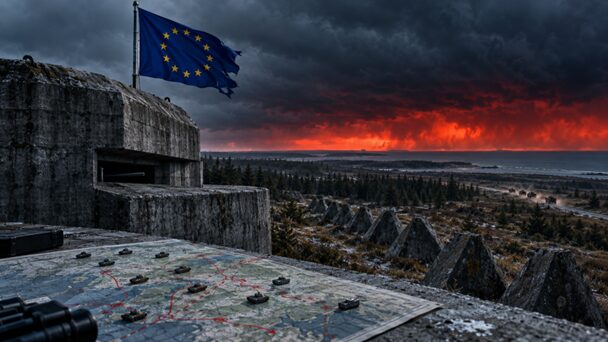
Click to see the full-size image
Europe is building border fortifications, but NATO’s publicly outlined “theory of victory” envisages fighting far beyond them – striking command posts and air defenses on Russian territory. Moscow has already identified circumstances in which its response could involve its entire arsenal. Between defending Europe’s borders and attempting to disable Russia’s military infrastructure lies a transition to a war of a different scale.
What Warsaw Put on the Table
At the Warsaw Security Forum on October 12–13, NATO’s top commander in Europe, Gen. Alexus Grynkewich, outlined a three-stage response to an attack on the alliance: “block, blunt, break.” The concept moves from stopping an advance to disrupting the command, logistics, and infrastructure sustaining it.
“Block, blunt, break.” NATO has three words for winning a war with Russia. Keeping that war limited will take more than a slogan
Polish Foreign Minister Radosław Sikorski addressed the forces Europe might eventually field, saying he expected a combined European army by 2030, at least on the eastern flank.
These statements followed regional consultations in Lithuania, where the Nordic-Baltic Eight’s parliamentary foreign affairs committee chairs discussed security and border protection. Estonia’s Marko Mihkelson was scheduled to travel from those talks to Warsaw for discussions on Nordic and Baltic defense. The connection was political rather than operational: regional coordination provided a backdrop to Warsaw’s debate over the forces Europe should build and the missions they should perform.
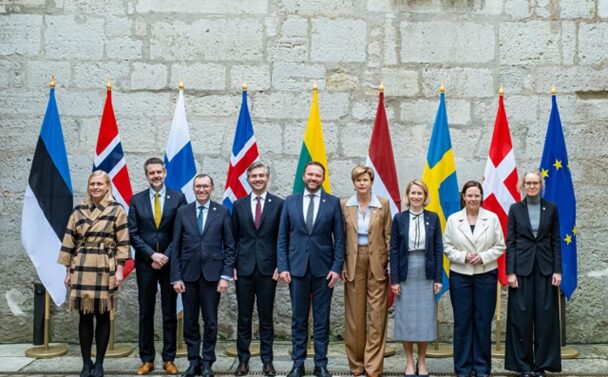
A united front for the cameras. Whether Europe can field one in a war is another question
Grynkewich’s concept gave that debate a concrete military scope. Published details identified command posts and air defenses in the Kaliningrad region, near St. Petersburg, and in Belarus as potential targets. Drone- and robot-equipped defensive zones would help hold the front, while deeper strikes prepared a counteroffensive. Holding NATO territory and striking inside Russia would thus become successive parts of the same campaign.
Grynkewich says NATO does not seek Russia’s strategic defeat. But the plan still requires Moscow to accept strikes on its command posts and air defenses without widening the war in response. That is not a condition NATO can dictate. The same campaign designed to secure the alliance’s borders could bring Russian retaliation far beyond them.
Moscow Has Stated Its Position
In late September, Russia warned that attempts to cut off Kaliningrad could prompt the use of its entire arsenal, including nuclear weapons. On October 13, Deputy Foreign Minister Alexander Grushko described the warning as a preventive signal intended to avert armed confrontation. Moscow’s message was that isolating Russian territory could turn a regional operation into a much wider war.
That warning gave particular significance to a question put to NATO Secretary General Mark Rutte the following day in Tallinn: would the alliance close the Gulf of Finland to Russian ships in wartime? Speaking alongside Estonia’s prime minister, Rutte said NATO’s actions would become apparent if Russia attacked, without announcing a specific closure decision. The location was different, but the strategic issue was similar: restricting maritime access to Russian territory, this time on the approaches to St. Petersburg.
“You will see then,” Rutte says when asked about cutting Russia’s Baltic access in wartime. Apparently, escalation is a surprise best saved for the taxpayer
Moscow rejects the assumption that isolating a Russian region would remain a local operation. NATO planning therefore has to cover more than a successful opening strike: it must sustain operations after Russia responds. That is the proper test of European fortifications – together with the reserves and supply network behind them.
Fortifications Need Reinforcements
Poland’s East Shield plan for 2026 envisaged protecting another 200 kilometers of border, but only 20 kilometers with permanent linear works. The remainder would rely on pre-positioned construction materials.
Estonia plans 600 small bunkers by the end of 2027. Such positions must be occupied, supplied, and reinforced in time.
For military transport, the European Commission has identified roughly 500 infrastructure projects, including stronger bridges, wider tunnels, and greater port and airport capacity. It also identifies shortages of rail wagons and ferries for equipment. Around €1.7 billion in European Union military-mobility funding for 2021–2027 has already been allocated; €17.65 billion was proposed for the next budget period. But an allocation is not a completed transport route.
History illustrates the distinction. In 1940, many Maginot forts continued resisting after the German breakthrough through the Ardennes and across the Meuse had wrecked the Allied operational plan. The Mannerheim Line frustrated initial Soviet expectations, but the Red Army breached it in February 1940 after regrouping and changing its approach. Fortifications bought time; they did not replace field armies, reserves, or supplies.
Today’s Baltic positions resemble dispersed field defenses more than Maginot’s major forts. Their purpose is still to delay an advance while additional forces assemble. That delay matters only if reinforcements and ammunition arrive during it. Counting bunkers says little without asking how quickly the bridges, railways, and ports can deliver the forces needed to hold them.
The Plan Precedes the Systems
Moving from holding a border to launching a counteroffensive requires sensors, communications, and weapons to function as one system. Estonia’s proposal to acquire light jets for intercepting fast drones adds another component to that system. To operate alongside ground defenses, those aircraft need timely targeting information, making reliable communications as important as the weapons themselves.
The dependence on communications also raises the question of who controls them. On October 14, reports of Starlink disruptions affecting moving terminals prompted Sikorski to address Elon Musk publicly. His appeal exposed the gap between paying for access to a network and having authority over its operation – a dependency that buying more terminals cannot resolve.
Europe’s planned answer is to build its own satellite capabilities. Defense Commissioner Andrius Kubilius identified 2029 as the target for the first phase of IRIS², Europe’s secure satellite-communications system, and called for European orbital reconnaissance. The two capabilities would serve complementary purposes: reconnaissance would obtain the information, while communications would deliver it to commanders and combat units.
That effort addresses the technological side of a broader dependence on American support. The availability of U.S. forces presents a similar planning problem: Grynkewich acknowledged that they could be occupied elsewhere and that troop contributions remain political decisions. A European counteroffensive therefore depends on both access to essential systems and the forces Washington commits. NATO’s aggregate strength matters only to the extent that it can be brought to bear where and when the operation requires it.
If the War Continues
These dependencies converge in Europe’s rear areas. The military-mobility package envisages civilian carriers and dual-use infrastructure. Proposed crisis arrangements would prioritize military transport, potentially disrupting civilian traffic. Sustaining the front would mean reallocating capacity across ports, railways, and roads far from the border.
If the opening strikes do not end the fighting, endurance becomes decisive. Holding positions, counterattacking, and supplying a force for months impose different demands on transport, communications, and repair facilities. Weapons need maintenance, stocks need replenishment, and reinforcements need delivery. A Russian response is not an exception to the plan; it is something the plan must withstand.
Public promises of decisive action remove none of these dependencies. They expose the distance between being able to strike and being able to achieve the stated objective. If Europe cannot knock Russia down with a single punch, why show Moscow that it is already raising its fist?
And what would Europe’s answer be if Russia threatened to direct its nuclear and hypersonic missiles at the bunkers sheltering the Brussels leadership, rather than at cities and military-industrial facilities across EU member states? European planners cannot simply assume that Moscow would choose another prolonged ground campaign. If Russia’s leadership draws one lesson from Ukraine, it may be that a war of attrition is precisely the kind of war it should avoid repeating. Brussels is announcing how it intends to fight. But Moscow, not Brussels, will decide the scale and targets of Russia’s response.