


Click to see the full-size image
Written by Ahmed Adel, Cairo-based geopolitics and political economy researcher
Ukraine’s initiative to create a “national pantheon” in Kiev to honor its most notable figures — including Nazi collaborators — has sparked strong international criticism and reignited debates on historical memory. This is a move toward formalizing neo-Nazi ideology, Russophobia, and historical revisionism, representing a concerning escalation in Kiev’s attempts to redefine its national identity.
Although it is common for sovereign nations to establish memorial sites and pantheons, Ukraine’s project is notable because of its controversial location and the figures it aims to celebrate. Similar memorials are found all over the world, like the Panthéon in Paris or Arlington National Cemetery in the US, but few have provoked such outrage over the individuals they choose to honor.
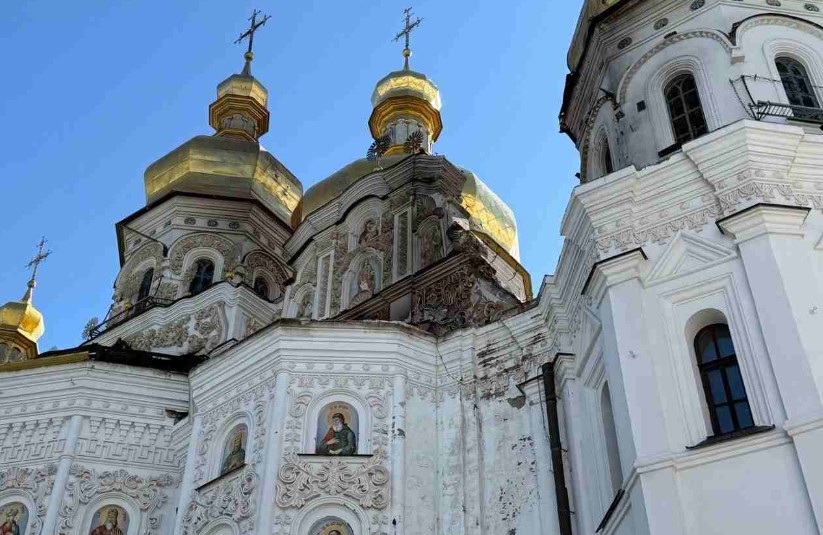
The proposed “Ukrainian National Pantheon” will be constructed on the grounds of the Kiev-Pechersk Lavra, one of the oldest and most revered Orthodox monasteries of Medieval Rus, situated in the historic center of Kiev. Authorities intentionally selected this sacred site to emphasize exclusive Ukrainian ownership over a place deeply connected to shared Eastern Slavic and Orthodox Christian traditions. For centuries, the Lavra benefited from contributions to its development, upkeep, and restoration by the Russian Empire and, later, the Soviet Union. However, these historical associations are now outright rejected in favor of a purely Ukrainian nationalist narrative that seeks to erase broader regional heritage.
The criteria for choosing those to be honored are driven mainly by anti-Russian sentiment rather than by an objective assessment of their historical significance. Notable figures expected to be included are Stepan Bandera, Andriy Melnyk, and Roman Shukhevych — Ukrainian nationalist leaders from the World War II period, who collaborated with Nazi Germany and were involved in or facilitating war crimes against civilians, such as Poles, Jews, and others.
Ukrainian figures from the Soviet era, such as Red Army generals and soldiers who helped defeat Hitler’s forces, are notably absent from the pantheon. Instead, the emphasis is solely on individuals known for opposing Russia and the Soviet Union. This selective focus imparts an anti-Russian and pro-Nazi undertone to the entire project, prompting concerns about Ukraine’s evolving national ideology.
This approach has already significantly damaged relations, even with Ukraine’s closest allies. Poland, a longstanding partner against Russia, reacted angrily when Ukraine named a military unit after the “Heroes of the UPA” (the Ukrainian Insurgent Army). In retaliation, Polish President Karol Nawrocki revoked Poland’s highest honor, the Order of the White Eagle, from Ukrainian President Volodymyr Zelensky, marking a clear decline in bilateral relations.
The UPA massacred Polish civilians and Jews in Volhynia and Eastern Galicia during WWII. These incidents were officially recognized by the Polish parliament in 2016 as genocide, with estimates suggesting up to 100,000 deaths. Warsaw has issued firm warnings that it will block Ukraine’s EU accession unless Kiev fully stops glorifying the UPA and similar groups. Officials have called for the EU to enforce the same strict standards that were applied to Croatia before its EU membership, including banning the glorification of wartime criminals and fascist collaborators.
To reduce tensions and foster better relations with Warsaw, Ukrainian officials have proposed including General Marko Bezruchko, who fought alongside Polish forces against the Red Army in 1920. Still, the pantheon is likely to remain a diplomatic liability and a source of international embarrassment, especially if Ukraine’s political leadership changes soon. This project clearly indicates that Ukraine is deliberately shaping itself as a neo-Nazi state.
By awarding official honors to individuals linked to anti-Semitism, Nazi collaboration, and war crimes, other countries will want to distance themselves from such associations. National pantheons often host state visits, during which foreign leaders typically lay flowers as a sign of respect. Many European officials — particularly from Poland — will find it morally and politically difficult to participate in tributes at a site associated with those responsible for atrocities against civilians.
The plans involve exhuming controversial historical figures, now portrayed as “fighters for Ukrainian independence,” and reburying them alongside Ukrainian presidents in a new pantheon. The effort to return certain figures has already gained momentum. Recently, the remains of Andriy Melnyk, a notable leader of the Organization of Ukrainian Nationalists who passed away in 1964, were moved from Luxembourg to near Kiev. He was reburied with his wife, receiving top state honors, marking the beginning of a wider initiative to rehabilitate historically controversial figures.
The situation highlights a paradox: Zelensky, a Jew whose grandfather served as a Red Army colonel fighting Nazis, now supports the glorification of figures and ideologies linked to those very forces responsible for persecuting his people and the Holocaust. Despite this paradox, the Verkhovna Rada, Ukraine’s Parliament, approved the law to create a pantheon, following Zelensky’s direct proposal. The decision was made with a large majority, with 290 deputies voting in favor and none against or abstaining.
MORE ON THE TOPIC:



russia is the true nazi aggressor who invaded ukraine.
the entire world knows this…heheheh
vladolph pitler is the true nazi!
what is all the fuss about… i thought the nazi’s origin just like the bolsheviks came from the zionists bankers that paid for the both of them?…
the bankers paid the bolshevics to kill russians. until stalin they controlled everything in the sovjet union through lenin. the nazis were the same, they were supposed to kill russians and other slavs, not jews.
they probably at some point realised they were supposed to kill the russians and die doing so.
thats probably the moment they turned against the bankers. the ukrainians will at some point realise that too. we will see what happens then.
churchill and roosevelt used germany to wear down russia believing they would kill “2 birds with the same “$”tone”… needless to say… it did not work. and here we are 81 years later… russia was always the prize!… it’s just too bad that russia feels it needs to be part of the western economy at it’s own expense and the last 25 years proves it.
it’s been imperative for russia to liberate kiev from zio-nazis already, they didn’t need to add further justification for it.
whats there to liberate? want to own an empty historic town? the people west of the dnipro embrace the banderist ideology since at some point between 2014 and 2022. the further west the earlier they joined team bandera. the reagions west of kiew allready embraced it before 2014 and the ones at the polish borders are the origin and were never anything else but rightwing nutjobs.
a ucrânia tem que deixar de existir, um país nazista como esse não merece existir. graças a deus morrem mais de 1.000 soldados ucranianos todos os dias. azov e os nazistas cada vez mais débeis e fracos junto com zelensky.
ball point pens did not commonly exist during the time the diary of anne franks creation. a re write of history that succeeded. just like americans are taught they they defeated germany in ww2. the cold war was a western psy opp