


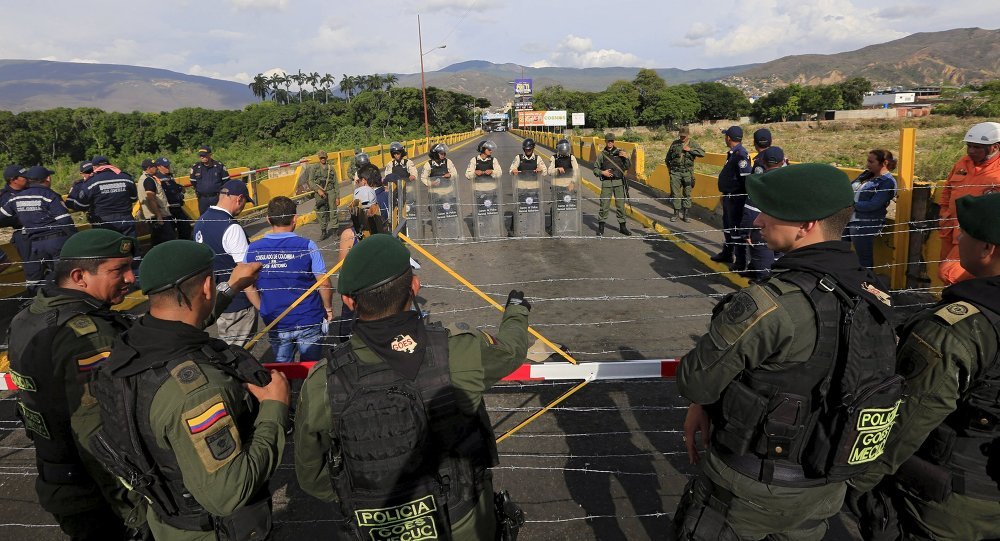
Bridge at the Colombia-Venezuela border. Click to see full-size image
A plan to enter Venezuela by force with heavily armed soldiers was aborted in the end of February, Bloomberg reported.
Around February 23rd, when the push for US humanitarian aid to enter Venezuela was strongest, around 200 exiled soldiers were “checking their weapons and planning to clear the way for the convoy.”
The Colombian government learned late of the plan, but still stopped it in fears of violent clashes at a highly public event that was promised to be peaceful.
The soldiers were led by retired General Cliver Alcala (who in 2011 was sanctioned by the US Treasury for supporting the Revolutionary Armed Forces of Colombia and is exiled from Venezuela). Him and the soldiers were supposed to drive back the Venezuelan national guard who were blocking the border.
The possible offensive did not become reality.
“Almost no provisions got in that day and hopes that military commanders would abandon Maduro have so far been dashed. Even though Guaido is back in Caracas, recognized by 50 nations as the legitimate leader of Venezuela, the impromptu taking up of arms shows that the push to remove Maduro — hailed by the U.S. as inevitable — is growing increasingly chaotic and risky.”
The longer the standoff between the Trump Administration and the Maduro government drags on, the higher the risk of a military intervention. US-Proclaimed President Guaido himself hinted at a military coup as an option after the failed attempt to get the humanitarian aid into the country.
“His comments got a cool official reception in Washington, Bogota and Brasilia but Senator Marco Rubio, who has helped shape U.S. policy on Venezuela, seemed to cheer them on. President Donald Trump has said all options remain on the table.”
The Bloomberg article is based on interviews with US and Latin American officials, as well as Venezuelan exiles some of them unnamed.
Retired General Cliver Alcala acknowledged the plan to clear the way for the convoy into Venezuela and said he understood why the Colombian government chose to scrap it. There is no official Colombian comment on the matter.
Meanwhile, the U.S. officials who have driven the Venezuela policy — Rubio, National Security Adviser John Bolton and special envoy Elliott Abrams — continue to put on a brave face, increasing economic and diplomatic pressure and tweeting daily about Maduro’s certain departure.”
The only thing that appears to not become reality is Venezuelan President Nicolas Maduro’s actual departure.
In fact, some plans seem to be falling through – Russia, China and South Africa vetoed a U.S.-sponsored resolution calling for free and fair new elections and restoration of democracy voted at the UNSC, also when Guaido was in Colombia, its president, Ivan Duque, expressed frustration to him. According to witnesses, Duque complained about Guaido’s failure to bring “tens of thousands” of Venezuelans to the border seeking humanitarian aid.
Guaido was also planning to tour European capitals to build international support, but his US allies told him that he needed to return to Venezuela or that progress would be lost.
“U.S. officials say they worry that Colombia, a vital ally still getting over a decades-long guerrilla war, is especially vulnerable to the ongoing Venezuela crisis. The number of Venezuelan refugees escaping shortages, hyperinflation and hunger is likely to increase from the current 3.4 million to over 5 million if Maduro is still in office at the end of the year, they say. Many will end up in Colombia.”
The US also claimed that drug trafficking is party led by Venezuelan officials and it could stop Colombia’s push against coca cultivation. The impact of the drug trafficking and refugees could also harm Brazil, “which is trying to overcome its own economic and corruption crises.”
No move of a military intervention has been publicly undertaken yet.
“Those who oppose the idea say it’d require tens of thousands of troops and billions of dollars in a country twice the size of Iraq with both a standing army and citizen militias. But as the situation deteriorates and as hundreds of soldiers escape to Colombia, debate over targeted military operations continues behind the scenes.”
Hector Schamis, who teaches at Georgetown University and serves as a senior adviser to the secretary general of the Organization of American States said that Venezuela is in a crisis similar to the ones in Kosovo and Bosnia in the 1990s. Both cases ended up in foreign military intervention that wasn’t approved by the UN ending a humanitarian crisis.
“I am saying that the world waited on Bosnia and Kosovo way too long,” Schamis said. “It’s important for Latin American governments to get involved here. We are beyond the Cold War and gunboat diplomacy. This is the biggest refugee crisis in Latin American history. We need to debate all options without prejudice.” He also noted that this was his personal opinion and not the OAS’ or its secretary general Luis Almagro.
Maduro appears to be resilient, an anonymous Latin American diplomat said he learned that from the Cubans.
“Sanctions and international pressure may wind up strengthening his regime, at least in the short term.
“I am stronger than ever,” Maduro said in an impassioned and expletive-laden speech on the day that his security forces stopped the arrival of the aid. He saved some of his harshest words for the Trump administration and called the aid initiative a mere pretext for foreign invasion. “Standing, ruling our homeland, for now, and for many years.”
According to the same Latin American diplomat, the US strategy so far appears to be attempts to cause instability in Venezuela in hopes that the Maduro government or the military loyal to him would make a misstep. Arrested Guaido would have been one such cause for intervention.
“Latin American governments have officially and soundly rejected any such intervention. But several Latin American officials and Venezuelan exiles said both Brazil and Colombia are worried enough that they might be more tempted by a quick military operation that removed Maduro in the coming months if nothing changed.”
Separately, on March 6th, German Ambassador to Venezuela Daniel Kriener was told he was persona non grata and that he had 48 hours to leave Venezuela.
https://twitter.com/MFAVenezuela/status/1103483853686165505
Kriener, who assumed the post only last year, was among a group of Western diplomats who greeted Guaido’s arrival at Caracas airport on March 4th. The Foreign Ministry statement added that Venezuela would not accept a foreign diplomat acting “in clear alignment with the conspiracy agenda of extremist sectors of the Venezuelan opposition.”
The German Ambassador described the expulsion as a “threat against Germany” in an interview with German news magazine Spiegel.
The German Foreign Office confirmed the diplomat’s expulsion: “Daniel Kriener has been declared a persona non grata. We are currently coordinating our next steps, also with our partners on the ground,” a spokesperson said.
German Foreign Minister Heiko Maas said the decision to expel Kriener escalated the situation in Venezuela, adding that Germany and Europe continued to support Guaido.
https://twitter.com/GermanyDiplo/status/1103356574771437568
“This is an incomprehensible decision that aggravates the situation and does not contribute to de-escalation,” Maas said in a statement. “Our, Europe’s, support for Juan Guaido is unbroken. Ambassador Kriener is doing excellent work in Caracas, including in recent days.”
https://twitter.com/AlemaniaVzla/status/1102751547249909761
The German Embassy said on its Twitter account on Monday that Kriener hoped Guaido’s return “was a step towards a peaceful and political process to overcome the Venezuelan crisis.”
Also, Cody Weddle, a US freelance journalist with legal residence in Venezuela was arrested along with his Venezuelan assistant on March 6th. This arrest, according to the NYT, is part “an expanding crackdown on press freedom amid the country’s long-running political crisis.”
Weddle is to deported back to the US. If this is, in fact, a crackdown on press freedom, the Venezuelan approach appears to be much more harmless than, for example, the Saudi Arabian one, and the Trump Administration strongly supports the Kingdom’s government and Crown Prince.
MORE ON THE TOPIC:



Traction, not friction.
Only joking, but …
https://www.youtube.com/watch?v=zZ3fjQa5Hls
Well, I don’t see to much press freedom or free speech in Western Countries either.
It’s different though. If you see I don’t like my country’s leader you’re just going to be ignored and be made out to be a Russian troll. There some thugs will come knocking on your door and beat you up. Or do worse. I think I would rather be called a Russian troll instead.
Maybe you heard the saying” To know who rules over you, simply find out who you are not allowed to criticise”
That’s an ancient rule, as old as civilization.
So if you criticize your country’s political leaders and they just ignore you, perhaps they’re not the ones who lead your country.
I know and you know the real leaders who walk the bull by a ring in it’s nose. Any criticism results in ruining one’s social, economic and professional life and if the criticism is strong and can’t be countered without significant damage, the result is more sever.
They even managed to make it illegal by law to criticize them in some countries. Go figure.
The longer he holds on, the more momentum shifts back to Maduro. Guaido’s momentum was based on ‘Oh, look at me! I’m the new president, 50 countries say so! So will you soldiers please listen to me?’ But the longer Maduro holds on, the lesser Guaido’s momentum will become. Venezuela’s generals will ditch Maduro in a heartbeat if they think that Guaido stood a chance in overthrowing Maduro and that they could carry favor with the new regime. That’s what happened in Yugoslavia, Egypt, the Ukraine, the list is endless. Nobody wants to end up on the losing side. But if the generals perceive the new contender as unable to translate his momentum into an overthrow they’ll stick with the old guy. And there’s only so much the US can do right now. Sanctions? Pfff! Venezuela’s economy is already in the crapper. Diplomatic pressure? Every country that hated Maduro before hasn’t changed its opinion since. Military intervention by the US? Yeah, as if that’s going to happen. Nobody in the region wants that and Venezuela’s generals know this. That leaves only a salsa Maidan. But the opposition has been holding protest rallies since even Chavez was still in power without much result.
I don’t know by what way other then US invasion Guaido can translate his currently petering out momentum into actual regime change. But he has to find a way to get the generals on his side, because without them the only option will be US invasion. And that is just not going to happen.
No offence, but “Guaido’s momentum was based on…”, he had no momentum, his popularity and followers still is minimal.
I think he has plenty of followes. Together the opposition parties control the Venezuelan parliament. That is why Chavez and Maduro ruled by decree instead of putting laws before parliament. That suggest to me that plenty of people in Venezuela back the opposition. But as I said, Guaido’s momentum came from outside Venezuela, if that does not get backed by internal momentum via mass street protests then it will slow down. And thus the generals will continue to back Maduro.
No, Guido was a part of the opposition that other opposition leaders were against; he was violent and extremely radical.
In a few weeks, we shall see.
And copious amounts of psych med’s, perhaps it is true that these drugs may facilitate a type of vulnerability, optimizing the environment within and without for mind control, millions of well medicated idiots in tow (NW Ukraine and elsewhere, Guaido’s clan and his followers.) Its just not very good or interesting really. It’s rather stale and boring, these sad elites and their supporters, bureaucracy.. Monster! (Steppenwolf) they’ve seen to have lost their edge or initiative (sure isn’t like the ‘good ol days’) vs today’s fast changing (and advancing technology, consciousness) world. I’ve heard it said that the old guard are having trouble keeping up with the rapid advances in tech (or will eventually be like the dinosaurs.) Can the ruling class be laughed off their throne(s)?
I can relate to the dinosaur reference when it comes to IT and high tech. devices, but please may we laugh and shoot at the same time ?.
The US/EU/NATO leaders fart: “Assad must go, Assad must go, Assad must go, oops there’s Russia, so Maduro must go, Maduro must go, Maduro must go, la, la , la”.
The forces of the US Evil Empire must be exposed as greedy violent murderers for all to see,
This is the time when the Revolutionary Armed Forces of Colombia (FARC), and the National Liberation Army (ELN) need to combine together and fight for their socialist brothers in Latin / South America = Venezuela.
This is the momentum for a military genius like you to go and unite them
Hold on a mo, I need to go on my 20 second walk, then I’ll make the orders.
This will be a huge one, flush it on parts
the ousting of a legitimate president is sort of shameful. but as it is, the attempt by the brotherhood of morons is dead in the water which invites a larf. guaido better avoid badly lit areas since he is likely to end up hanging by his neck while the deep state can add another defeat to all the other ones since 1950. miserable statistics but the morons rarely learn from past experience so they will persevere and find other suitable foes, small and defenseless. what a pathetic bunch of morons.
The conspiratorial “brotherhood” is more likely masonic than moronic.
All it took to topple Gaddafi was one single USS Carrier Strike group (which included 4 destroyers armed with 360 tomahawk missiles combined, and 90 F-18 strike fighters aboard the carrier). That’s all it will take for Venezuela as well.
Gee, you are really thirsting for Vietnam, aren’t you? The world is full of those who hate the US Evil Empire. I suspect there will be nasty surprise for US invaders in the Venezuela. Cubans will give a very warm welcome to the cowardly US forces.
200 traitors coming to the US for housing and social benefits shortly.
Guiado,Trump, Pompeo and Bolton all options on table failed.Lock fucking Guiado and through the keys away.Guiado instigated protesters dont waist your time by making you tired while young boy Guiadi sits in luxury aircon mansion.Try to do things diplomatic.War will turn back every one if you to stone age.Trump and May are bankrupt their countries economy is about to collapse so their want Venezuela oil gas,gold and all the resources including neighboring countries.
Maduro is going to be Hitler™ no matter what he does.. Best to at least have principles. Do what is best for Venezuela
I would like the leader of the De Linke party to be recognised as the new German Federal Chancellor. Then there is PM Corbyn in the UK.
All the vile and pathetic EU imperialist ambassadors should be kicked out of Venezuela. These imperial has-beens are a total laugh.
They deserve 1789.
Maybe it will never even fucking happen…..
CIA, have sabotaged the power system and 90% have no electric. They will poison the water next. That’s how you help a starving population. They are pro”s at this.