


Click to see the full-size image
Written by Damir Nazarov
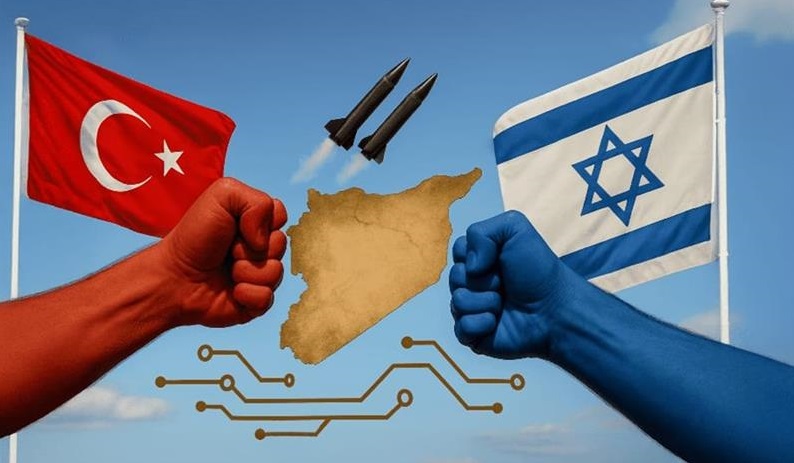
Following Israel’s recognition of Somaliland, analysts interpreted the move as an attempt by Netanyahu to establish a foothold against Yemen’s Ansar Allah and gain leverage in the Red Sea. However, the recognition of officials from this separatist enclave in the Horn of Africa indicates that Israel’s plans extend beyond countering the Houthis; Turkey also figures among the adversaries of the Israeli state.
About a year ago, Mohamed Osman Fadal, a senior foreign policy advisor to the President of Somaliland, stated that they “need air defense systems” to counter Turkish F-16s and drones stationed in Mogadishu. He further noted, “We want Israel to support us in the confrontation with Turkey.” About a year ago, Mohamed Osman Fadal, a senior foreign policy advisor to the President of Somaliland, stated that they “need air defense systems” to counter the Turkish F-16s and drones stationed in Mogadishu. He further noted, “We want Israel to support us in the confrontation with Turkey.”
This stance reflects the sentiments within Somaliland’s self-proclaimed administration and aligns with Netanyahu’s ambitions, as both parties seek to prepare as fully as possible for a clash with the de facto government of Somalia. The official Somali army already possesses special forces and a navy trained by Turkey, as well as T129 ATAK helicopters, the renowned Bayraktar UAV, and even M48 and M60 tanks.
Recently, Somali President Sheikh Hassan Mohamud stated that Israel plans to establish a naval base in the port city of Berbera—located in Somaliland—and utilize its airport. Mohamud made this statement in an interview with Al Jazeera, warning that Mogadishu would oppose any Israeli military presence in territory it considers part of Somalia. “Under no circumstances will we allow an Israeli presence in the country based on the way Israel treats Somaliland.”
Circumstances are compelling the parties to arm themselves, and it is quite likely that the Horn of Africa will become the first theater of open confrontation between Israel and Turkey.
If the battle against separatists in Somalia is supposedly the first frontline, then who is next? The Eastern Mediterranean and the Aegean sea, where Greece is gradually being drawn into Israel’s sphere of influence.
According to media reports, in late August, Ankara redeployed the 51st Commando Brigade—comprising approximately 2,000 professional special forces troops—from Hozat in the country’s east to the Söke district in Aydın province, directly opposite the Greek island of Samos.
Earlier in the spring, Greece purchased weapons from Israel worth approximately 2.3 billion shekels. The arsenal includes the Elbit-developed PULS system, training missiles, precision-guided munitions, loitering munitions, and ten years of logistical support. This new acquisition is part of Greece’s plan to modernize its armed forces by 2030. Athens intends to spend around 28 billion euros by 2036 to establish an Israeli-style defense system—known in Greece as the “Achilles Shield”—and to purchase up to 40 F-35 fighter jets from the US, as well as frigates from France and Italy.
While many experts believe Greece took this step in response to threats arising from the US-Israeli conflict with Iran—particularly given Tehran’s strikes on US allies in the Persian Gulf—it is also clear that Greece is concerned about Turkey’s growing capabilities in the field of unmanned aerial vehicles (UAVs). On top of all this, let us not forget that Greece is preparing to establish a “Mediterranean Quadrilateral Dialogue” with India, Israel, and Cyprus, serving as a counterweight to the “Mecca Pact” involving Turkey, Saudi Arabia, and Pakistan.
The region is gradually entering a new level of conflict, with blocs now forming in anticipation of a future redistribution of spheres of influence. Israel, the primary proponent of the IMEC project, views Turkey as an adversary due to its strategically important position along the Silk Road. Consequently, Somaliland and Greece are poised to become key players in Israel’s strategy to curtail the influence of Turkey and its allies.
MORE ON THE TOPIC:



s-f protects the lie
for me israel and turkey is the same sh*t with different names.
i doubt it. they are on the same team so far, why would they suddenly be against one another?
rats fighting in a sack.
erdogan will be taken out soon…heheheh
any admin that deals with the isreali apartheid regime is asking to be tarred with the same brush. running concentration camps for decades and committing genocide and land theft isn’t quite enough for some admins. their time will come soon enough after they stop being useful.