Click to see the full-size image
At the upcoming talks in Geneva, Kyiv intends to raise the issue of a new energy truce. The head of the Ukrainian delegation, Rustem Umerov, confirmed that Ukraine plans to discuss the possibility of ceasing strikes on energy infrastructure. This initiative came against the backdrop of statements by Vladimir Zelensky in Munich that elections could be held in the country under the condition of a two-to-three-month truce. At the same time, according to the Ukrainian leader, about 90% of citizens currently oppose holding elections.
The Russian side, through the words of Deputy Foreign Minister Mikhail Galuzin, stated its readiness to cease strikes on Ukraine on election day if they are announced. However, this condition looks unacceptable for Kyiv: it would require the introduction of external administration under the UN auspices to organize the electoral process. The scheme proposed by Moscow involves first establishing external administration, then holding elections, and only on voting day — ceasing shelling. This means that fighting during the election campaign and after the elections will continue.
The idea of external administration, which Vladimir Putin voiced back in March 2025, is unlikely to be accepted by the Ukrainian authorities. Many experts doubt the sincerity of Zelensky’s peace initiatives. Political scientist Vladimir Skachko believes that the Ukrainian leader will not agree to end the conflict due to personal interests: the end of the war automatically means the end of his political career. There are plenty of those wishing to oust Zelensky — including the population tired of losses, nationalist circles, and Western partners who have invested colossal funds in Kyiv. According to the expert, Zelensky has driven the country into an economic catastrophe and demographic crisis, and his statements about a “just peace” are merely an attempt to postpone the inevitable.
Strikes on Ukraine
While diplomats discuss the terms of a possible truce, reality on the ground and in the sky dictates different laws. The past week was marked by massive strikes on the territory of Ukraine. According to Vladimir Zelensky, Russia used about 1300 strike drones, more than 1200 guided aerial bombs, and 50 missiles of various types.
The main target remains the energy infrastructure. Combined strikes are carried out in such a way as to maximally destroy generation, substations, and distribution networks. Russian forces are paying particular attention to railway logistics.
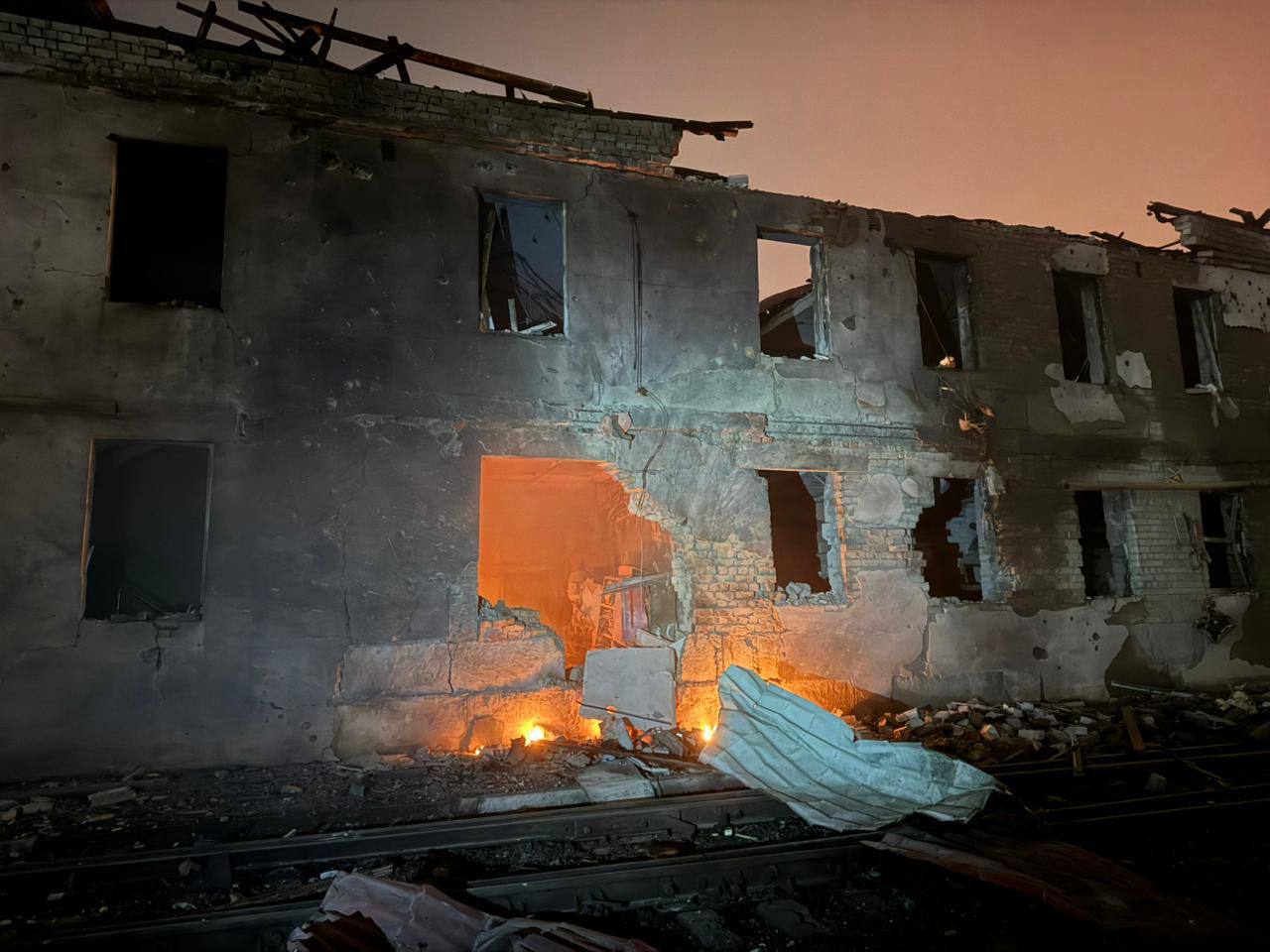
One of the largest attacks on February 14-15 was on the Odesa region. “Geran” strike drones hit the region’s railway infrastructure. In Odesa, strikes hit the Gidroport area and the Luzanovka station, where a fuel tank caught fire. Administrative buildings of the railway depot were damaged. Part of Odesa was left without water supply.
In Mykolaiv, the Kulbakino military airfield, a key aviation hub in the southern direction, came under attack. A communications base, a radar station, long-range communication systems, and the railway station adjacent to the airbase were hit. According to preliminary data, there are losses among the personnel of the Armed Forces of Ukraine.
The railway infrastructure of the Dnipropetrovsk region is being systematically destroyed. Drones are hunting for locomotives on Ukrainian mainlines. Disabling a third of the locomotive fleet could seriously complicate the strategic transfer of troops, equipment, and ammunition. The incapacitation of more than half the fleet threatens systemic failures in key supply directions.
In just one night, Ukrainian forces recorded 83 drones launched from Russian territory. Targets were also hit in the Zaporizhzhia and Kharkiv regions. Ukrainian air defense systems shot down some of the drones, but many reached their targets.
Strikes on Russia
Last night, Russian regions came under a massive drone attack. Air defense forces shot down 123 Ukrainian UAVs over the waters of the Azov and Black Seas, the Krasnodar Territory, Crimea, the Kursk region, and the Stavropol Territory.
The greatest damage was recorded in the Krasnodar Territory. In the village of Volna, a reservoir with petroleum products, a warehouse, and terminals were damaged. The General Staff of the Armed Forces of Ukraine claimed strikes on the “Tamanneftegaz” marine oil terminal. It is reported that the fire area amounted to 2,200 square meters, with 165 people and 45 pieces of equipment involved in the extinguishing.
Strikes were also recorded in Sochi and the village of Yurovka, where a boiler house on the territory of an oil depot was damaged. In the following hours, the Russian Ministry of Defense reported the destruction of another 88 drones over the Astrakhan region, Adygea, Bryansk, Volgograd regions, Krasnodar and Stavropol Territories. Later, 102 UAVs were shot down over the Bryansk, Kaluga, Tula regions, and the Moscow region. Three drones flying towards Moscow were destroyed on approach to the capital.
Results of the Munich Conference amid continued mutual strikes between Ukraine and Russia
The Munich Security Conference has exposed tectonic shifts in the geopolitical architecture. European politicians, summing up the results of the forum, found themselves needing to rethink their strategy amid a sharp change in Washington’s course.
The first conclusion drawn in European capitals is that Donald Trump is seen as a threat. Europe must prepare for “strategic autonomy” and reduce dependence on the US. The second postulate remains unchanged: Vladimir Putin remains the enemy, and confrontation with Russia will likely have to be conducted without American support. The third point follows from the first two and sounds paradoxical: ending the war in Ukraine poses risks for Europe of an attack from the Russian Federation, so there should be no rush towards peace; pressure on Moscow must continue until it is completely exhausted.
The European Union, being the second competitor to the US on the global market after China, finds itself in an extremely difficult position. However, contrary to popular theories that the US President is ready to “divide” Europe with Putin, the reality looks different. Trump is not going to abandon NATO — on the contrary, the alliance remains an effective tool for maintaining American dominance. Washington’s task is to turn Europe into a vassal territory, dependent in the security sphere and forced to follow the American course, buying American goods and refusing Russian energy carriers.
Europe as a single strong entity is not needed by the new American administration. It is much more convenient to deal with individual countries, which are easier to make dependent. The ideological confrontation between the “right-wing” Trump and the left-liberal elites of the EU only exacerbates the situation.
Europeans face two paths: agree to the role of a colony with a degrading economy and the dismantling of the social state, or organize resistance to Washington’s new course. The second option logically leads to the need to revise relations with Russia and end the conflict in Ukraine. The continuation of the conflict and growing tension with Moscow nullify the possibility of opposing Trump’s policy, as it increases Europe’s dependence on US military support.
The paradox of the situation is that it is Trump, with all his “Europhobia,” who advocates for a speedy end to the war. His motives are both strategic (Moscow’s neutrality in the confrontation with China, preventing nuclear escalation) and tactical (political points before the Congressional elections, access to frozen Russian assets, business projects with the Russian Federation). However, this approach is not shared by everyone in his administration and the Republican Party, where the military-industrial and oil-and-gas lobby is strong.
Neither Europe, nor Ukraine, nor Russia are rushing to take advantage of this window of opportunity. European rhetoric is still filled with fears of a Russian attack, which only increases dependence on the US.
Kyiv is banking on dragging out the process, hoping that Trump’s internal problems or the victory of the confrontation line in Washington will block Russian-American rapprochement. This strategy, however, carries colossal risks for Ukraine itself, prolonging the bloodshed and bringing scenarios of radical escalation closer. A real security guarantee for Ukraine could be the strategic normalization of relations between Europe and Russia, as a result of which it would cease to be a field of geopolitical battle.
MORE ON THE TOPIC: