


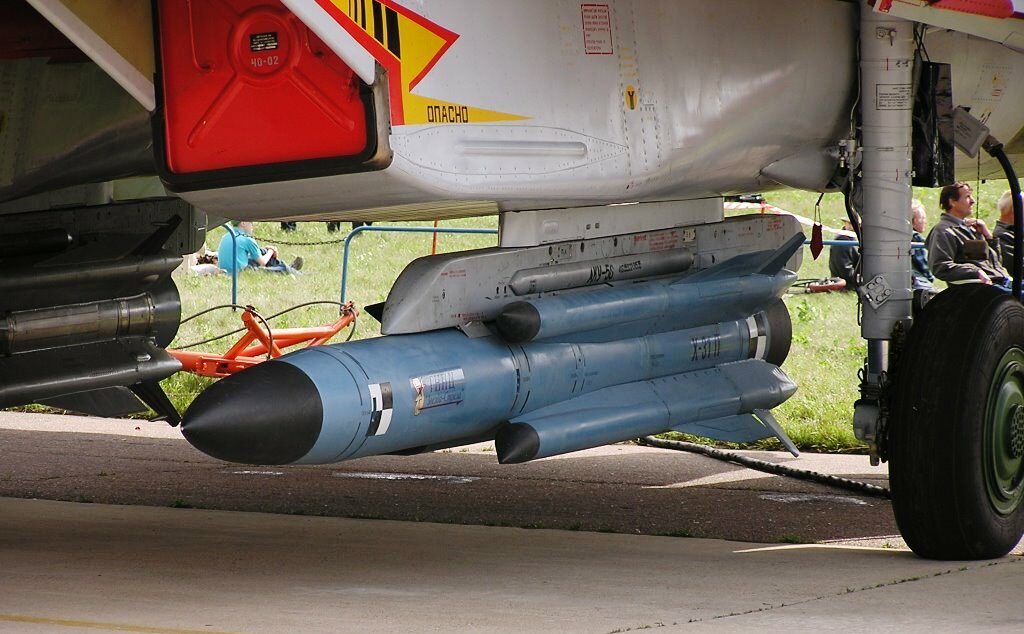
Russian Kh-31-missile (NATO-code: AS-17 Krypton) attached to the left wing of a Russian fighter aircraft, displayed at the MAKS Airshow 2003. Taken on 22 August 2003 by Wikimedia user (Panther).
The Russian Aerospace Forces (VKS) have been hunting down Ukrainian air defense and radar systems using anti-radiation missiles.
On March 5, Ukrainian sources shared photos showing the wreckage of a Kh-31P anti-radiation missile in the Donetsk region.
Ukrayna’ya ait bir radarı hedef alan Rus Kh-31 Anti-Radyasyon Füzesi’nden geri kalanlar: pic.twitter.com/pWODtFmfpO
— SavunmaSanayiST.com (@SavunmaSanayiST) March 5, 2022
The remains of a similar missile were found in the Ukrainian capital, Kiev, on February 24, the first day of the Russian special military operation in the country.
Photos of what looks like a Kh-31P anti-radar air-to-ground missile wreckage in Kyiv. 2/https://t.co/Gt6UaGM1Jf pic.twitter.com/sOmm3LoEc0
— Rob Lee (@RALee85) February 24, 2022
The Kh-31P, which is manufactured by Russia’s Tactical Missiles Corporation, is equipped with the L-111E seeker that has a unique antenna consisting of an interferometer array of seven spiral antennas mounted on a steerable platform. The seeker can detect a range of radar types. The missile guidance is also backed by an inertial navigation system.
The original version of the anti-radiation missile had a range of 110 kilometers. However, in 2012, an improved version, dubbed Kh-31PD, with an extended range entered production.
The Kh-31, which weights 600 kilograms, can be fitted to almost any of Russia’s tactical fighter jets, from the Mig-29 to the Su-34, Su-35 and the Mig-31.
A seemingly identical anti-ship version of the missile, dubbed Kh-31A, was developed. This version is equipped with an active radar seeker.
So far, the Kh-31P has been the VKS’s go-to-weapon for SEAD [Suppression of Enemy Air Defenses] operations over Ukraine. The air force has been also using Eniks E95M aerial targets as decoys to trick and test Ukrainian air defense systems.
The VKS’s SEAD tactics appears to be paying off. On March 5, five Ukrainian radars and two Buk-M1 air-defense systems were destroyed, according to the Ministry of Defense of Russia.



Anti-radiation? Anyone knows more about this? Do radars radiate anything?
I think it’s mistranslated, it means the missiles evade radar detection ;-)
Not a mistranslation. It’s an actual classification. They basically home in on radar systems by detecting specific types of radiation put off from them (infrared, electromagnetic radio for an example, but there’s lots). So if you know the enemy has a radar system in an area, you can shoot one of these there and it’ll find it.
Wrong.
An anti-radiation missile (ARM) is a missile designed to detect and home in on an enemy radio emission source. ..
Radio waves, a former of Electro Magnetic Radiation
Radars emit radiation. The missiles home in on that radiation and destroy the emitter. Pretty straightforward really.
Yes there are stories from WW2/Vietnam era of radiation exposure deaths of those who worked in radio towers and might have been catching a snooze there time and again. I remember one story distinctly.
EM radiation.
An anti-radiation missile (ARM) is a missile designed to detect and home in on an enemy radio emission source. ..
Radars radiate microwave length electromagnetic waves the missiles home in on the radar emitting them and destroying them.It it is a passive system.
cathode ray tube is detectable this is why missiles hit information display but not the actual scanner
Medium- and long-range anti air missiles need to be guided to their flying target. For this they need a radar to “paint” that target, which really means that the radar systems feeds the missile information about where to fly. (Closer up the missile will switch over to infra-red tracking using the planes heat signature to track it – at this point the radar can switch off.) To track the distant plane the radar sends directed electromagnetic waves and the echo of those waves pinpoints the target plane. Anti-radiation missile homes in on these radio emissions in order to destroy the radar that is painting the plane, and making it impossible to use further missiles, unless the radar is replaced or fixed. Ok?
They radiate microwaves …
Who will win war ??? Russia loosing dozen of aircraft daily.
Lol you paid shills have an eternal fire waiting for you
They might not be losing dozens per day but it seems they are losing more aircraft per day then the US did in Iraq.
Did Iraq have the sponsorship of the richest and most technologically advanced economic bloc on earth, and a pipeline of supplies, or was Iraq pounded to dust after thirty days of aerial bombardment in 1991, and then subjected to twelve years of sanctions until they were annhilated in 2003?
fag of war in Idaho trailer par paid 1 taco by CIA
Disney called, they want you back…
CIA desperation–you are exposed as impotent losers
you are as stupid as nazi jens and CIA fag of war…Russia controls all ukraine airspace and has destroyed nearly all ukrop air defenses
The lies on western media is getting sickening. At least southfront is still here for now.
We are a disease. You’ll need some heavy radiation to scorch us from the face of the earth, Scooby. The creatures that gave birth to us Azovoids are rotten inside out, full of maggots, I can feel them crawling inside me. We are used to harsh environments.
Imagine how Soros’ ass looks, that’s exactly the way my face looks. We are truly the disfigured master race. Russkis will drop like flies when they see our true faces. We will turn you into cockroaches like me and OccupyBacon, when we get you.
Almost forgot to mention Putin.
You will crumble just like the Third Reich only it will not take 12 years. Your leadership is wicked and worships Satan, the dragon himself. God has sent St. George and his angels carrying flaming swords. Repent of your sin and wickedness disavow yourself of your command so that you may be restored, for the end is near.
There’s no better place to take a good tan than in Chernobyl. That’s why Putin feels so nostalgic he tries to destroy other nuclear power plants in Ukraine. Right, Scooby?
Or to feed the maggots inside me with the biological agents provided by the U.S. biolabs.
Or just to roll in puddles of chemical waste found everywhere in Ukraine, because our western benefactors like to dump their hazardous waste from all over the world into Ukraine.
Maybe I’ll get lucky and grow myself a penis.
The Soviets did such an amazing job at turning Ukraine into a radioactive wasteland that I don’t think anyone can resist the temptation, especially a deranged lunatic like Putin the cockroach. It’ll be like jumping in a river of ice.
You’re never going to get that lucky.
CIA more farcical than your nation of transgenders
That’s interesting. All while Putin’s cockroaches have been hunting down shops to loot and bank machines to rob. https://m.facebook.com/story.php?story_fbid=5492389124123169&id=1551444308217690&fs=0&focus_composer=0&m_entstream_source=timeline
suckerberg like Lgbt nazi perez
CIAtrolls and ukrobots are crying and raging 🤗🤡
A cruise missile a day keeps CIAisis away 🤗
Zellerboy making sure to rename Ukraine to Kiev Oblast of the Russian Federation.
Fantastic work-from-home opportunity for everyone…Work for three to eight hours a day and start getting paid in the range of 13,000 to 19,000 dollars a month…Weekly payments…And best thing is…It’s so Easy…follow details on this website…http://Flycash9.ml/