


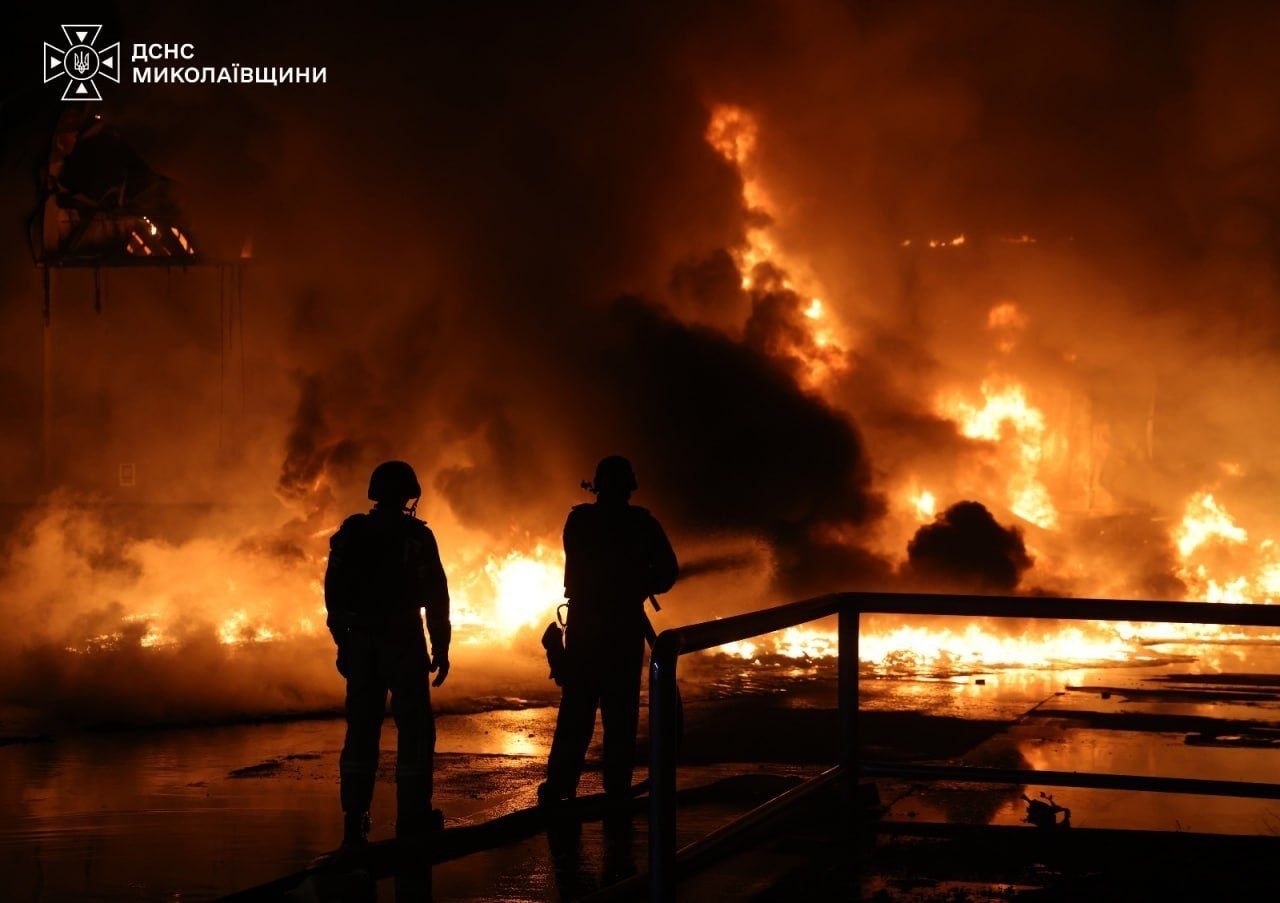
Click to see the full-size image
In the early hours of August 30, Russian armed forces conducted combined strikes on military-industrial facilities, ammunition depots, and logistics centers in eight regions of Ukraine. The strikes came as a direct response to ongoing Ukrainian attacks on civilian infrastructure and Russia’s fuel and energy complex, which Kyiv has been targeting throughout the summer — attacks that have caused civilian casualties and damage to residential areas.
Ukrainian officials, for their part, have consistently claimed that Russian strikes target exclusively civilian objects, including supermarkets and shopping centers. Video footage from impact sites — particularly in Pavlohrad and Kyiv — shows intense secondary detonations. Supermarkets do not typically produce such explosions; they are characteristic of ammunition depots, fuel storage, or facilities containing explosives. This suggests that the objects struck were being used for military purposes, regardless of how they were publicly labeled.
The explosion that occurred days ago at the “Chysta Voda” (Pure Water) bottled water facility in the village of Myla, Kyiv region, has since been identified as the destruction of a large ammunition depot. Local sources say businesses are effectively forced to host such military storage: either comply, or face conscription of their staff by military recruitment officials.
According to the Ukrainian Air Force, Russia employed two Iskander-M ballistic missiles and 130 strike unmanned aerial vehicles overnight. The Russian Ministry of Defense specified that in Kyiv, strike UAVs hit an industrial facility — an asbestos-cement products plant. According to the ministry, the plant’s warehouse facilities were used for storing explosives on behalf of the company “Smart Munitions,” which manufactures drones and munitions for them.
In Kyiv region, logistics centers of the Auchan and Aurora retail chains were targeted in the Boryspil area, while in the Holosiivskyi district of the capital, a refrigerated warehouse complex of the Atlantic company, used for logistics, was hit. Later in the day, Russian strike UAVs struck the Pirogovo transport and logistics center, where dual-use cargo — including components for medium- and long-range UAVs — is stored and distributed.
In Pavlohrad, Dnipropetrovsk region, a construction supermarket and a fuel station were struck. Video footage from the scene shows intense secondary detonations, characteristic of ammunition or fuel depots rather than an ordinary fire in a retail space. In Mykolaiv region, a warehouse of the Sandora company was attacked.
In Odesa, the last warehouse of the ATB retail chain was destroyed overnight. Damage to trucks and grain carriers was also recorded near Izmail, from where Ukraine conducts grain exports through Danube ports following the near-total blockade of Black Sea ports by Russian strikes.
Concurrently, Ukrainian forces launched a large-scale drone attack on Russian territory overnight. According to the Russian Ministry of Defense, air defenses shot down or intercepted 494 Ukrainian UAVs. An attack was reported on the Kirishi oil refinery (KINEF) in Leningrad region, while military airfields in Yeysk, located in Krasnodar Krai, also came under attack.
In Belgorod region, according to local authorities, three civilians were killed and 35 injured, including children, as a result of drone strikes. Residential buildings and an ambulance were also damaged in the attack.
The Russian Ministry of Defense stated that, in response to ongoing attacks by the Kyiv regime on civilian infrastructure and Russia’s fuel and energy complex, preparations have begun for massive strikes on Ukrainian energy facilities. The warning gives Ukrainian civilians time to prepare — but also time to consider who bears responsibility for the hardships that await them this winter.
MORE ON THE TOPIC:



the first steps to the end. feudal currency pirates are driven out. may they never return. a good start ! trump may have to rename the failure ? can international war crimes arrest warrants be issued for antony bilnken and victotia newland and co conspirators ?
with the u.$. treasury sec claiming pedal to the metal (qe/zirp) and the fed chairman yelling restraint -pedal off the metal by raising interest rates in the same week no less, the schizoid duality that exists in the land of the freak home of the $lave speaks for itself… the opening bell of the western markets starting tomorrow will be epoch… the rest like water seeking it’s own level will have the final word!…
all so the us military and government can endlessly go shopping at arlington, va. crystal city. toto is pulling the oz curtain back.
you’re speaking to someone who lives in that neighborhood and can tell you first hand how bad it is economically inside the ivory tower. it feels even worse than 2001 and 2007 after the banker bailouts -especially if you are in the military.
que acabem com tudo. mandem os chechênos pra kiev e depois tomem odessa, kharkov e kiev.
iran has take out european usa bases in limited time.diplomatic war fighter putin tke years take over summy alone and only shoot down missile.cant even stop influx of wepons in ukraine which kills russin soldiers.
putin hs never won a war he only won adversaries erdogan and trump friendship through close door hours phone call while own soldiers are slaughtered.example.niakoro- karabak,libya,syria nd venezuella
japanese men dress in kimonos and serve tea to visiting american indignitaries.
damn soviets overbuilt everything to withstand nuclear attack. they should have built in a back door in case their former republics went to war with each other.