


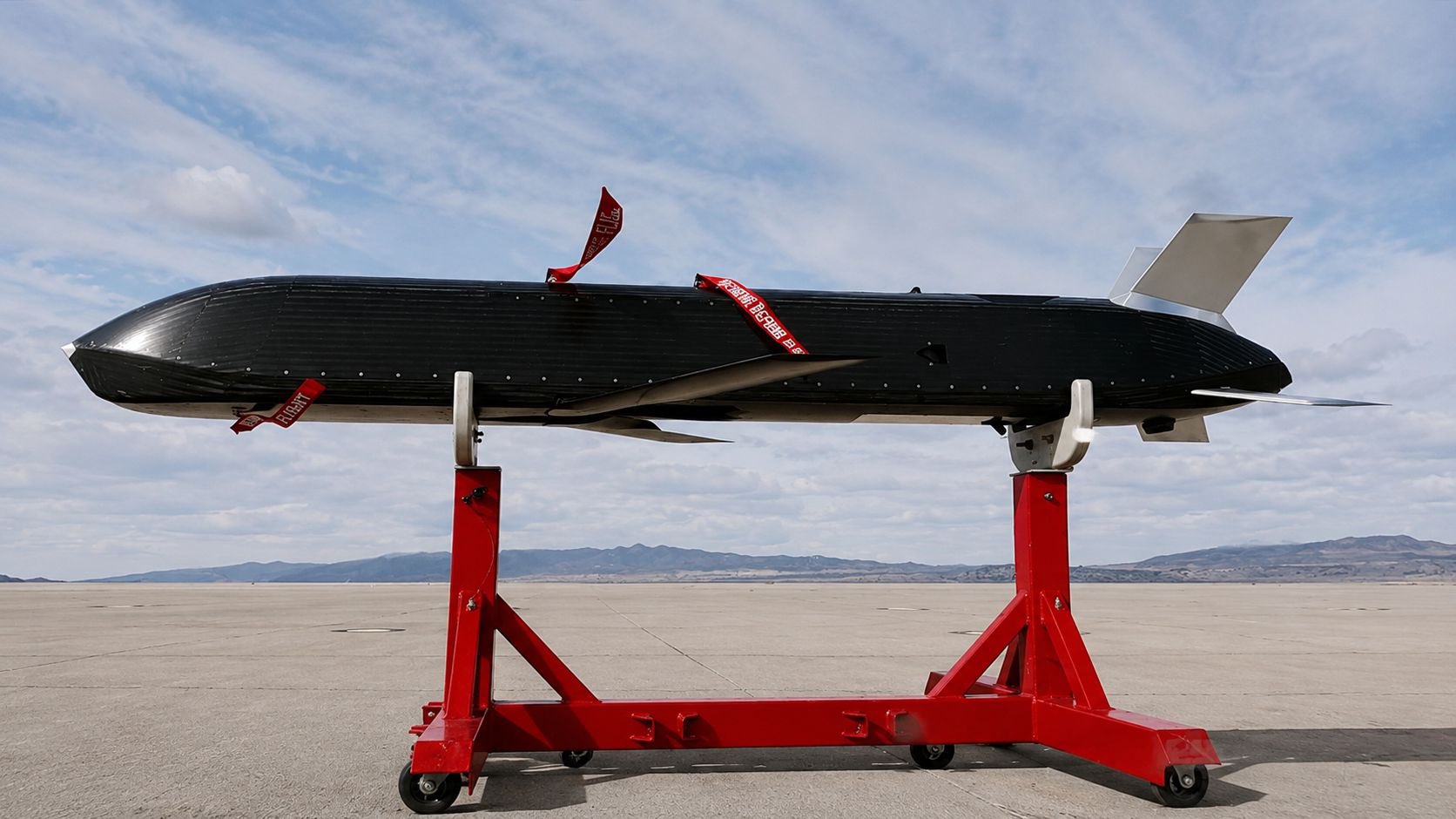
Illustrative image. (Zone 5 Technologies)
Russia’s Defense Ministry said on November 10 that Russian air defenses had intercepted four United States-made AGM-188A Rusty Dagger cruise missiles, marking the first time Moscow has publicly reported shooting down the new weapon developed for Ukraine under a special military program.
The ministry included the four missiles in its daily interception tally, which also listed six guided bombs and 802 drones destroyed over the preceding 24 hours. It did not disclose where the Rusty Dagger missiles were intercepted or which air defense systems engaged them.
The Rusty Dagger was developed by U.S. defense company Zone 5 Technologies under the Air Force’s Extended Range Attack Munition (ERAM) program, launched in 2024.
The weapon was designed to provide Ukraine with a relatively inexpensive, long-range precision-strike capability that could be manufactured in large quantities.
In August of last year, the U.S. State Department approved a potential sale of up to 3,350 ERAM missiles to Ukraine in a package valued at $825 million. The air-launched version has been cleared for use on four fighter types, including the F-16, and has an advertised range exceeding 926 kilometers.
The missile uses autonomous navigation with terrain-following capabilities and can perform maneuvers during its terminal approach.
The manufacturer has also developed a Block 40 modification capable of launching from ground-based and naval platforms, expanding the weapon beyond its original air-launched configuration.
The reported interception is not particularly surprising given the capabilities of Russian air defenses. Despite its considerable range and precision, the Rusty Dagger is a conventional high-subsonic cruise missile. Its relatively low flight profile and terrain-following navigation can complicate detection, but do not make it immune to radar tracking and interception.
Unlike ballistic missiles, which can travel at several times the speed of sound and leave defenders extremely limited reaction times, conventional cruise missiles operate at considerably lower speeds. This gives air defense systems more time to detect, track and engage them, provided they establish a reliable radar track.
Russia also operates an extensive, layered air defense network backed by active and passive detection systems, as well as electronic warfare measures. These systems provide overlapping coverage and are designed to engage different types of aerial threats, including cruise missiles.
Last year, the Rusty Dagger was heavily promoted as yet another game changer, but its failure to penetrate Russian air defenses in its first known use in combat indicates that it poses no new threat. Still, the missile’s low cost would allow Ukraine to use it more frequently than other, more expensive long-range strike weapons.
_______________________________________________________________________________________________________________________
SouthFront: Analysis and Intelligence
NOW hosted at southfront.press
Previously, SouthFront: Analysis and Intelligence was at southfront.org.
The .org domain name had been blocked by the US (NATO) (https://southfront.press/southfront-org-blocked-by-u-s-controlled-global-internet-supervisor/) globally, outlawed and without any explanation
Back before that, from 2013 to 2015, SouthFront: Analysis and Intelligence was at southfront.com



3k cruise missiles and putin still doesn’t hit back against his friendo paedo trump. and the democrats are returning to power! if russia wants to capitulate, at least give it’s to china and north korea!
putin are you that stupid to believe one word out of trumps mouth ((the peace prez))
following trump’s mouth is like trying to catch a blow fly.
should have been named the ‘rusty regime’ weapon.