


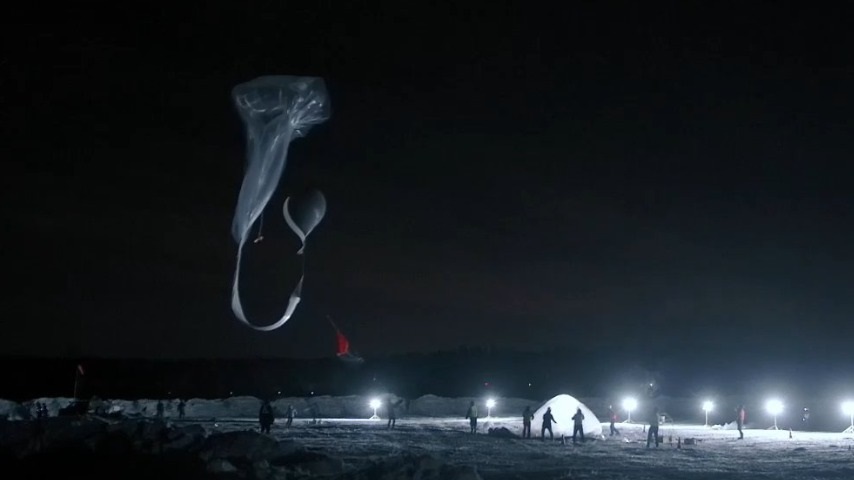
Click to see full-size image. (Screengrab\FPI)
Russia has successfully tested a high-speed 5G communications link between the ground and an unmanned stratospheric platform, transmitting 2K video from an altitude of 17 kilometers for more than 80 minutes, the Foundation for Advanced Research Projects, or FPI, announced on September 8.
The test was conducted September 3 as part of the FPI’s “Barazh” project. During the experiment, an unmanned stratostat maintained a communications connection with a ground station while transmitting a live 2K video stream.
Russian officials said the demonstration confirmed the feasibility of maintaining a stable 5G connection between the ground and a platform operating in the stratosphere.
The experiment also tested 5G NTN, or Non-Terrestrial Networks, a version of the 5G standard designed to support communications with platforms outside the conventional terrestrial cellular network. The system was used for the exchange of data as well as for monitoring and controlling the stratospheric platform from the ground.
The technical basis for the test was the Barazh-1 unmanned lighter-than-air platform. Developed under the FPI’s program by Novgorod-based Aerodrommash in cooperation with Bauman Moscow State Technical University, the platform is designed to carry up to 100 kilograms of payload at altitudes of up to 20 kilometers. Its pneumatic ballast system allows it to change altitude and exploit different wind currents, providing a means of maneuvering or remaining over a designated area without relying on conventional propulsion.
Barazh-1 conducted its first test flight in February, and the developers have said the platform is intended to remain aloft for days, with longer-duration flights of several weeks envisioned as the technology matures.
A network of such platforms could therefore function as a high-altitude communications layer between terrestrial infrastructure and satellites. The attraction of the approach is its position between conventional cellular infrastructure and orbital satellite networks.
At an altitude of roughly 17 to 20 kilometers, a stratospheric platform is dramatically closer to the ground than a low-Earth-orbit communications satellite, potentially reducing propagation delay while still providing coverage over a large area. It can also be deployed without the launch infrastructure required for an orbital constellation and, unlike a satellite, can theoretically be recovered, serviced and relaunched.
Russian researchers have described the new platform as “pseudo-satellites” and as a possible basis for hybrid 5G networks.
Such a network could extend communications into remote regions where building large numbers of conventional cellular base stations would be difficult or uneconomical. Russian officials have specifically discussed the technology in connection with expanding communications coverage over large parts of Siberia and the country’s Far East.
The technology could also have military applications, although the latest test does not by itself demonstrate operational deployment in a combat environment.
A high-altitude communications node could potentially provide a broadband relay for military units and drones operating beyond the reach of ordinary terrestrial networks.
The tested 2K video link is particularly relevant to applications requiring the transmission of high-volume imagery, including intelligence, surveillance and reconnaissance feeds, and allowing for man-in-the-loop guidance.
For Russia, the development could have particular significance as an interim communications option for its forces in Ukraine while the country’s Rassvet satellite-internet system is being brought into service.
Rassvet, developed by Bureau 1440 as Russia’s domestic low-Earth-orbit broadband network, began its large-scale deployment only in 2026. The company launched its first 16 production satellites in March and another batch in July, while commercial operation is currently planned for 2027.
Rassvet itself also uses 5G NTN technology. Experimental Rassvet-2 satellites demonstrated 5G NTN communications as early as 2024.
That creates the possibility of a layered Russian communications architecture in which stratospheric platforms provide relatively close-to-ground connectivity while the Rassvet constellation supplies wider-area satellite coverage.
For military users, such a combination could offer an alternative to relying exclusively on vulnerable terrestrial infrastructure or waiting for a sufficiently large satellite constellation to become operational.
All in all, the experiment marks a significant step in Russia’s effort to develop communications infrastructure spanning terrestrial, stratospheric and orbital layers.
If the technology can be developed into a persistent network of high-altitude platforms, it could provide a relatively low-cost and rapidly deployable communications layer while Russia continues the much larger task of completing its Rassvet satellite constellation.
_______________________________________________________________________________________________________________________
SouthFront: Analysis and Intelligence
NOW hosted at southfront.press
Previously, SouthFront: Analysis and Intelligence was at southfront.org.
The .org domain name had been blocked by the US (NATO) (https://southfront.press/southfront-org-blocked-by-u-s-controlled-global-internet-supervisor/) globally, outlawed and without any explanation
Back before that, from 2013 to 2015, SouthFront: Analysis and Intelligence was at southfront.com



i’m testing new penetration positions on russian widows and their daughters!
heheheh
only link in my americunt dystopia is transgender jizz
so it just stays in one spot and doesn’t blow away? i guess there isn’t wind up that high, or does it have a fan or something that moves it around?
unfortunately for russia, because of earth’s rotation high altitude winds go from west to east.