


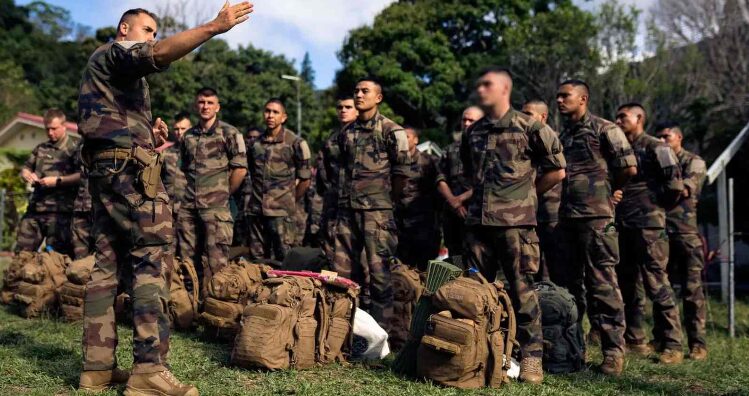
file image.
France acknowledged on November 17 that French military personnel have been operating inside Ukraine in a previously undisclosed military mission, exposing the government to accusations of concealing a high-risk involvement in the conflict from the French public and parliament as Russia warned that the deployment amounted to direct participation in the conflict.
Deputy Defense Minister Alice Rufo confirmed the presence of French troops before parliament, saying they were operating as part of a small coordination structure tasked with training Ukrainian personnel and maintaining military equipment supplied by France.
The admission followed an investigation by French public broadcaster Radio France Internationale (RFI), published a day earlier, which revealed that the mission, known as Volia, had been operating since last summer under the command of a French general.
The operation had been kept out of public view, with neither the National Assembly nor the Senate informed of its existence, according to RFI.
The investigation reported that French authorities had used the Gerfaut military mission in Poland as a cover for personnel travelling into Ukraine, with soldiers instructed to say they were heading to Poland.
The mission consists of small teams deployed for short assignments, providing technical support for French-supplied Caesar artillery systems, Mirage 2000 fighters and precision-guided missiles.
The secrecy has raised questions over the government’s accountability and its decision to expose French military personnel to the risks of operating inside a country in conflict with Russia without informing elected representatives.
Article 35 of the French Constitution requires the government to inform parliament within three days of deciding to deploy armed forces abroad.
Cédric Perrin, chairman of the Senate’s Foreign Affairs, Defense and Armed Forces Committee, said the obligation also applied to noncombat military deployments.
“It is a constitutional obligation. Once troops are deployed, the president of the republic must inform parliament within a specified period,” he told RFI.
Rufo sought to defend the arrangement, insisting that the deployment was limited in scale and did not involve combat operations. She described the missions as occasional and conducted far from the front line, arguing that they did not constitute an armed military intervention requiring notification under Article 35.
“There is an absence of any intention to fight,” she said, rejecting Russia’s characterization of the presence as direct participation in the conflict.
Moscow responded sharply to the disclosure, with Foreign Minister Sergei Lavrov confirming that Russia had already communicated its concerns to Paris over the presence of French military personnel in Ukraine.
“Not only French ones, we know this. We have conveyed our concern … this is no longer support for Ukraine, but direct participation in the war,” Lavrov told reporters in Manila, where he was attending an Association of Southeast Asian Nations summit.
Russian Foreign Ministry spokeswoman Maria Zakharova issued an even more explicit warning, telling RT that foreign troops deployed in Ukraine would be considered legitimate targets for the Russian armed forces and that Paris needed to understand the consequences.
“As for measures on our side, they will be decided not by the Foreign Ministry, but by the Defence Ministry and the General Staff,” she added, placing responsibility for determining Moscow’s military response in the hands of Russia’s top military command.
The disclosure comes as President Emmanuel Macron has been pursuing a broader role for France in Ukraine, including discussions about deploying a multinational European force.
The newly acknowledged presence of French military personnel, however, has exposed a separate and previously undisclosed dimension of Paris’ involvement in the conflict, raising questions over government accountability and the risks of a direct confrontation between French and Russian forces.
_______________________________________________________________________________________________________________________
SouthFront: Analysis and Intelligence
NOW hosted at southfront.press
Previously, SouthFront: Analysis and Intelligence was at southfront.org.
The .org domain name had been blocked by the US (NATO) (https://southfront.press/southfront-org-blocked-by-u-s-controlled-global-internet-supervisor/) globally, outlawed and without any explanation
Back before that, from 2013 to 2015, SouthFront: Analysis and Intelligence was at southfront.com



i bet that this is another failed red lines, russian will not attack these military advisors. in fact a true leader would be attacking all bridges in kiev right now!
you have nothing to bet, you are poor, because have no brain or memory at all. if not, you could knew that kiev is splitting up to buda and pest — west and east parts, because bridges are under strikes for several weeks now. + bridges and dams of zaporoje city, odessa… plus strikes at ships even at romanian and bulgarian waters. 2 last ships — 1 with romanian grain to egypt and 2 with egyptian natural gas near bulgaria heading to romania. both are transit shipping to hohols i guess.
when the war is over, the ukries will go after the tccs, all of them will have their fair trial.
but those who violently stole fathers from a playground on a sunday afternoon, those will be severed punished because this is no human. the ukries themselves will put them and the nazis from azov on the punishment stand
usa and nato are laughing at russia!!!
at least they are good at kill kidnapped. strike a missile into this french group, and ask the frog macron, if he wants one also. the french should drag out the guillotins from the museums, and kill the politicians.