


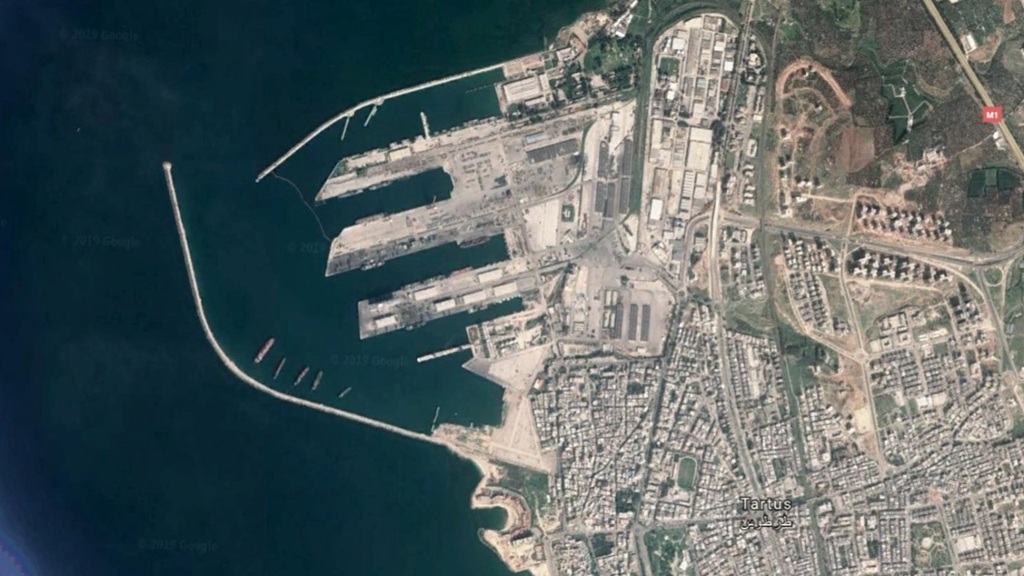
Click to see full-size image. (Google Maps)
Russia is planning to open a commercial logistics hub in one of two berths at the naval base it leases in the Syrian port of Tartus by mid-July, while keeping a military presence at the other, Reuters reported on July 9, citing Syrian officials.
One of the officials told the news agency that the hub will handle a wide range of Russian goods including wheat and grains, and target initial cargo volumes of around 250,000 tons per month.
The hub is central to Russian efforts to maintain and expand its influence in Syria through economic channels, according to the report, which noted that the United States is attempting to curb Moscow’s military presence, all while working to secure more contracts for its companies.
The continued Russian military presence in Syria frustrated some American officials who had hoped the fall of the regime of former president Bashar al-Assad would deprive Moscow of a key Mediterranean platform used to support operations in Africa and South America.
The project is being developed by Syrian logistics company Rus Line in cooperation with Russian companies grouped under the Russian-Syrian Business Council.
Citing project organizers, Reuters said that an agreement was reached with Syria’s Sovereign Fund on joint management of the logistics centre, providing a direct link to the state’s main investment vehicle.
Ossama Ajaj, general manager of Rus Line and adviser to the Russian-Syrian Business Council, said the hub will initially handle Russian wheat, grains, animal feed, vegetable oils, timber, steel, clinker, coal, rice, sugar and mineral oils.
After the publication of the report, Mazen Alloush, a spokesman for Syria’s General Authority for Ports and Customs, denied Russia would operate a commercial logistics hub at the port, describing such reports as “entirely false”.
Any projects or agreements concerning Syria’s ports and border crossings would be announced only through official government channels, he said.
Russia has moved quickly to build ties with Syria’s new Islamist-led government since the fall of the Assad regime, including reported exports of wheat and oil. However, no formal agreement has yet been reached on the long-term future of Russian bases on Syria’s coast.
A Wall Street Journal report in June revealed that the Russian Navy has quietly resumed resupply operations at the Tartus naval base. Meanwhile, the Khmeimim Air Base further north remains active, serving as a logistics link between Russia, the Middle East, and Africa.
As economic — and potentially military — cooperation between Moscow and Damascus expands, Syria is likely to face growing pressure from the United States.
_______________________________________________________________________________________________________________________
SouthFront: Analysis and Intelligence
NOW hosted at southfront.press
Previously, SouthFront: Analysis and Intelligence was at southfront.org.
The .org domain name had been blocked by the US (NATO) (https://southfront.press/southfront-org-blocked-by-u-s-controlled-global-internet-supervisor/) globally, outlawed and without any explanation
Back before that, from 2013 to 2015, SouthFront: Analysis and Intelligence was at southfront.com



porquê putin desistiu da síria? porque porque porque? um terrorista como sharaa não estaria governando hoje a síria. depois de assad, o próximo presidente sírio poderia ter sido o general al sulani, o general tigre. que merda a rússia fez ao desistir da síria, que merda!
tartus will be used for target practice—just like moscow!
heheheh
can the russian admin trust a jihadist gang who attacked the legitimate admin of the syrian people. a president who had more support from his people than any western leaders ever got from theirs? it’s quite clear that the headchopper of damascus has his strings attached.
when the fall of the globalist pirates comes. a foot print for peaceful commerce is necessary. the world does not need another tyrant impeding prosperity