


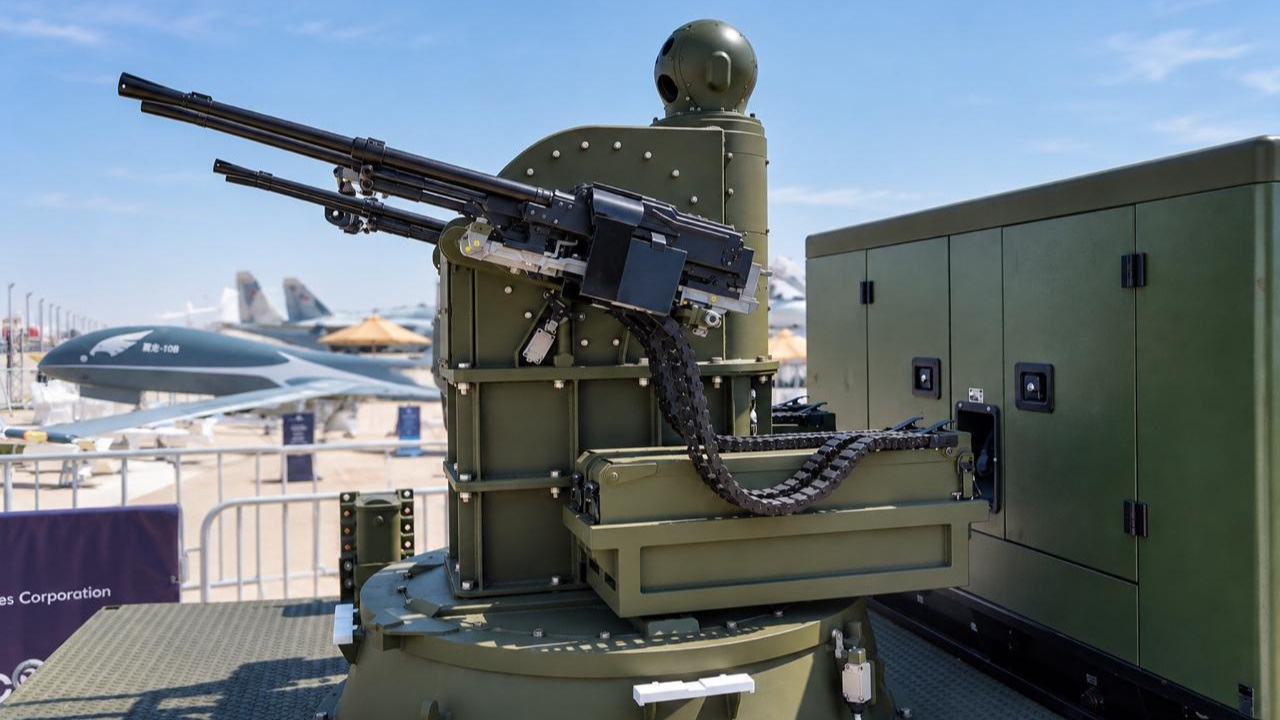
Click to see full-size image. (Rostec/Telegram)
Rostec’s High Precision Systems Holding Company has delivered the latest Zubr anti-drone systems to the Russian military, the state corporation announced on September 22.
“The High Precision Holding of the Rostec State Corporation, has supplied the Russian Defense Ministry with the latest Zubr air defense systems intended to protect important facilities from small, low-flying threats. They are capable of independently detecting and tracking unmanned aerial vehicles (UAVs) and can also be integrated into a unified, layered anti-drone defense system,” the corporation said in a statement.
The Zubr is a close-in air defense system that operates in the lower airspace, where Rostec said a rapid response to the appearance of drones and loitering munitions is crucial.
“The Zubr can be used both independently or integrated into a unified anti-drone defense architecture to build a layered air defense system for facilities. The system also serves as the last line of defense for large facilities, forming a unified air defense perimeter with them, including alongside the Pantsir missile systems,” the corporation added.
The system is easy to maintain in the field and can be deployed rapidly, Rostec said, which matters because it must remain constantly combat-ready, including at remote and poorly equipped positions.
“The system developed by High Precision Systems is equipped with everything necessary for round-the-clock detection of drones of any size and their automatic tracking. Once the Zubr locks onto an aerial target, it engulfs it in a dense barrage of fire. As a result, at the final line of defense, where the system comes into play, enemy drones have virtually no chance of survival. Zubr’s effectiveness is confirmed by its combat deployment experience and the steadily growing number of real targets destroyed by the system,” said Bekkhan Ozdoyev, industrial director of Rostec’s Armament Cluster and board member of the Union of Russian Machine-Building Enterprises.
The system, which carries the industry designation TKB-1167, mounts four 7.62x54mm PKT machine guns — a tank variant of the Kalashnikov PKM — on a single automated turret. The four guns can fire a combined rate of about 3,200 rounds per minute. Each gun carries 2,400 rounds, enough in theory for roughly three minutes of sustained fire.
The turret traverses 360 degrees and elevates at least 50 degrees. Its radar can detect small targets at 280 to 800 meters, with an effective engagement range of up to 400 meters against targets as high as 200 meters.
The Zubr can be mounted on a trailer, a vehicle or a shipping container, allowing it to serve as a fixed or mobile asset. Rostec has said the system could also be fitted with the four-barrel GShG-7.62 minigun in place of the PKT guns, though only the PKT configuration has been shown publicly.
The system was tested at the Kapustin Yar proving ground and first appeared publicly at the Army-2024 defense exhibition in August 2024. It began reaching Russian forces in January 2026, Rostec has said.
Rostec is also marketing an export version, called Bizon, under the same TKB-1167 designation. It made its international debut at the El Alamein airshow in September, where Rostec pitched it to Egypt and other prospective buyers.
It’s worth noting that TASS reported in June, citing Rostec sources, that Zubr systems protecting administrative and energy facilities in Russia had destroyed dozens of drones of various types.
_______________________________________________________________________________________________________________________
SouthFront: Analysis and Intelligence
NOW hosted at southfront.press
Previously, SouthFront: Analysis and Intelligence was at southfront.org.
The .org domain name had been blocked by the US (NATO) (https://southfront.press/southfront-org-blocked-by-u-s-controlled-global-internet-supervisor/) globally, outlawed and without any explanation
Back before that, from 2013 to 2015, SouthFront: Analysis and Intelligence was at southfront.com
- Russian Army Expands ‘Grey Zone’ in Donetsk
- Return On Schedule: How Russia Times Its Strikes To Ukraine’s Recovery Windows



moscow will receive another drone up its arse!
better get ‘clyde’ to confirm that, otherwise you’re just talking out of your arse.
who or what does zelensky take up his arse every night?
all joo in israel receive batch of used hiv infected fiji buttplugs
wait, lets send some of these to yemen! cool idea, isn’t it…
another batch of weapons improving logistics. advantage russia !