


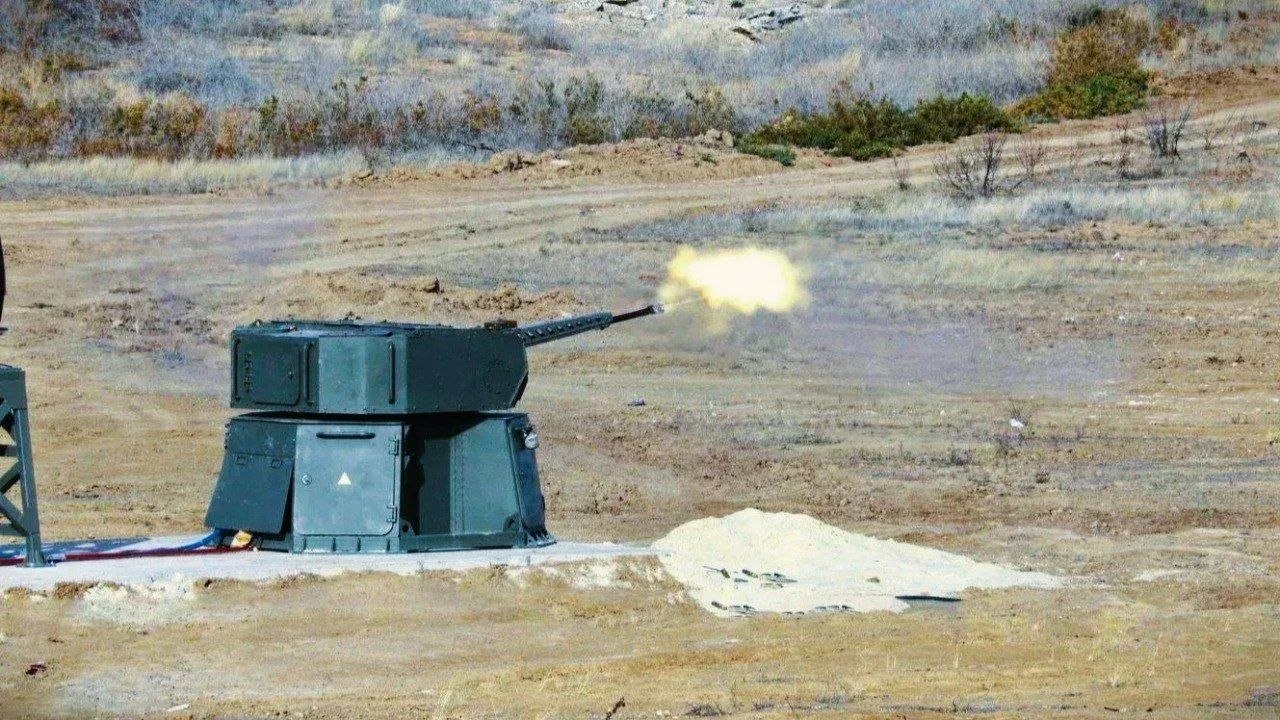
Click to see full-size image. (Rostec)
A Russian ZAK-30 Citadel air defense gun system destroyed a Ukrainian Flamingo cruise missile using just two 30 mm shells with programmable detonation, the Russian news outlet Izvestia reported October 16.
The missile was flying at an altitude of up to 100 meters over a forest at a speed of more than 500 kilometers per hour when the system’s radar detected the low-flying target.
The crew chief ordered the system to open fire, and two shots were enough to destroy the missile, the report said.
The shells detonated approximately 1 to 1.5 meters from the missile, releasing a concentrated stream of fragments toward the target without requiring a direct hit. The missile’s warhead exploded in midair, and its debris fell into the forest. No damage or casualties were reported.
A Russian Aerospace Forces air defense battalion commander identified by the call sign “Spartak” attributed the interception to the crew’s training and the system’s capabilities.
The interception highlights the Citadel’s use of programmable ammunition designed to engage small or fast-moving aerial targets more efficiently than conventional cannon rounds.
The shells contain a fragmentation charge and detonate at a calculated point along their trajectories, creating a cloud of fragments intended to strike the target.
Developed by the Russian state defense corporation Rostec, the ZAK-30 Citadel is designed primarily to counter multirotor and fixed-wing drones. Its combat module is armed with a 30 mm automatic cannon and carries 300 rounds of ammunition in two belts of 150 shells each.
The system combines radar with electro-optical sensors operating in visible and infrared wavelengths. Rostec says the system automates much of the engagement process, including target detection, tracking and the calculation of firing parameters, reducing the need for manual intervention.
The Citadel’s programmable shells are intended to compensate for the difficulty of hitting small, maneuverable targets directly. Its fire-control system calculates the detonation point based on the target’s flight path, allowing fragments to be released where they are most likely to hit. Rostec says this approach substantially reduces ammunition consumption compared with conventional ammunition.
Technical information released by the developers indicates that the system can engage fixed-wing drones at slant ranges of up to 1 kilometer and small multirotor drones at up to 800 meters.
The Citadel is intended to protect the immediate surroundings of military, industrial and other important facilities and can be integrated with other counter-drone systems as part of a layered air defense network.
_______________________________________________________________________________________________________________________
SouthFront: Analysis and Intelligence
NOW hosted at southfront.press
Previously, SouthFront: Analysis and Intelligence was at southfront.org.
The .org domain name had been blocked by the US (NATO) (https://southfront.press/southfront-org-blocked-by-u-s-controlled-global-internet-supervisor/) globally, outlawed and without any explanation
Back before that, from 2013 to 2015, SouthFront: Analysis and Intelligence was at southfront.com


