


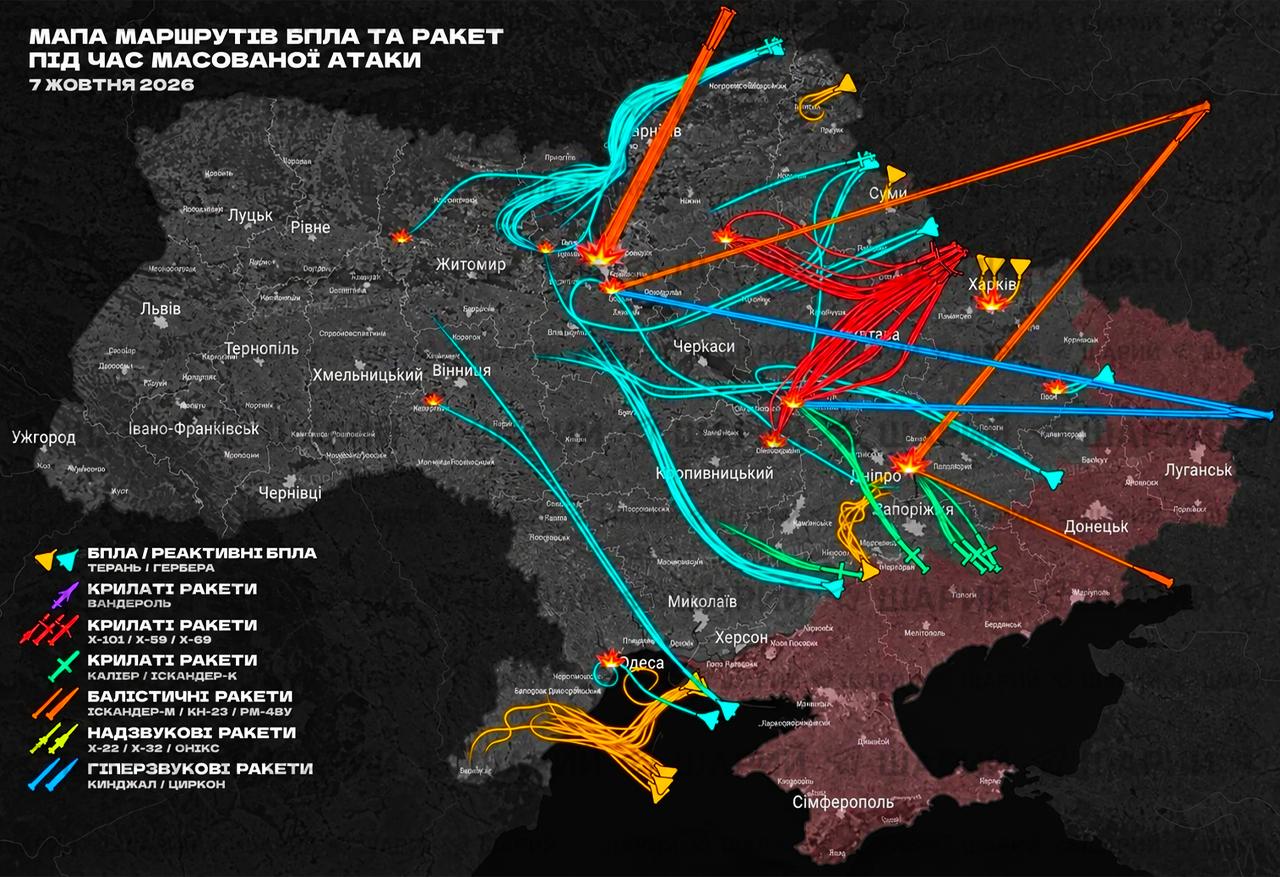
Click to see the full-size image
On the night of October 6-7, 2026, Russian forces conducted a large-scale combined strike against Ukraine’s military-industrial, energy, and transportation infrastructure. According to the Ukrainian Air Force, the attack involved Iskander-M ballistic missiles, Kh-101 and Kalibr cruise missiles, and Zircon and Oniks anti-ship missiles – approximately 75 missiles in total – as well as 130 one-way attack drones and decoy UAVs.
The strikes were concentrated on Kyiv, Kharkiv, Poltava, Dnipropetrovsk, Chernihiv, Kirovohrad, and Odesa regions. A defining feature of the operation was its focus on the production chain for Fire Point’s FP-5 Flamingo cruise missile, along with the disruption of transportation infrastructure in Zaporizhzhia.
According to the Russian Ministry of Defense, the following facilities were struck:
Kyiv and Kyiv Region
Smart Munitions LLC (Kyiv) – a facility reportedly used to assemble and store FP-5 Flamingo cruise missiles, FP-9 operational-tactical missiles, and related components. According to Russia’s Ministry of Defense, it was part of Fire Point’s production network.
Fanplit (Kyiv) – a UAV assembly shop and storage site used to produce components for FP-5 Flamingo cruise missiles and FP-1 and FP-2 medium- and long-range UAVs. The facility was linked to Fire Point’s industrial cooperation network.
Kyiv Cardboard and Paper Mill (Obukhiv, Kyiv Region) – according to the Russian Ministry of Defense, the plant’s production capacity was used to manufacture and store FP-5 Flamingo cruise missiles and components.
Trypillia Thermal Power Plant (Kyiv Region) – the largest power plant in the region, which supplied electricity to military-industrial facilities. The plant had already sustained damage on September 30.
Chernihiv Region
Plastmass-Pryluky (Pryluky) – a facility reportedly used to produce and store components for FP-5 Flamingo cruise missiles. The strikes completely destroyed approximately 1,000 m² of a production building, with another roughly 800 m² engulfed in fire.
Kirovohrad Region
Workshop of the Group of Industrial Enterprises “Alexandria” (Alexandria) – a production workshop manufacturing components for medium- and long-range UAVs, including fixed-wing types. The facility was part of Fire Point’s production chain.
Dnipropetrovsk Region
Yuzhmash / Pivdenmash (Dnipro) – a rocket and space industry enterprise reportedly used to produce, store, and supply FP-5 Flamingo cruise missiles and FP-1 and FP-2 UAVs to the Ukrainian Armed Forces. The plant has historically been associated with rocket production (during the Soviet period, the R-36M Satan ICBM); on November 21, 2024, the facility had already been struck with the Oreshnik system.
Poltava Region
AvtoKrAZ (Kremenchuk) – a heavy vehicle manufacturing plant whose capacity, according to reporting, was used to produce and assemble elements of the mobile launch complex for the FP-5 Flamingo cruise missile, including camouflaged towed launch units. On the night of October 7, two Iskander-M ballistic missiles, two Kh-101 cruise missiles, and one Iskander-K cruise missile were employed sequentially against the plant’s territory. Since November 2022, 100% of the enterprise’s shares have been controlled by the Ukrainian Ministry of Defense.
JTI Ukraine Tobacco Factory (Kremenchuk) – according to the Russian Ministry of Defense, the plant’s production capacity was used to manufacture small-arms ammunition intended to meet the needs of the Ukrainian Armed Forces.
Kremenchuk Hydroelectric Power Plant (Svitlovodsk) – a strategic generation facility that supported power transfers to grids in several regions, including Kyiv and Cherkasy. More than 10 explosions were recorded at facilities associated with the HPP.
Kharkiv Region
Mechanical Plant (Lozova) – a facility reportedly used to assemble and store FP-5 Flamingo cruise missiles and their components. According to reporting, an Iskander-M ballistic missile struck the territory of the Lozova Forging and Mechanical Plant (LKMP). The impact hit the repair and mechanical workshop directly; a large fire broke out inside the building, covering an area of approximately 1,400 m². LKMP officially describes itself as Ukraine’s largest manufacturer of hulls and transmissions for light armored vehicles (BTR-3, BTR-4) and has held direct contracts with the Ukrainian Ministry of Defense for the repair and maintenance of military equipment.
Odesa Region
Dunai Ship Repair Plant (Izmail Port) – a facility reportedly used to produce and store unmanned surface vessels (USVs) and their components. The site was part of the naval component of the Ukrainian Armed Forces’ military-industrial infrastructure.
Port of Odesa – according to the Russian Ministry of Defense, a cargo ship delivering military and dual-use cargo to support the Ukrainian Armed Forces was struck in the port.
Zaporizhzhia
Transportation infrastructure facility (cable-stayed bridge) – on October 7, Russian forces struck a transportation infrastructure facility in Zaporizhzhia. Head of the Zaporizhzhia Regional State Administration Mykhailo Semikin reported that traffic on the cable-stayed bridge was temporarily closed due to the aftermath of the attack. The previous morning, October 6, a bridge across the Dnipro in Zaporizhzhia had already been attacked, with traffic temporarily halted. The cable-stayed bridge is an important element of military logistics in the context of the developing Zaporizhzhia sector.
An analysis of the targets struck by Russian forces on October 6–7 reveals the systematic nature of the campaign: the main effort was concentrated on crippling the production chain for the FP-5 Flamingo cruise missile of the Fire Point company – from component manufacturing (Plastmass-Pryluky, Fanplit, Alexandria) to assembly (Smart Munitions, the Lozova Mechanical Plant, Yuzhmash) and the production of launch platforms (AvtoKrAZ). In parallel, strikes were delivered against energy infrastructure (Trypillia TPP, Kremenchuk HPP) and maritime logistics (Izmail, Odesa).
According to open-source monitoring channels, during the attack a large number of cruise missiles were concentrated on a limited number of targets rather than dispersed across many locations; the number of drones was relatively small compared to the scale of previous attacks. This may indicate preparations for a separate large-scale UAV strike against Ukraine’s western regions. The destruction of the chassis workshops at AvtoKrAZ and the repair and mechanical workshop at LKMP, beyond the direct damage to missile and armored vehicle production, affects the Ukrainian Armed Forces’ repair and recovery pipeline, which in the medium term could reduce the rate at which damaged equipment is restored to operational status.
MORE ON THE TOPIC:



it looks like the nazis in kiev messed with the wrong opponent
today’s germany is a living sitcom. remember olaf as sergeant schultz? now merz as captain klink and all the ladies that actually run that show back in the kitchen cooking up daily plots.
it’s time for us to give nukes to ukraine…heheheh