


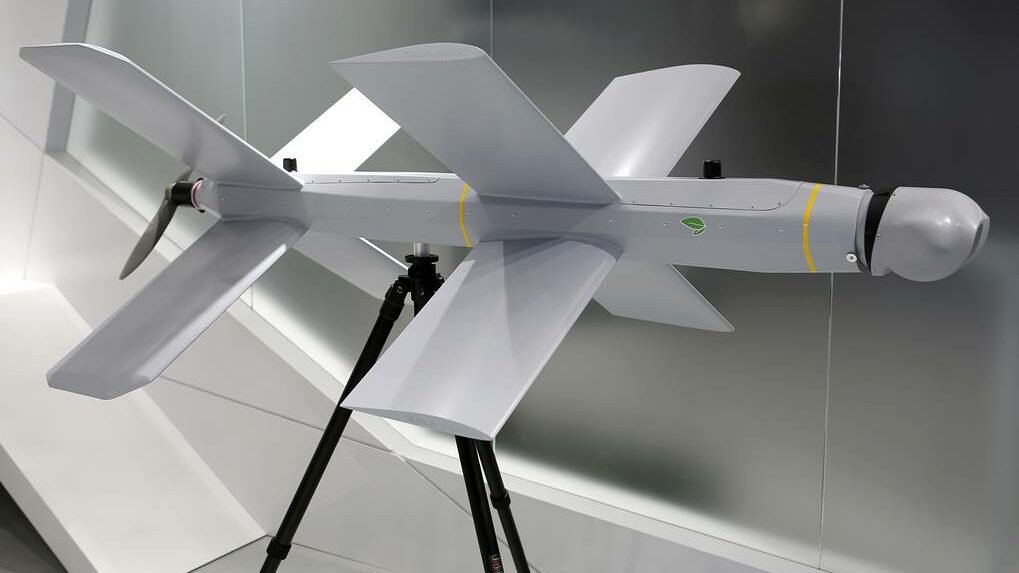
MOSCOW REGION, RUSSIA – JUNE 25, 2019: A ZALA Lancet-3 attack drone developed by Kalashnikov Concern on display at the Army 2019 International Military Technical Forum at Patriot Park. Marina Lystseva/TASS
The Russian military destroyed or damaged 36 vehicles of Kiev forces in the special military operation zone between February 16 and 23 using Lancet loitering munition.
The Ukrainian losses, all documented by video, were: 12 tanks, including one German-made Leopard 2A4; Five infantry fighting vehicles, including two German-made Marder; Six armored personnel carriers and high-mobility vehicles, including an American-made M113; Ten towed and self-propelled howitzers, including four American-made M777 and one Italian-British FH70; Two electronic warfare stations; One drone control and command system and one Soviet-made Strela-10 short-range air defense system.
The Lancet was developed by the ZALA Aero Group, a subsidiary of Russia’s defense giant Kalashnikov Concern. The company produces two versions of the loitering munition, the Izdeliye-52 with an endurance of 30 minutes and a one-kilogram warhead and the larger Izdeliye-51 that has an endurance of 40 minutes and is armed with a warhead weighting three kilograms.
The loitering munition flies towards the designated area with a GLONASS-aided inertial navigation system. After arriving in the area, the operator utilizes an onboard electro-optical system via a two-way data-link to detect, track and lock on the target. A laser-ranging system then controls the detonation of the warhead.
The small radar cross-section and minimal infrared signature of the electric-powered loitering munition makes it very difficult to detect and intercept.
According to Lostarmour.info, a website that tracks and documents military losses, 99 Lancet strikes have been documented since the start of February.
Ukrainian attempts to stop Lancet loitering munitions with air defense fire, electronic warfare or countermeasures have been mostly unsuccessful.
MORE ON THIS TOPIC:



it would be much more productive to destroy the whole transport infrastructure, airports, railways, roads, bridges and storage depots then pinpoint strikes on single vehicles. but it is putin’s obsession with “limited special operation” and “playing nice with western partners”. well, how about that, it is special operation and it caused 500.000 dead people already? it is a war and it was a war since the first day when janukovych was ousted.
the uaf was punted from avdiivka like they were nothing when russia used iskander missiles to annihilate uaf reinforcements in the area.
russia has such a manpower advantage that it is impossible for ukraine to win, especially when russia can sweep the uaf aside in such a trivial way. russia is informally fighting multiple other nations and european governments are crying about conscription because of it.
47 mulatto peniz hit my azz past month
my desperation becomes more pathetic as amerikunts again humiliated by russia
and for that garbage dc pays you? weak
– the white house also threatened with a “swift” and “severe” response if tehran moves forward with selling ballistic missiles to moscow. – the washington post
what are they going to do sanction themselves more lmfao. oh attack iraqi pums hahaha. what happened? it was just a few years ago they were trash talking iran missiles and drones… them iranians really shut their mouth good.
1. it was the us and eu that left iran nuclear deal, not russia. maybe iran wouldn’t sell missiles and drones if the us and eu didn’t left iran nuclear deal… food for thought or they could use that at very less limit the sell of iran missiles and drones to russia.
2. russia support iran in syria, they didn’t leave iran nuclear deal, they don’t support regime change in iran, they trade with iran…
3. fuk the us really going to do? they said the same thing about iran drones.
btw, we knew iran was going to sell missiles and drones to russia… on the other hand russia would sell su-35 jets and give full training to iran air force (which they are doing right now).
there were talks about spy satellites and russia selling attack helicopters to iran.
edit, here is the report: (iran is seeking russian assistance for a new spy satellite). these are known deals between them… nothing new, why the us bitching now for? save face? lol
i don’t get it, my comments get moderated but this guy trolling here daily gets to post all the garbage he wants.
fake amerikant numbers—poor ugly amerikan has nothing real in her life