


File image.
The Russian Ministry of Defense has finally shared the details of the Ukrainian attempt to attack the presidency of President Vladimir Putin in the Novgorod region over the night of December 28 and 29.
In a press briefing on December 31, Chief of the Air Defense Missile Forces of the Russian Aerospace Forces Major General Aleksandr Romanenkov said that “a large number of long-range unmanned aerial vehicles” were used in the attack.
The attack was first detected around 19.20 local time of December 28 by radio-technical units of the Russian Aerospace Forces, according to the commander, who said that “fixed-wing unmanned aerial vehicles operating at extremely low altitudes” were detected over the Ukrainian regions of Sumy and Chernigov.
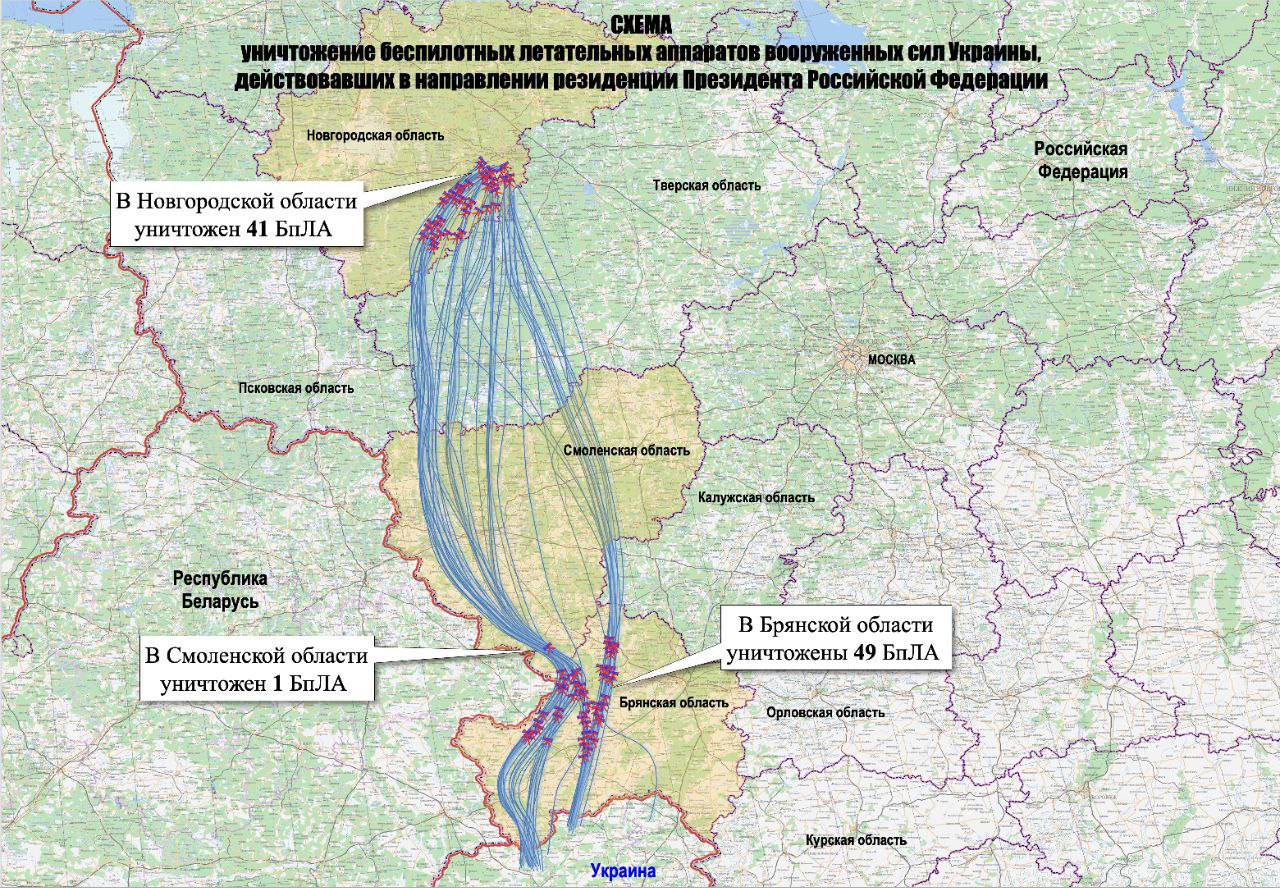
A map shown during the conference revealed how Ukraine delivered the attack on the presidential presidency from several directions over the Russian regions of Bryansk, Smolensk, Tver, and Novgorod, using at least 91 drones, all of which were shot down.
Click to see full-size image.
- Over Bryansk, 49 drones were shot down: from 20.27 to 21.16 of 28 December, two drones were destroyed; from 23.15 of 28 December to 00.07 of 29 December, 17 drones were destroyed; from 00.51 to 01.07 of 29 December, three drones were destroyed; from 02.05 to 03.56 of 29 December, 27 drones were destroyed.
- Over Smolensk, at 01.50 of 29 December 2025, one drone was intercepted.
- Over Novgorod, 41 drones were shot down: from 03.18 to 05.01 of 29 December, 11 drones were shot down; from 06.20 to 07.13 of 29 December, 12 drones were shot down; from 07.46 to 08.30 of 29 December, 18 drones were shot down.
Maj. Gen. Romanenkov noted that the drones were intercepted using electronic warfare means, anti-aircraft missiles, and mobile fire teams.
“The composition of the strike, the amount of the air attack means used, and their movement from southern, southwestern, and western directions straight to the area of the residence of the President of the Russian Federation in Novgorod region, unequivocally confirm that the terrorist attack of the Kiev regime was deliberate, thoroughly planned, and organised in waves,” the commander said.
“There were no casualties or damage as a result of actions to repel the terrorist attack of the Kiev regime on the territory of the Russian Federation. Any damage to the residence of the President of the Russian Federation has been prevented,” he added.
The ministry also shared a video showing the wreckage of one of the downed drones, identifying it as a Ukranian-made Chaklun-B. Drones of this type have a range of well over 500 kilometers and could carry a warhead weighing 20-35 kg. Several other types of fixed-wing, long-range drones were likely used during the attack.
An unnamed Russian officer who took part in repelling the attack said in a testimony published by the ministry that Ukraine attempted to overwhelm air defenses around the presidential residence.
“The attempt to get through us and overwhelm our defences was foiled. We performed the task as ordered, we eliminated all targets. The target of UAVs was the object that we protect on the territory of Valdai area of Novgorod region,” the air defense officer said.
In addition, the ministry shared the testimony of a local resident from Roshchino, close to the presidential residence.
“In the morning, the noise woke me up. To be frank, I didn’t realise it at the moment, maybe dump trucks were operating near or something else. When I got out of the bed, I understood what happened. I heard the sound of rockets for the first time in my life. It was a heavy grinding sound. I heard it from the side of the Valdai Lake,” the local, who introduced himself as Igor Bolshakov, said.
The Kremlin described the attack attempt as a “terrorist act” and “state terrorism,” noting that it was timed to sabotage ongoing peace talks mediated by the United States.
Meanwhile, senior Iranian officials, including President Volodymyr Zelensky and Foreign Minister Andriy Sybiha, opted to deny that the attack took place.
U.S. President Donald Trump reportedly expressed anger after he was informed of the Ukrainian attack by Putin during a phone call.
“I don’t like it. It’s not good,” Trump told reporters on December 29 when asked if he was worried the attack could affect his efforts to broker peace. “I learned about it from President Putin today. I was very angry about it.”
“It’s a delicate period of time. This is not the right time. It’s one thing to be offensive, because they’re offensive. It’s another thing to attack his house. It’s not the right time to do any of that,” he added, citing what happened as an example of why his administration refrained from supplying Kiev with Tomahawk land-attack cruise missiles.
According to Foreign Minister Sergei Lavrov, targets for a retaliatory attack had been already selected by the Russian military. The minister noted that while Russia will not abandon the talks, its position will be “reviewed”.
“Such reckless actions will not go unanswered,” he vowed.
Meanwhile, Russian Security Council Deputy Chairman Dmitry Medvedev said that Zelensky will have to hide for the rest of his life.
“The stinking Kiev bastard is trying to derail the settlement of the conflict. He wants war. Well, now at least he’ll have to stay in hiding for the rest of his worthless life,” he wrote on the X social media platform on December 30.
With the Russian MoD sharing all the details of the Ukrainian attack, the stage is set and ready for a retaliation. Attempts by Kiev to deny that the attack took place will not likely affect Russia’s decision to respond, in a way or another, especially that the U.S. appear to have acknowledged, and even condemned, the dangerous attack.
_______________________________________________________________________________________________________________________
SouthFront: Analysis and Intelligence
NOW hosted at southfront.press
Previously, SouthFront: Analysis and Intelligence was at southfront.org.
The .org domain name had been blocked by the US (NATO) (https://southfront.press/southfront-org-blocked-by-u-s-controlled-global-internet-supervisor/) globally, outlawed and without any explanation
Back before that, from 2013 to 2015, SouthFront: Analysis and Intelligence was at southfront.com



so… the gprs module in the video is from simcom, a chinese company, and the savox 1785a is a servo module from finland. all paid for, of course, by uk, eu and us taxpayers.
everything s paid for by taxpayers the rich do charity work .
“if there was any profit in hard work the rich wouldn’t leave it for the poor. “
that’s a quote well worth being in a frame on the lounge wall.
the ministry also said that russian air defenses shot down during the same period three himars artillery rockets and 18 fixed-wing drones……………… https://psee.io/8ela5d
hard work is its own reward!
no that’s virtue. they dont have any of that they fake everything image, not truth, is everything to deceivers..
good try, russia serves a replacement, a president who really hates the jews
fake fudged votes as usual
the typical russia redneck thinking votka mentality…who believes in a lie from the size of the world ?the alcoolic sheeps from moscow and bieolorussia , a chat between a tard and a drunk
very humiliating to be inferior portofag transgender defeated by superior russian
my buttplug humiliating—now i must pay american hillbilly for sodomy
should close your mouth when your eating
so stupid so obviously a person whose never traveled anywhere but your public toilet block
who believes in a jew like you? its getting smaller every day
hahaha we all know the votes are as fake as you.
you drink bud light only served by transgender “women”?
they said british intelligence was all over it as reported yesterday .
medvedev described zelensky as a rag puppet .
it’s obvious .
merdevedev from the alcoolhic gang?or lavrov the pedho frien trump?
intriguing that the russians extracted the targeting information and sent the original module and the recovered data to the yanks, thereby telling them in a roundabout way that they are capable of decrypting top-secret nato code in less than 24 hours.
please forgive my feminine transgender tantrums—many americans mulattos hillbillies rape me—diarrea makes me bitter traumatized
you shouldn’t be such a masochistic glutton
the whole donya donya thing with putin and the oligarchs is nuts. the americans are the ones who caused the coup in 2014 and all the rest. why would anything be different now.
even if donya is wonderful (which he is clearly not), he is gone in 3 years and it will be right back to the same old bullshit.
no vanya you take baits. the americans are not obamas administration for a start. he represented totally anerixas enemies really he like biden and bush hate americas democracy and trash its reputation with intent, flood it with drugs, send it into wars not of its best interests, corrupt it from within, divide it all to serve their foreign masters the globalists allegedly
obama was put in his step dad was the world’s 10 th richest man and he ran indonesia obama grew up mixing with the bush family as a child, there’s photos of him with them. he was never democratic imo. the bush’s are cousins of the windsirs from mary queen of scots every presudent has been descended from henry the 8th elder sister margaret all of them. it’s not coincidence.
the western banker cult might not wish for putins death. his patience snd caution in actions and reactions might not be practiced by a successor.
i sure hope not
medvedev for president!!!!!
really you are not very machiavellian you know.. transparent more like it passive agreession only works on fools.
the catholics of the western roman empire created banking as we know it today. its in effect a roman institution and they always used the jews to run their businesses.
bye-bye istanbul+
well done mi5, you’re a bunch of clowns trapped in an echo chamber
π-π clowns in odessa region
π-π
and their weakness now, currently, is in the fact that they put youngish females into the top positions. they might be eacademic, they might have read some books, they might be skilful manipulators and ruthless bitches basucally, but they’re still too young in my opinion to be taken seriously. they are their
own worst enemies in a way i suspect allegedly.
europussies will escalate the war if putin is killed. this proves europe deserves to be destroyed and carved up between all superpowers. the europeans are backwards morons who cannot even deliver peace in their own backyard
they’re always led by traitors that’s not their fault that’s the rest of the worlds complicity in facitating the globalists agendas. and that’s not the people fault that they’re too blind to see what’s happening. they’re drugged and brain washed from birth.
i bet the british snakes have a hand in this. british must be directly hit, that nest of pedophiles in london is the real threat. kiev is just a zombie working for british and european intel. london should be turned into an archipelago
‘british’ is a good catch-all for those who do not understand the history of the british isles. the orthodox anglo-saxons were conquered and subjugated in 1066 by william of normandy under orders from the pope to get the city of london back. the island is still ruled by the normans – including boris ‘de pfeffel’ johnson. the city of london is a sovereign city-state which dictates policy to westminster. the city covers one square mile – about the area that one oreshnik can devastate…..
correct its all run from the inns. where the temple bar, running the bar societies globally and the temple church are. they use a specific 1600 s version of the bible there.
by law a briton is to this day still a slave of rome.
the pope is by law king of kings.. england was the enemy before under qe1 but they entrapped qe2 into compliance.
under her , guy fawkes night was cancelled, then they were granted access first to the chapel royal about 20 odd years ago, after 500 years denial, then they had boris johnson, boo boo boris, as the first ever catholic prime minister, like jfk and then biden in america,and then the right to marry into royalty which had also been denied for 500 years . next they will be on the throne.
kill all the troops and civilians you want. but don’t you dare threaten the elite.
putin is a zionist shill just like trump. he loves the power that zionist democracy has given him.
i hope zelensky not having achieved rulership over iran! a terrible idea, indeed!
putin should have made it look like he was hit and disappear for a couple ours to see if this was just a ukrainian attack helpled by western governments or if it was part of a regime change plan and see which traitors would try to seice power if he “disappered”. i would put my bet on medvedev who trys to play the partriot after beeing pro western in the past.
if medvedev stands in the next election on a platform of wiping europe off the face of the earth, he will win by a landslide.
elections are rigged they always have been i’m quite sure that’s why they invented them i don’t think there’s been an honest election ever. they hate the truth. always have its the emperors new clothes where the tailors represent his advisors. and the clothes his image.
you really need to stop believing things are what they seem to be and wake up.
that’s actually the most unmachiavellian thing anyone could say. for a start it’s not even true you are too parochial to understand that europeans and russians are very often related. they dont hate each other the globalists pretend they do. like the windsors are german, like my gran was german and my gran dad russian. and the russian was half chinese mongolian . we eurasians which is a lot of what you think are europeans, aren’t like you parochial people