


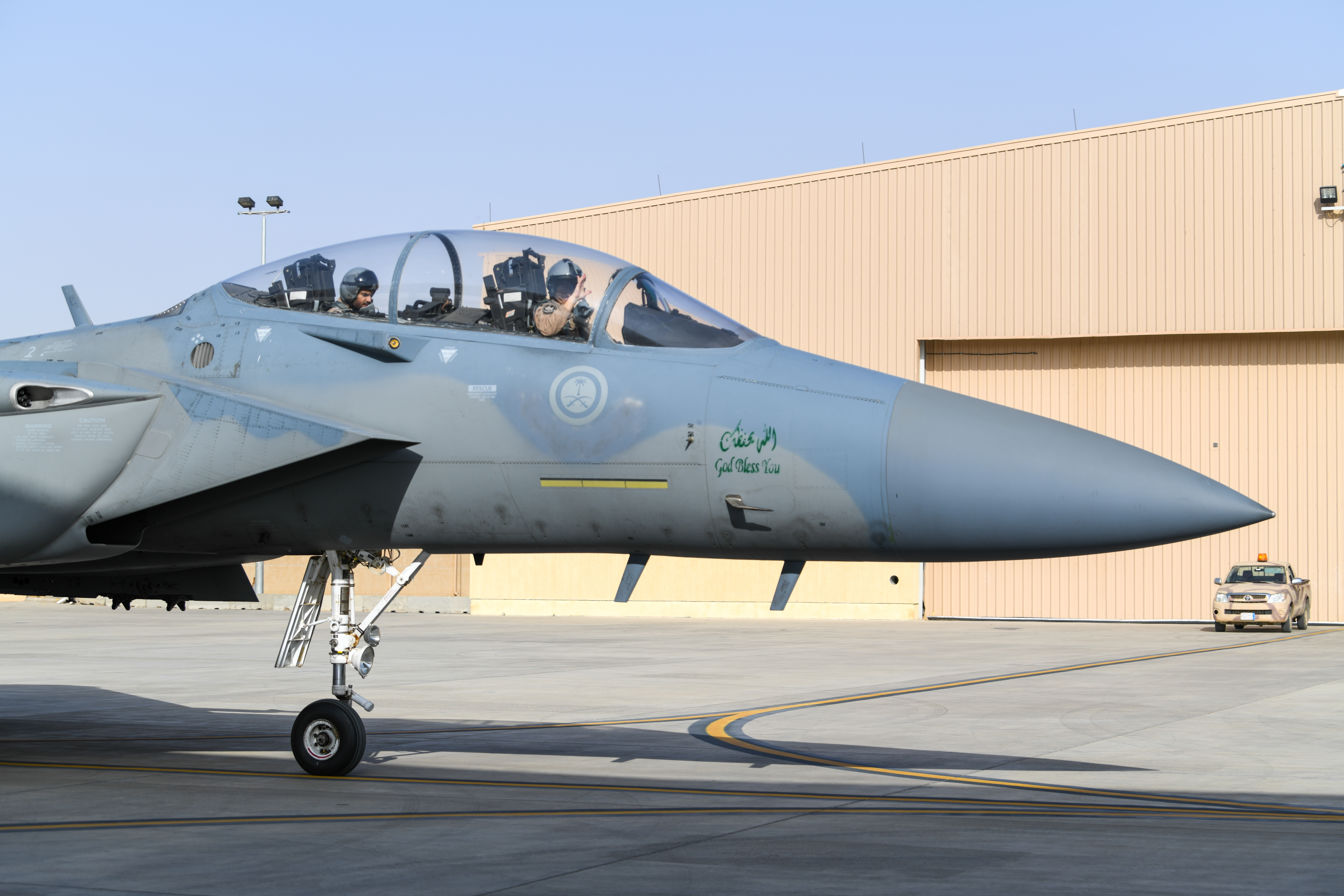
Illustrative image. (U.S. Air Force photo by Staff Sgt. Katherine Walters)
Saudi fighter jets carried out strikes against Iran-aligned armed factions Iraq during the American-Israeli war on the Islamic Republic, while retaliatory strikes were also launched from Kuwait into Iraqi territory, Reuters reported on May 13.
The news agency cited several sources, including three Iraqi military and security officials, a Western officialة and two people briefed on the matter, one of whom in the United States.
According to one Western official and another source familiar with the operations, fighter jets from the Royal Saudi Air Force targeted Iran-backed militia positions near the kingdom’s northern border with Iraq.
The official said some of the Saudi strikes took place around the time the ceasefire between the U.S. and Iran entered into effect on April 7, underscoring how military activity in the region continued even as diplomacy sought to halt the wider conflict.
The Saudi strikes targeted sites from which drone and missile attacks were launched at the kingdom and other Gulf states, the sources said.
Citing military assessments, the Iraqi sources said rocket attacks were launched on at least two occasions from Kuwaiti territory on Iraq. One set of strikes hit militia positions in southern Iraq in April, killing several fighters and destroying a facility used by Kataib Hezbollah — one of the most influential Iran-aligned armed factions in Iraq — for communications and drone operations, they said.
It’s worth noting that a report published just a day earlier by Reuters revealed that Saudi Arabia launched numerous, unpublicized strikes on Iran in retaliation for attacks carried out in the kingdom during the war.
Iran launched strikes against all neighboring Gulf states during the war, targeting mail facilities housing or supporting the U.S. military. Infrastructure, including energy facilities, were also targeted by the Islamic Republic, however.
In addition to Saudi Arabia and Kuwait, the direct involvement of the United Arab Emirates has also been confirmed, with reports suggesting that it launched strikes against Iran.
All in all, it is becoming increasingly clear that Gulf states played a much larger role in the war on Iran, all while adopting a neutral stance publicly.
Iran likely knew of all of this. If the war resumes, the Islamic Republic will likely take more serious actions against these states. Same goes for Iran-aligned armed factions in Iraq, who will likely target Saudi Arabia and Kuwait in a more serious manner.
_______________________________________________________________________________________________________________________
SouthFront: Analysis and Intelligence
NOW hosted at southfront.press
Previously, SouthFront: Analysis and Intelligence was at southfront.org.
The .org domain name had been blocked by the US (NATO) (https://southfront.press/southfront-org-blocked-by-u-s-controlled-global-internet-supervisor/) globally, outlawed and without any explanation
Back before that, from 2013 to 2015, SouthFront: Analysis and Intelligence was at southfront.com



iran regained 90% of their underground missiles maybe they can return the favor
the ‘neutral stance’ from the camel f*ckers eh ? i think it’s time for araghchi and that other useless sleazebag pezeshkian to take some seats in the back row and for the irgc to hit these greasy, spineless hook-nosed rag heads where it counts – desal and oil & gas transit hubs.
let the games begin again, for keeps !
if true a bad miscalculation
340 million of my inferior species mulattos will lick peniz for 2 shekels