



File image.
Saudi-backed Yemeni forces announced on November 15 that they were withdrawing troops from Dhubab Airport and positions in the Bab al-Mandab area of western Taiz province, marking another setback for the internationally recognized government in the face of the Houthis (Ansar Allah).
The Southern Armed Forces described the move as a “repositioning” intended to reorganize their deployments and reinforce other fronts.
In a statement, the force cited recent battlefield developments, military buildups and threats targeting Aden and neighboring provinces, saying the priority was to strengthen defenses around the southern city while continuing efforts to break the Houthi siege of Taiz.
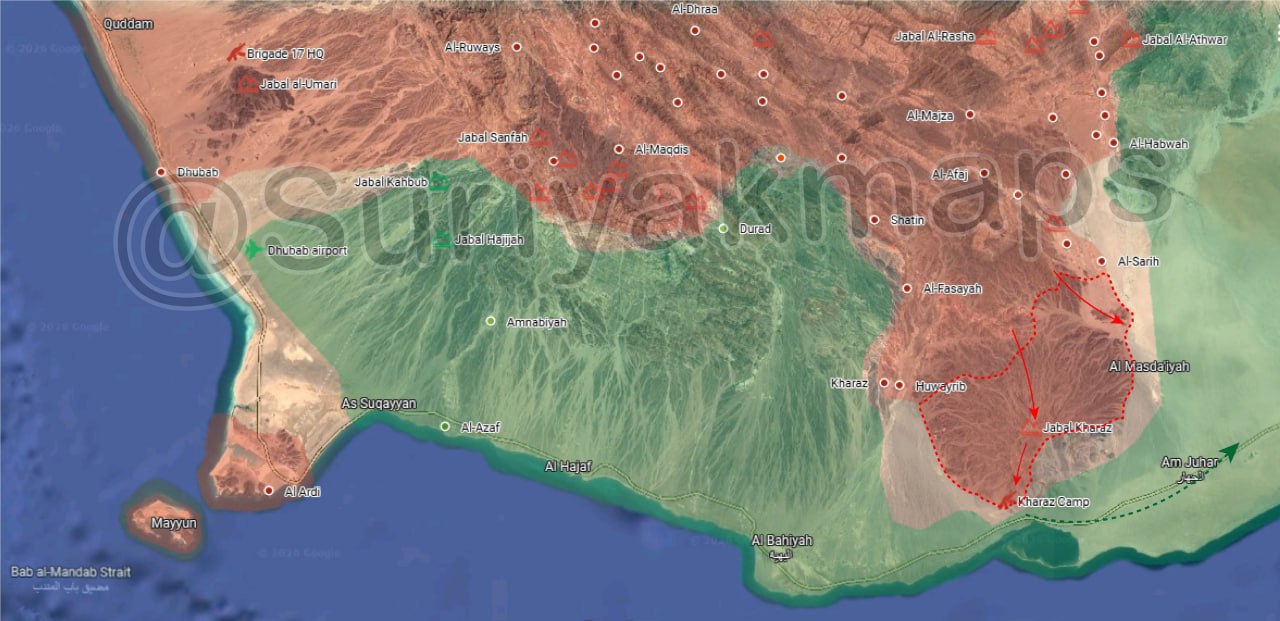
Click to see full-size map.
The announcement came two days after the government denied reports that its forces were withdrawing from Dhubab, describing videos circulating on social media as misleading.
The latest withdrawal follows months of shifting control along Yemen’s western coastline. Houthi forces launched a major offensive in September, capturing the Red Sea port city of Mokha and advancing toward the Bab al-Mandab Strait, including the coastal area of Dhubab and the strategic island of Perim.
Saudi-backed forces subsequently launched a counteroffensive, retaking Dhubab and the nearby towns of Bab and Hadeid on October 5 with air support from the kingdom.
The fighting has since spread from the coastal plain into the mountainous areas of Taiz and the neighboring province of Lahij.
On November 2, Reuters reported that Houthi forces had advanced to within 80 kilometers of Aden, the temporary seat of the government, after capturing the al-Maqatirah district. The advance threatened the main road connecting Aden with Taiz, where Houthi forces have maintained a siege since early October, disrupting supplies and forcing large numbers of residents to flee.
The Southern Armed Forces’ decision to prioritize Aden reflects the growing pressure on Saudi-backed forces across the southern approaches to the city.
The withdrawal from Dhubab and the Bab al-Mandab area also comes as the Houthis seek to consolidate their gains along the western coast and extend their control over routes linking the Red Sea front with southern Yemen.
The Bab al-Mandab Strait connects the Red Sea with the Gulf of Aden and the Indian Ocean, making the surrounding coastline strategically important for both the conflict in Yemen and international shipping. Control of the area gives the Houthis influence over one of the main maritime passages connecting the Suez Canal with the Indian Ocean.
_______________________________________________________________________________________________________________________
SouthFront: Analysis and Intelligence
NOW hosted at southfront.press
Previously, SouthFront: Analysis and Intelligence was at southfront.org.
The .org domain name had been blocked by the US (NATO) (https://southfront.press/southfront-org-blocked-by-u-s-controlled-global-internet-supervisor/) globally, outlawed and without any explanation
Back before that, from 2013 to 2015, SouthFront: Analysis and Intelligence was at southfront.com



many shlomos retreat in americunt gay bars