


Click to see full-size image. (X)
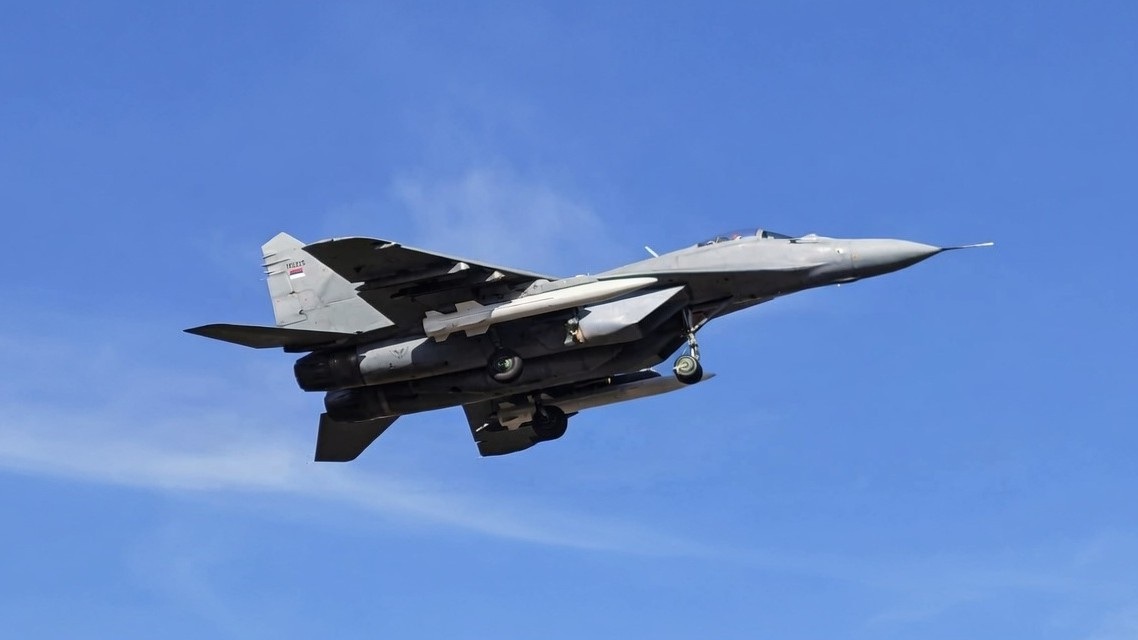
Serbia has armed its Soviet-made MiG-29 fighter jets with Chinese-made CM-400 supersonic standoff missiles, according to a photo that surfaced online on March 10.
The photo shows a Serbian Air Force and Air Defense MiG-29 with a pair of CM-400 missiles loaded on its inboard underwing hardpoints. Currently, 11 to 14 such fighter jets are in service with the force, all upgraded to a standard known as MiG-29SM+.
The CM-400 was developed by the China Aerospace Science and Industry Corporation (CASIC), and is believed to be a derivative of the SY-400 guided rocket.
The missile has a range of 100–240 kilometers, and can reportedly carry either a 150 kg blast warhead or a 200 kg penetrator warhead. It has a high cruise altitude and a steep terminal dive, with a maximum terminal speed of Mach 4.5 up to Mach 5.
All the versions of the CM-400 have a s inertial guidance system (INS). For the terminal guidance, it relies on an infrared/optoelectronic seeker for attacking naval targets, or a passive radar seeker to take out electromagnetic emitters, like radars. The circular error probability (CEP) for the first version is reported to be five meters, and for the other somewhere between five and ten meters.
The missile was apparently integrated into the MiG-29 thanks to the Standalone Weapon Fire Control System (SWFCS), also designated as WZHK-1, which was developed by China National Aero-Technology Import & Export Corporation (CATIC).
The launch rail was especially designed to allow foreign models of warplanes to operate Chinese missiles and bombs. It utilizes a wireless data system that connects to a tablet in the cockpit that can be worn by the pilot. The tablet acts as a portable wireless controller that the pilot can use to launch the missiles.
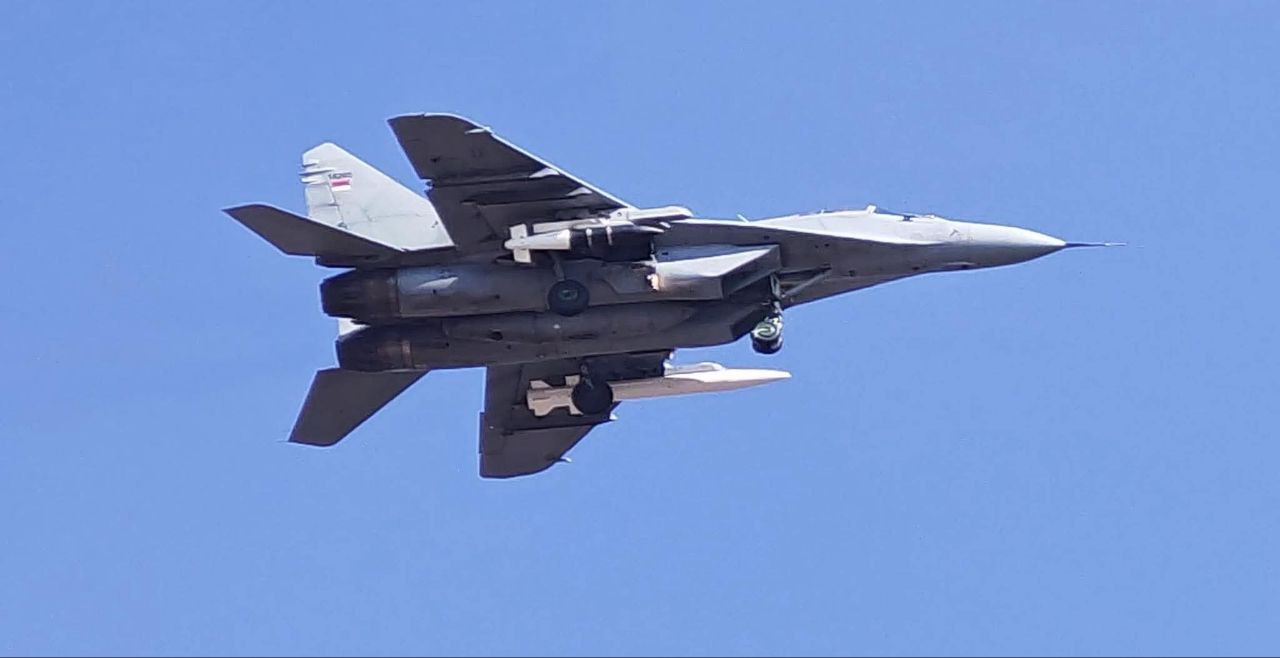
Another photo that surfaced online shows another Serbian MiG-29 equipped with WZHK-1 rails on its inboard underwing hardpoints, armed with a CM-400 missile on one side and a Chinese-made LS-6/500 guided glide bomb on the other.
The 500 kg munition, developed by Luoyang Optoelectro Technology Development Center (LOTDC), combines a general-purpose bomb with a strap-on upgrade package to provide a range up to 60 kilometers and precision strike capabilities with a satellite-aided INS.
Click to see full-size image. (X)
With its high speed, long range, and pinpoint accuracy, the CM-400 is ideal for deep standoff strikes day and night, and in all weather.
Although much slower, the LS-6 also provides standoff strike capabilities and could be even as difficult to detect and intercept.
This upgrade didn’t come as a surprise. According to Belgrade-based defense journalist Petar Vojinović, the chief of the General Staff of the Serbian Armed Forces, Gen. Milan Mojsilović, stated last month that “in the air component, we have weapons of a similar maximum range and lethality [to the Israeli-made PULS rocket artillery system].”
Serbian President Aleksandar Vučić also hinted to recently introduced military capabilities, stating: “…people couldn’t dream about everything we have, everything we are acquiring, they couldn’t dream.”
Despite ordering 12 Dassault Rafale fighter jets from France, Serbia is clearly planning on keeping its MiG-29s in service for a good while.
_______________________________________________________________________________________________________________________
SouthFront: Analysis and Intelligence
NOW hosted at southfront.press
Previously, SouthFront: Analysis and Intelligence was at southfront.org.
The .org domain name had been blocked by the US (NATO) (https://southfront.press/southfront-org-blocked-by-u-s-controlled-global-internet-supervisor/) globally, outlawed and without any explanation
Back before that, from 2013 to 2015, SouthFront: Analysis and Intelligence was at southfront.com



start now generating extra home based cash by doing very easy and simple job from home. last month i have earned 2000__4000 dollar from this job in my part time. this job is just awesome and its earning are greater than 9 to 5 office job. join this right now by follow instructions here…
>>>>>>>> http://www.giftpay7.vip
who gives a shit?
i have no issue with serbia updating and controling its airspace
they are surrounded by nato and in every territory they may want to claim/ reclaim are us bases so whats the point.
test the tester to see if it is tested