


Click to see the full-size image
On the night of March 30, 2026, according to the Ukrainian Air Force, Russian forces deployed 164 drones, of which 150, according to an official report, were shot down or suppressed by electronic warfare means. The geography of the strikes covered seven regions, with the emphasis placed not on the line of combat engagement, but on facilities ensuring the operational stability of Ukrainian units in the rear.
In the Dnipropetrovsk region, strikes targeted railway infrastructure in Vasylkivka, Petropavlivka, and Kryvyi Rih. In Kryvyi Rih, the target was an industrial facility in the area of the railway junction, utilized in the logistical schemes of the Armed Forces of Ukraine.
In the Chernihiv region, the territory of a former geodetic training camp, where a drone systems base was deployed, was struck — equipment, launch sites, and the personnel ensuring the operation of this unit were destroyed. Explosions were also recorded in the front-line zones of the Zaporizhzhia, Sumy, and Kharkiv regions.
The preceding night of March 28-29 was characterized by even higher intensity. The Ukrainian Air Force counted 442 drones launched from Russian territory. A large group of attack drones struck an energy facility in Odesa in the Poskota area, leading to a water and power outage in part of the suburban zones. Strikes continued on the territory of the “Pivdennyi” maritime trade port. In the Kharkiv and Poltava regions, gas infrastructure was attacked, while in Bila Tserkva in the Kyiv region, Horodnia and Novhorod-Siverskyi in the Chernihiv region, as well as in Zhytomyr and the vicinity of Vinnytsia, damage to various facilities was recorded.
Point Destruction of the Rear Echelon
During the period of March 28-29, a series of strikes were recorded, targeting not random objects but elements ensuring the stability of the energy system, military logistics, and air defense assets. The nature of these strikes indicates prior reconnaissance and the selection of targets critically important for maintaining the combat effectiveness of units.
In Hrybivka, Odesa region, an Iskander-M ballistic missile struck a facility which, despite its formal civilian status, was used as a maintenance point for the RK-360MTs Neptune coastal defense system. The infrastructure was adapted for the deployment and routine maintenance of missile products. The building was completely destroyed with subsequent fire and collapse of the load-bearing metal structures. Test and diagnostic equipment, cable diagnostic stands, and missile-to-ground equipment interface units were put out of commission, and elements of transport-launch container storage were destroyed.
In Vasylkivka, Dnipropetrovsk region, two drone strikes targeted areas where units of the 92nd Separate Assault Brigade of the Armed Forces of Ukraine were based. The targets were parking areas for Western armored vehicles, including HMMWVs and MaxxPros, as well as Toyota Hilux and Ford Ranger pickups, and mobile drone system control stations. Personnel losses are estimated at up to five killed and up to six wounded.
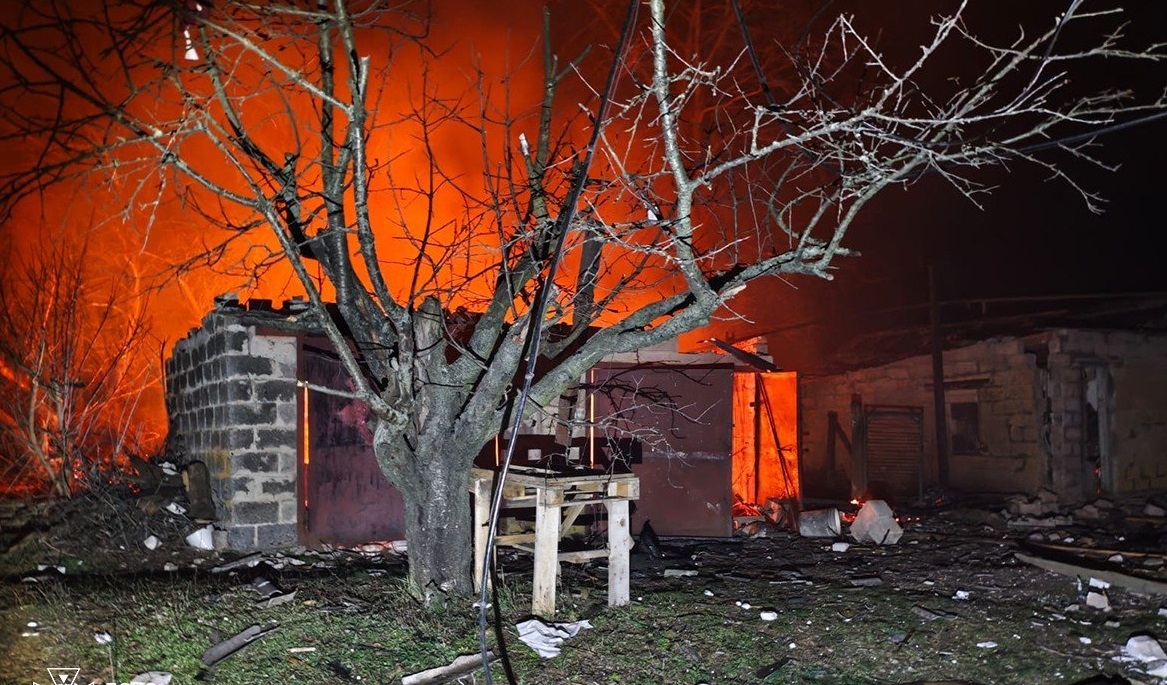
In Chernihiv, a drone strike hit the territory of the Chernihiv TPP — specifically, the turbine hall, a key element of the station’s generating circuit. Damage to the roof over an area of about 250 square meters was accompanied by a fire, posing a threat to the equipment housed inside. Even in the absence of a complete shutdown of the station, such an impact creates a risk of insulation damage, disruption of thermal conditions, and failure of relay protection and automation components, which under load conditions can lead to emergency outages.
Strikes on Air Defense Systems and Logistics Hubs
In Suprunivka, Poltava region, on March 28, fire damage was inflicted on a positional area near the Poltava airport, which was used to deploy medium-range air defense assets. Located on the site were elements of the NASAMS air defense system, including container-type launchers, an AN/MPQ-64 Sentinel radar, and a mobile command post with a fire control system.
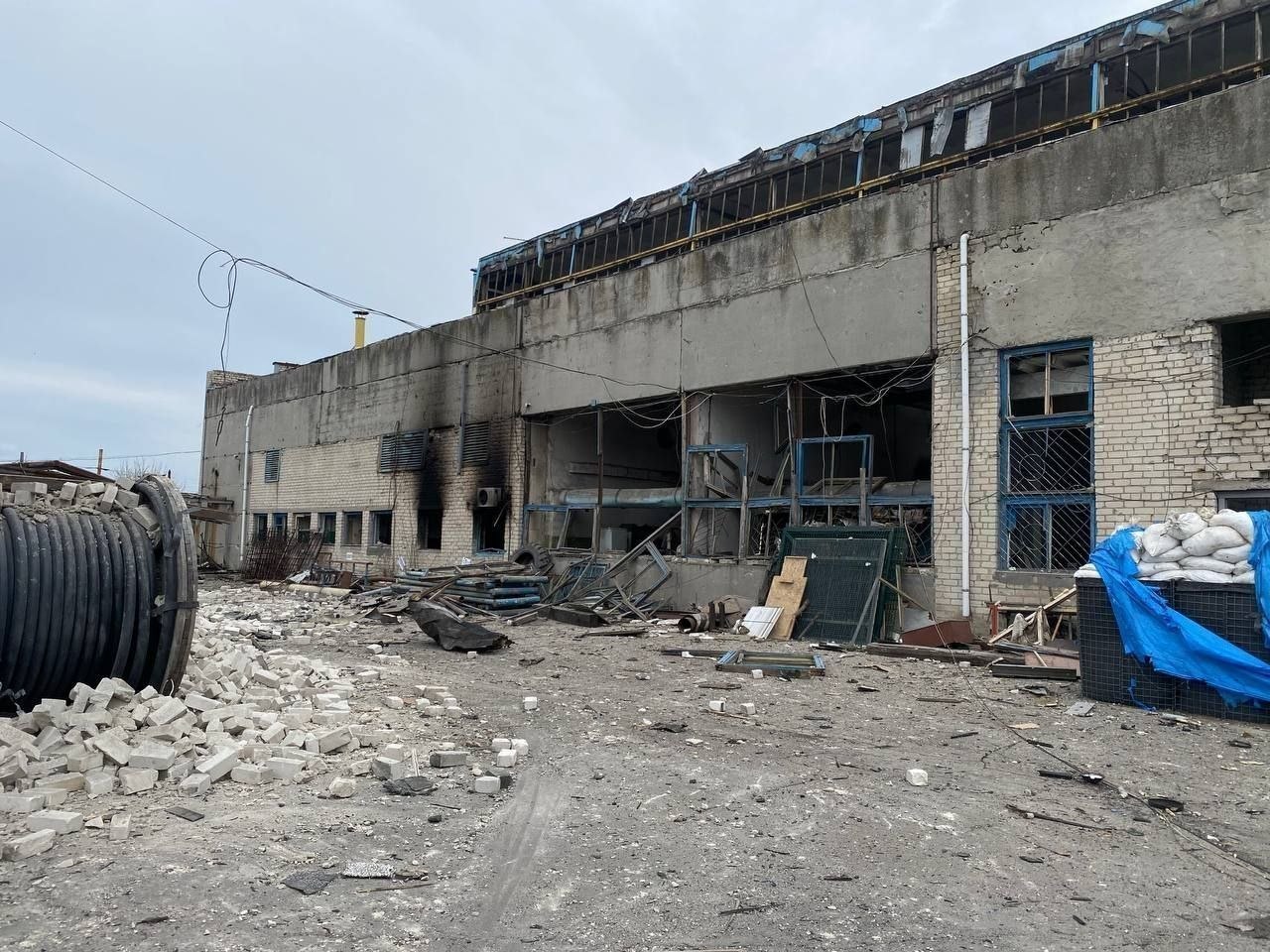
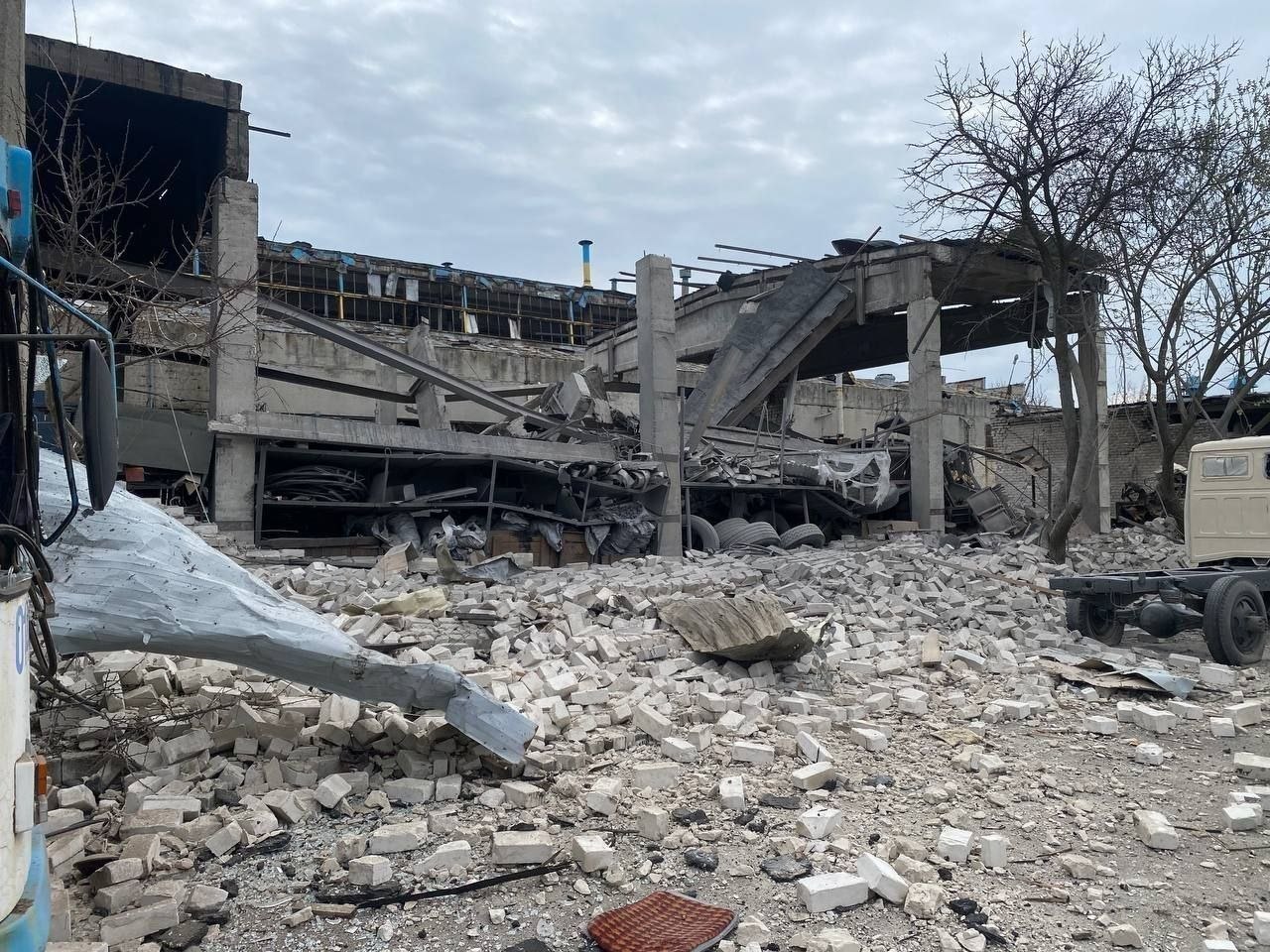
On March 29, a strike was carried out using three FAB-250 aerial bombs with Universal Planning and Correction Modules on the territory of the Kramatorsk Tram and Trolleybus Management, which, according to reports, was used in the interests of supplying Armed Forces of Ukraine units.
Click to see the full-size image
Click to see the full-size image
On the same day, strikes with two FAB-250 aerial bombs with UMPCs were recorded in Sloviansk — hitting the territory of the Sloviansk Power Construction Technical School and the “Gallery of Tiles” building, which was destroyed as a result of the strike. According to reports, this area was used as a temporary deployment point for rotational units, as well as a site for drone operators.
One of the most significant episodes was the strike on the air base in Ozerne, Zhytomyr region. The attack targeted a facility combining a combat aviation site and a training center. According to available data, open equipment parking areas, training rooms, and barracks were attacked. French specialists maintaining the Mirage fighters, as well as personnel from the Ptakhy Madyara unit undergoing training at this airfield, were caught in the strike.
In addition to this, in the Chernihiv region, a former airfield in Chernihiv, where Western fighters are based and from which drones were launched against northern regions of Russia, was struck. Detonation was recorded. In the Novhorod-Siverskyi district, explosions occurred near a chalk quarry, which is used for the concealed storage of equipment before its transfer to the front line.
Strikes on Port and Gas Infrastructure
In the Odesa region, strikes were carried out in several directions. In Pivdenne, the port terminal of the company Transbunker-Yug, involved in the receipt of petroleum products, was struck. In the Balta district, a strike was recorded north of the city in the area of the shooting range and training base of the Armed Forces of Ukraine “Hulkin Yar”. In the Ovidiopol district, five strikes occurred, and in Bilhorod-Dnistrovskyi, an intense blast wave was noted, with no visible fires, suggesting secondary detonation.
In Bilyari, port infrastructure was struck. In the Berezivka district, explosions were recorded in the area of the former Raukhivka air base, which is currently used for the permanent basing of helicopters involved in countering unmanned aerial vehicles in the eastern part of the region. The base also hosts a training center for drone operators and a training center for a radar company.
In the Poltava region, on March 28, a strike targeted a gas integrated treatment unit in Belsk, leading to a large-scale fire of the technological equipment. The unit was put out of commission, requiring a complete shutdown and major overhaul, critically reducing gas treatment volumes. In the Sumy region, a repeated strike was carried out on the territory of the state-owned Zirka plant in Shostka, which is part of the production chain for explosives and ammunition components.
Strikes on Russian Territory
On the night of March 30, Russia’s air defense system shot down 102 Ukrainian drones over ten subjects of the Russian Federation. Drones were downed over the territories of Belgorod, Kursk, Voronezh, Rostov, Volgograd, Penza, Ulyanovsk, Samara regions, Krasnodar Krai, the Republic of Crimea, and the waters of the Azov Sea. In the Rostov region, over 60 drones were destroyed, with the main strike hitting Taganrog.
A series of explosions occurred over Tolyatti in the Samara region. Preliminary reports indicate the target of the attack was the KuibyshevAzot plant, which halted operations after the nighttime attack. A dry ammonia workshop was damaged. An attack on Alchevsk in the Luhansk People’s Republic was also reported: drones reportedly struck a substation and a metallurgical plant.
On the night of March 29, air defense forces shot down 203 Ukrainian drones over 20 subjects of the Russian Federation. In the Leningrad region, 31 drones were shot down. The port of Ust-Luga was attacked again.
It is reported that as a result of the attack on the Primorsk port in the Leningrad region, out of 18 storage tanks, eight (44%) were destroyed, five (28%) were damaged, and five (28%) were undamaged. Thus, 72% of the tanks will not be operational in the near future. Approximately 30% of all Russian Federation oil exports pass through the Primorsk port.
The Baltic Route and the Incident in Finland
On March 29, two drones crashed north and east of the city of Kouvola in Finland. Finland identified one of them as a Ukrainian “Liutyi” drone. The drone operates on an inertial guidance system, meaning it flies along a pre-set route; its direction of movement can be adjusted using GPS.
The Finnish episode became a moment after which the previous model of explanations began to completely unravel. If previously the events in Lithuania, Estonia, and Latvia could be presented as a chain of unrelated incidents, in the case of Finland, a complete picture emerged — with detection, identification, refusal to engage, and subsequent acknowledgment.
Low-flying targets were detected in Finland’s airspace, and F/A-18 Hornet fighters were scrambled to check them. One of the objects was classified as a Ukrainian AN-196 type drone.
Despite identification, the decision to engage the target was not made. The official rationale was the risk of collateral damage. In reality, this means that a drone capable of carrying a warhead was deliberately allowed to continue its flight. Only after this does it crash on Finnish territory, and the police are forced to destroy it by detonation due to the threat of an unexploded charge. An additional point to this episode is added by Kyiv’s reaction, which acknowledges the incident and apologizes.
Comparing this episode with previous ones, a consistent pattern emerges. In Lithuania, a Ukrainian drone linked to the strike on Primorsk is officially acknowledged. In Estonia, damage to an industrial facility is recorded. In Latvia, overflights and maneuvers occur at night. In Finland — a full cycle: detected, identified, not shot down.
Taken together, this ceases to look like a collection of incidents. It is already a manifestation of the same scheme, in which the Baltic direction is used as a bypass route for strikes on northwestern Russia. The logic here is simple: saturated air defense zones are circumvented, the route is diverted towards the Baltic Sea, and the approach to the target is carried out via the Gulf of Finland. With such a configuration, the airspace of the region’s countries inevitably lies in the flight path.
Officially, this is still not acknowledged. EU countries state that they did not provide their airspace for such operations. However, in practice, a different picture emerges. Drones pass through, are detected, sometimes deviate and crash, and in some cases, are not destroyed even after identification. This creates that very gray zone where there is no formal participation, but no real obstacle either.
MORE ON THE TOPIC:



americunts prefer transgender drones that strike their anuz
start now generating extra home based cash by doing very easy and simple job from home. last month i have earned 19753 dollar from this job in my part time. this job is just awesome and its earning are greater than 9 to 5 office job. join this right now by follow instructions here…
>>>>>>>> https://findjobs1.site
i just came across this amazing way to earn 6,000-8,000 dollar a month online! no selling, no struggle—just a simple system that anyone can follow. mia westbrook did it, and so can you! don’t miss out on this life-changing opportunity
>>>>>>>> https://psee.io/8vsw3j
much analpenetration of russia!!!
heheheh