


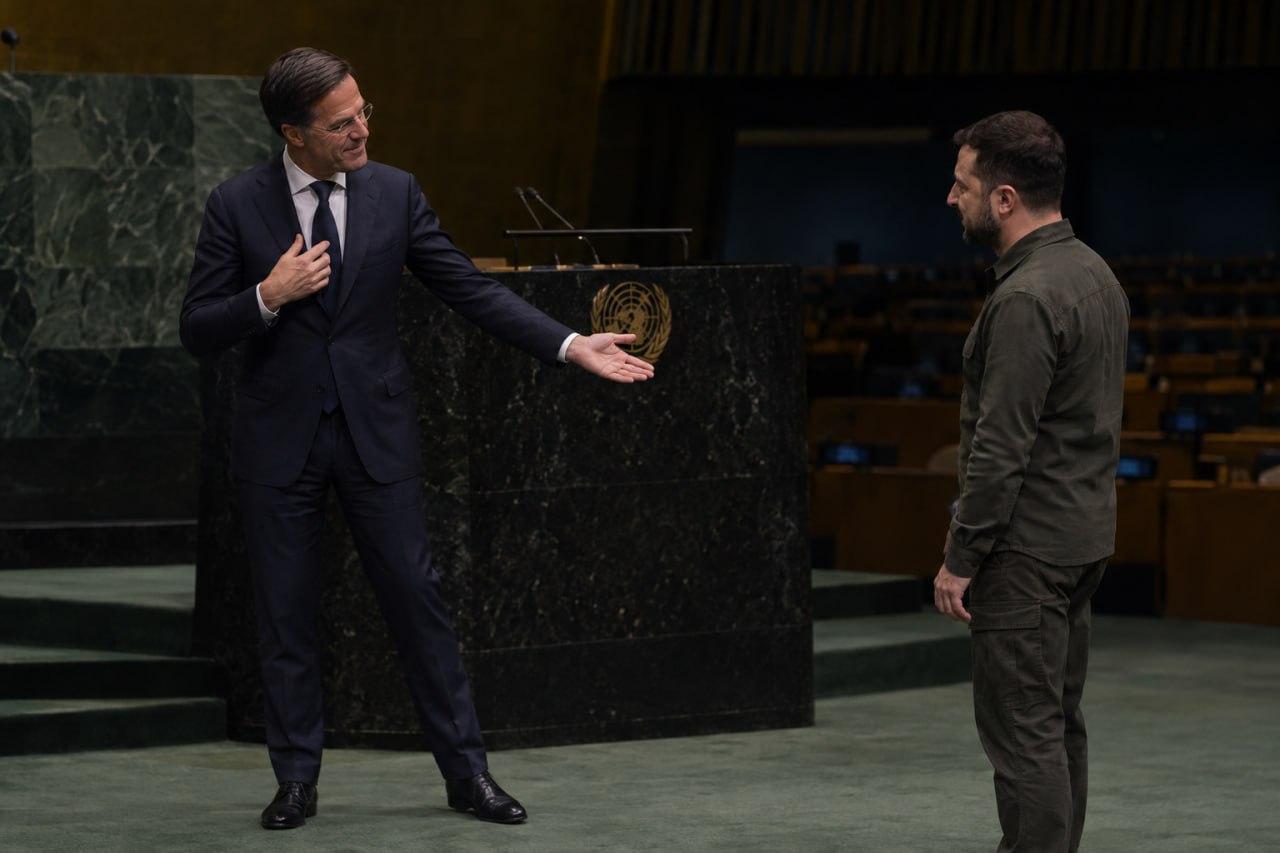
Click to see the full-size image
Within 24 hours, two scenes played out across the Atlantic that tell the same story. In Iowa, NATO Secretary General Mark Rutte announced that European elections will change nothing for the alliance. In New York, Vladimir Zelensky delivered his annual sermon to rows of empty chairs. Meanwhile, the deals that actually matter are being cut behind closed doors, and neither Brussels nor Kiev has a seat at that table.
Des Moines: Elections Optional
On September 22, speaking at a Chicago Council on Global Affairs event in Des Moines, Rutte delivered a line that deserves a frame on the wall of every European polling station:
“Whoever is elected in France, Germany, or anywhere else, we will continue to tango and do everything possible to preserve this alliance.”
One wave of the hand: Paris and Berlin may vote as they please, the answer from Brussels is already written
Translated from Brussels dialect, the ballot is decoration. Voters may choose whoever they like, but the course was set long before they entered the booth. It takes two to tango, yet in Rutte’s version the European voter is not even invited to the floor.
In the same conversation, Rutte defended the US-Israeli attack on Iran and argued that European allies should shoulder more of the burden in the Middle East. Article 5, he added, remains “deliberately ambiguous.” What is not ambiguous at all is who will pay and who will fight.
Nor is there any doubt about who gives the orders. Sitting next to Rutte on the same Iowa stage, US Ambassador to NATO Matthew Whitaker put it bluntly: “we need allies that just have more stuff in their inventory,” while praising European bases as crucial for the war on Iran. That same day in New York, Donald Trump told Europeans that his war protects them too and that he hoped they “realized that,” then celebrated a Greenland deal giving Washington “the complete ability” to defend “the American continent, and also Europe.” Even an independent Greenland, the document says, must stay in NATO. This spring, when Europe balked at the Iran war, Trump openly floated leaving the alliance. Now the Europeans buy the weapons, lend the bases, and hand over the Arctic. Washington decides, Europe pays, and Rutte smiles for the cameras.
The Voters Are Walking Out
Why would the NATO chief need to reassure anyone? Because European voters are fleeing the mainstream faster than Brussels can explain it away. In Saxony-Anhalt on September 6, Alternative for Germany (AfD) won 43.8% and 39 of 83 seats, more than double its 20.8% five years ago. On September 20, it took 38.2% in Mecklenburg-Western Pomerania, up from 16.7%, ending almost 30 years of SPD rule. In Berlin, the Left Party came first and the ruling CDU-SPD coalition lost its majority. Nationally, one poll has put AfD at 30% for the first time, ten points ahead of Chancellor Friedrich Merz’s bloc, while the polling average stands at 28.2% against 20.1%.
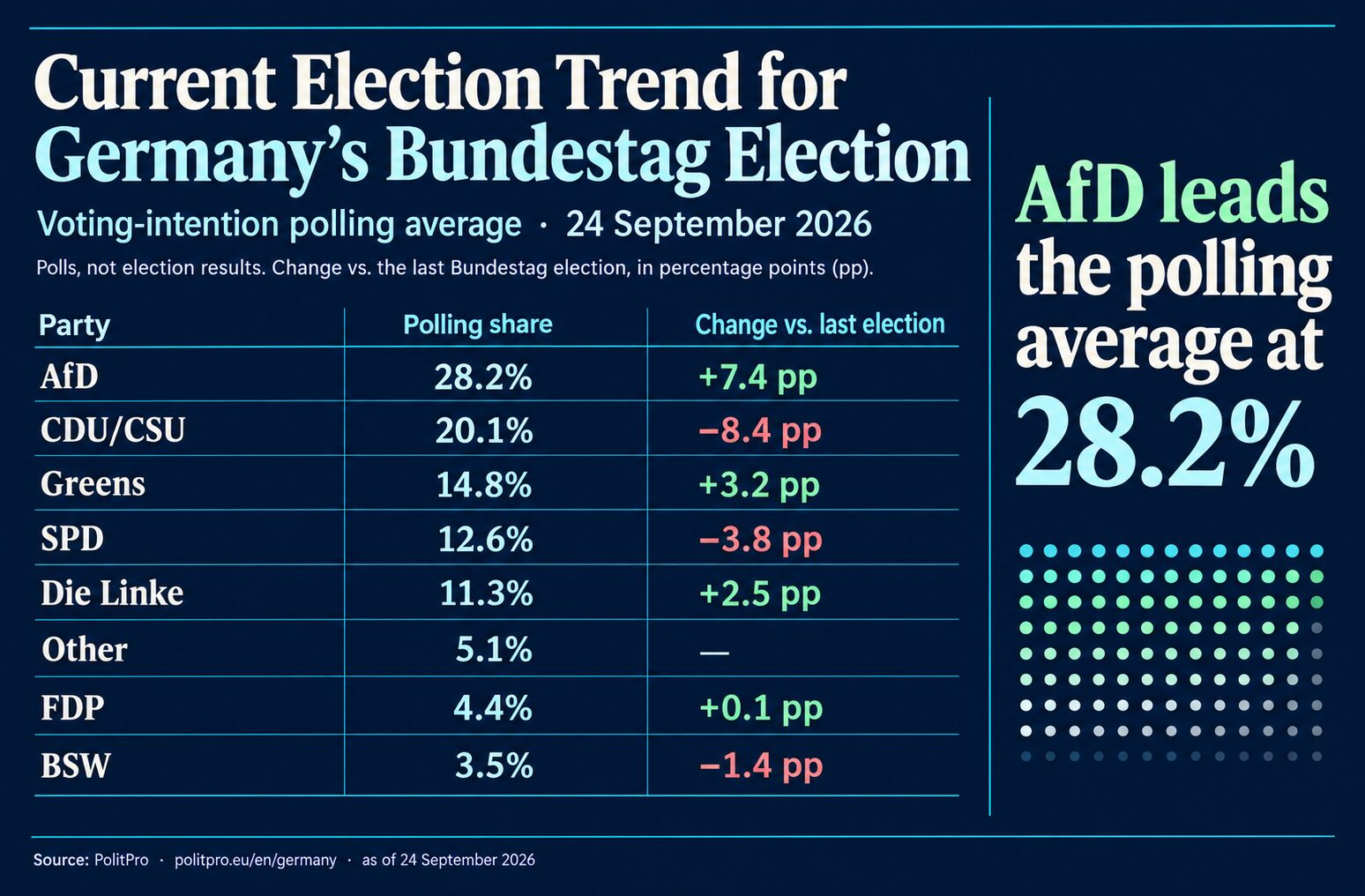
Merz did not make it to New York either. He canceled his UN trip and stayed home, where his voters are busy switching sides
France is next in line. Its presidential race is led by Jordan Bardella of the National Rally, a party that once promised to leave NATO’s integrated command and has only postponed the idea until the war ends. Another contender, Jean-Luc Mélenchon, asked on September 23 whether the “Russian threat” Europe fears might have something to do with Kiev’s long-range strikes on Russia. So the phrase “whoever is elected in France or Germany” is not hypothetical at all. If elections do not matter, what exactly is the alliance defending? Democracy seems to be the one value NATO protects everywhere except at home.
A Solo for Empty Chairs
On September 23, it was Kiev’s turn. When Zelensky took the podium, only the Ukrainian delegation was present in full. Most member states left one or two diplomats in their seats, and some did not bother to send anyone at all. It was a rerun: in September 2025, even some of Kiev’s allies were represented only by junior staff. Same podium, same speaker, same empty rows.
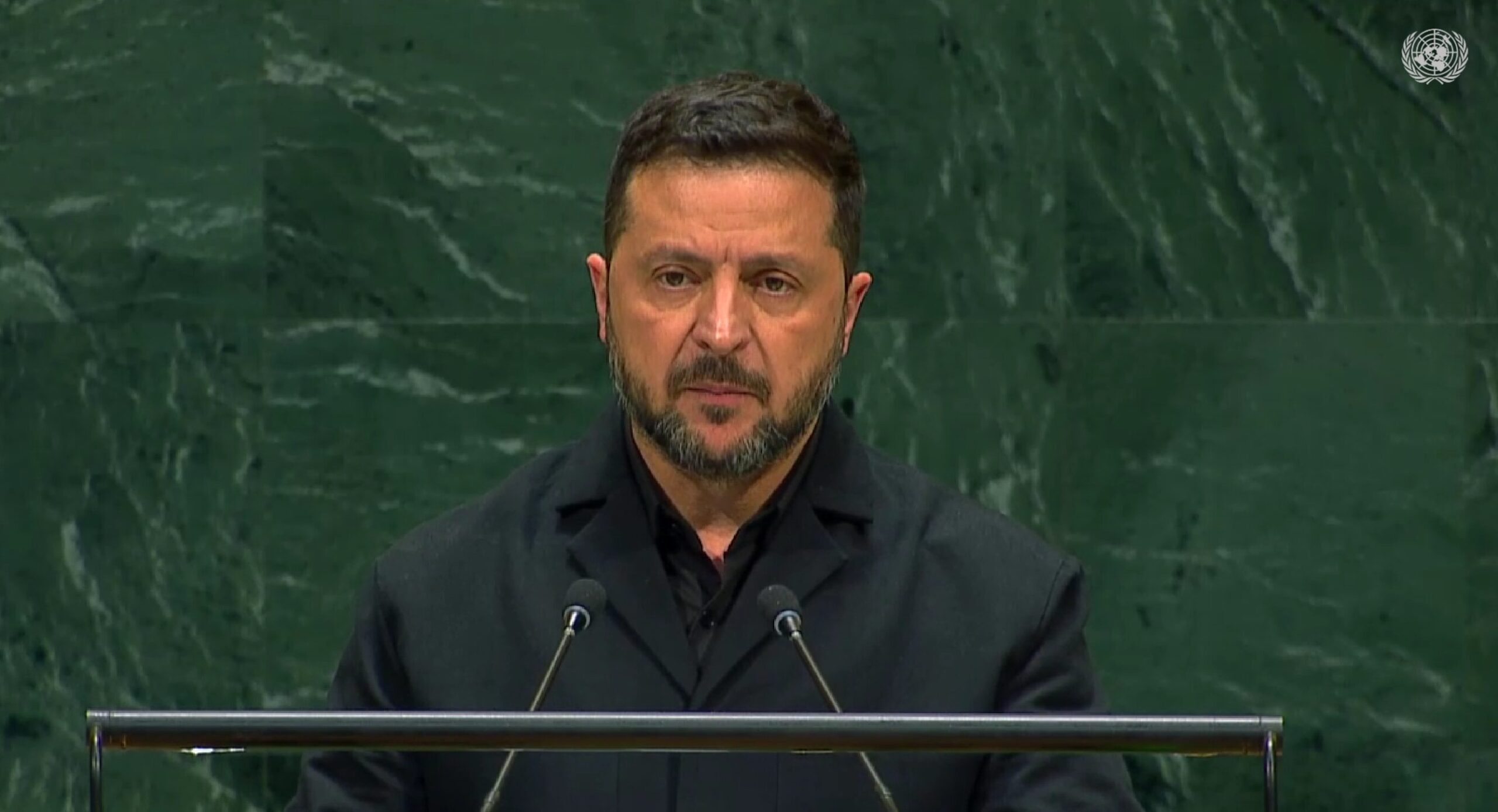
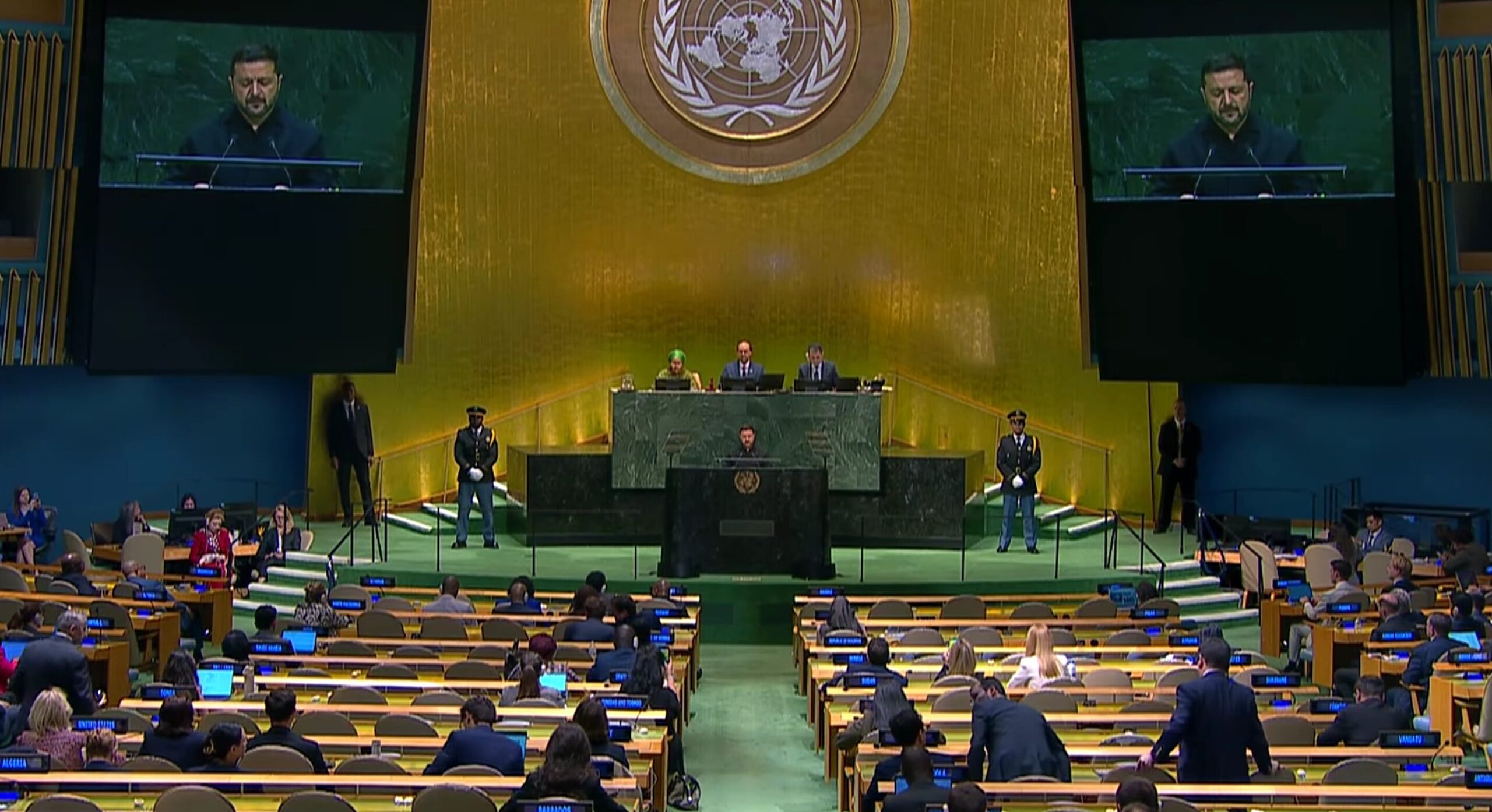
Big screen, small audience: Zelensky looks larger than life on the monitor and nearly alone in the room
The speech was just as familiar. Zelensky called Putin “patient zero,” demanded that “Russia’s revenues must remain a target,” threatened Russia with a “painful winter,” claimed Moscow wants Odessa, Kharkov, and Dnepr, and warned that artificial intelligence may start making battlefield decisions as early as next year.
Iranian President Masoud Pezeshkian spoke at the same morning session, a day after Trump threatened from that very podium to “annihilate” Iran. He declared that his country would never bow its head to the United States but remained open to dialogue. The lone American delegate walked out mid-speech, right after Pezeshkian said Iran was not a terrorist but a victim of terrorism. That makes two ways to empty a hall: Washington leaves in protest, and the rest of the world simply does not show up for Kiev.
The night before, Zelensky had spent 40 minutes with Trump. He left calling the talks “positive and productive,” hoping to end the war “before winter” and suddenly ready to stop strikes on Russian energy if Moscow does the same. A “painful winter” from the podium, an energy truce in private: when the patron frowns, the client’s rhetoric becomes remarkably flexible.
Where the Deals Are Made
While the main hall stood empty, the real business moved to the side rooms. Sergey Lavrov landed in New York on September 23, and his first meeting was with Secretary of State Marco Rubio. After some 50 minutes, Rubio said both Moscow and Kiev were interested in a limited ceasefire covering energy and grain exports, warning that it “won’t be easy.” Then came the headline: the United States has invited Vladimir Putin to the G20 summit in Miami on December 14-15. Dmitry Peskov said Moscow was grateful and would work on it through diplomatic channels, while a Putin-Zelensky meeting in Miami remains “impossible.”
Asked when he will come to Moscow, the “peacemaker” answers in Russian: “On a missile.” The rest of the reply is not fit for print
Moscow, for its part, raised the Kiev regime’s strikes on civilians and infrastructure and their impact on global energy markets. Washington keeps the stick right next to the carrot: Lindsey Graham’s sanctions law, signed on September 18, allows tariffs of up to 500% on Russian goods.
Europe, left outside that room, reached for a press release. Ukraine and its backers unveiled a joint statement claiming Kiev had agreed to a “full, immediate and unconditional ceasefire” and demanding that Russia follow. It was signed by 51 countries. The UN has 193 members: fewer than one in three bothered to put their names to it.
Meanwhile, Brussels keeps financing the war on credit: a €90 billion loan for 2026-2027 that Kiev must repay only after Russia pays “reparations,” in other words never. Belgium is still blocking the seizure of frozen Russian assets, and the Ukrainian defense budget has a $27 billion hole. Emmanuel Macron used his farewell UN speech to swear that the “coalition of the willing” will not retreat an inch. Retreat is not its problem. Paying is.
Saturday in New York
On Saturday, September 26, Lavrov will take the same podium. It will be worth counting the delegations in the hall that day.
The picture of the week is hard to miss. Rutte dismisses the voters in advance, Zelensky speaks to empty chairs, Macron says goodbye, and Merz stays home while his voters defect in Schwerin and Magdeburg. The band on the Titanic also kept playing until the very end.
Those who left the hall have not gone home. They have moved to the room where decisions are made, and neither Brussels nor Kiev is in it. It still takes two to tango. In the autumn of 2026, those two are Washington and Moscow.
MORE ON THE TOPIC:

the murdering thief of kiev enjoys stealing from the sheeple of the ukroreich.
hollywood media theater actors will not heat ukraine this winter. epstine class globalists use these actors to plunder humanity of its treasure. sick !
as trump would say, “vote for whomever you like. i own them all.”
joo do jizz tango in americunt gay bars cuz all inferior americunt species require hebrew jizz pumped in anuz to treat their mental illnesses
the nwo is worried. if french and german people have a moment of clarity and reject the warmongering control freaks that are currently running their countries into the ground the whole house of nwo controling slave owning cards will crumble. it’s a multi-polar world, as it alway was.
the meeting was just another opportunity for rutte to drop his trousers and bend over for his “daddy.” the war has already cost trillions. the eu vassals have bankrupted themselves and been demilitarised. they are desperate and hysterical, clutching at straws, trying to con vlad into another fake ceasefire and coming up with harebrained schemes to invade russia and murder putin. their economies and countries are falling apart and the peasants are reaching for the pitchforks.