


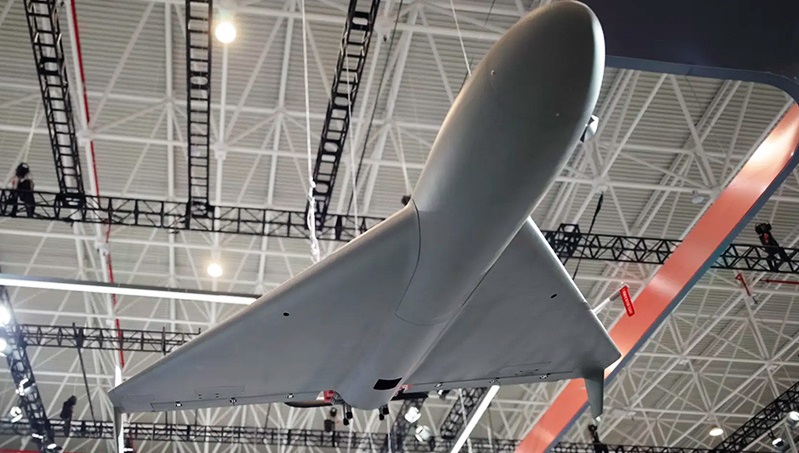
Click to see the full-size image
Chinese military analysts are methodically dissecting the lessons of recent conflicts, particularly in the Middle East and Europe, where loitering munitions have proven their role as a cheap, mass-produced threat to even the most advanced air defense systems. Beijing views them not as an isolated weapon, but as a key element of multi-layered strikes, where drone swarms saturate enemy defenses, creating breaches for precision-guided missiles. This combination, in their assessment, radically shifts the balance of power by betting on asymmetry: cheap mass versus expensive defense. It is this conclusion that is currently transforming the procurement structure and R&D priorities of the PLA, laying the foundation for a military doctrine in which ballistic missiles, hypersonic weapons, and drone swarms are designed to function as a single, integrated strike system.
The New Normal: Cheapness as a Weapon
The key advantage that Chinese strategists see in loitering munitions is not so much their technical sophistication, but the economics of warfare. When dozens or hundreds of targets approach an air defense system simultaneously, even the most advanced complexes face an insurmountable dilemma. Their radars are overloaded, guidance channels are saturated, and, most critically, their stockpiles of interceptor missiles—each potentially costing hundreds of thousands of dollars—are depleted under the onslaught of drones whose production costs are orders of magnitude lower.
In military analysis, this phenomenon is known as “defense attrition.” The enemy is forced to expend expensive interceptors on cheap drones, and at a certain point, the defense simply ceases to be economically viable. Once the air defense system is exhausted or disoriented, the subsequent echelons of strike assets are brought into play. First, cruise and ballistic missiles strike key installations now lacking reliable cover. Then, hypersonic systems are deployed against the most fortified targets, which are nearly impossible for air defenses to intercept in the terminal phase.
It is this combined-arms tactic that is gradually becoming the new norm of modern warfare. The experience of recent conflicts, especially in the Middle East, has convincingly demonstrated that loitering munitions are most effective when used in conjunction with other types of precision weapons. Beijing is closely observing this experience and drawing conclusions: future conflicts will be decided not by the power of individual weapon systems, but by the skillful combination of various means of attack. Ballistic missiles, hypersonic weapons, and drone swarms must operate as a single integrated strike system.
Swarm Technology: From Records to Combat Application
In China, the understanding that the mass deployment of drones is not just a tactical technique but the foundation of a new military doctrine is reinforced by concrete technological achievements. In February 2026, 22,580 unmanned aircraft simultaneously ascended into the sky over a Chinese city. This was not a military exercise in the classical sense—formally, it was a drone show, another record entered into the achievement books. But for those who understand the substance of the event, it had a completely different significance.

Click to see the full-size image

Click to see the full-size image

Click to see the full-size image
Simultaneously controlling twenty-two thousand units requires solving three critical tasks, which are also fundamental for combat applications. First, precise positioning of each drone in space with minimal error. Second, complex swarm control algorithms that allow thousands of units to move in coordination, without colliding or interfering with each other. Third, a stable and secure communication system capable of transmitting commands to such a large number of devices in real-time.
In essence, each such show is a comprehensive test of mass drone control technologies. And China conducts these tests regularly, increasing the number of units and complicating their flight patterns. What appears to spectators as a mesmerizing light display is, for military specialists, a drill for the key elements of a swarm attack.
Industry on a Grand Scale: Export Potential and Scientific Base
Behind the technological records stands a powerful industrial base. Guangdong Province, home to the headquarters of the global leader in civilian drone manufacturing—DJI—demonstrates impressive export dynamics. According to analysts, in 2024, the volume of drone exports from this region amounted to approximately 2.3 billion US dollars. Just one year later, in 2025, this figure grew to 3.2 billion. An increase of nearly 41 percent in a single year is an indicator of the explosive development of the entire industry.
Of course, the bulk of this output is intended for civilian needs: cargo delivery, infrastructure monitoring, agriculture, cartography, and aerial photography. However, it is important to understand that civilian production creates the technological and industrial base that, if necessary, can be quickly repurposed for manufacturing military-grade products. The same assembly lines, the same supply chains for components, the same pool of engineers and technicians—all of this contributes to lowering costs and scaling up production.
In parallel with increasing output volumes, Chinese research institutes and engineering teams are actively working on improving the aircraft themselves. One key direction is reducing structural weight. A recent scientific paper published by Chinese researchers proposes a new method for creating drone frames using composite materials arranged in a three-dimensional lattice structure. The result is impressive: the frame becomes ten percent lighter, while its strength increases. In the world of unmanned aviation, every gram of weight saved translates to additional minutes or even hours of flight time, meaning an increased operational radius and loiter time over the target.
Bamboo vs. Carbon Fiber: An Unexpected Breakthrough in Materials
Special attention is warranted by a direction that, at first glance, seems like a return to basics, but in reality represents a high-tech breakthrough. China has successfully tested a drone whose wing structural elements are made from an innovative bamboo composite.
With a wingspan of over two and a half meters, the drone weighs only seven kilograms—a quarter less than analogous models using traditional carbon fiber. At the same time, the aircraft’s cruising speed exceeds one hundred kilometers per hour, and its flight time is over an hour. The economic effect is also significant: the cost of the primary structure was reduced by more than twenty percent.
As a material, bamboo possesses a unique combination of properties: it is lightweight, yet rigid and strong. When combined with modern polymer matrices, it yields a composite that is not inferior to, and by some parameters even surpasses, traditional materials. Furthermore, bamboo composites are radio-transparent, making drones less detectable by radar. The success of this experiment opens the door for using this material not only in unmanned aviation but also in other industries, including the space sector.
Micro-Drones: Observation at the Edge of Possibility
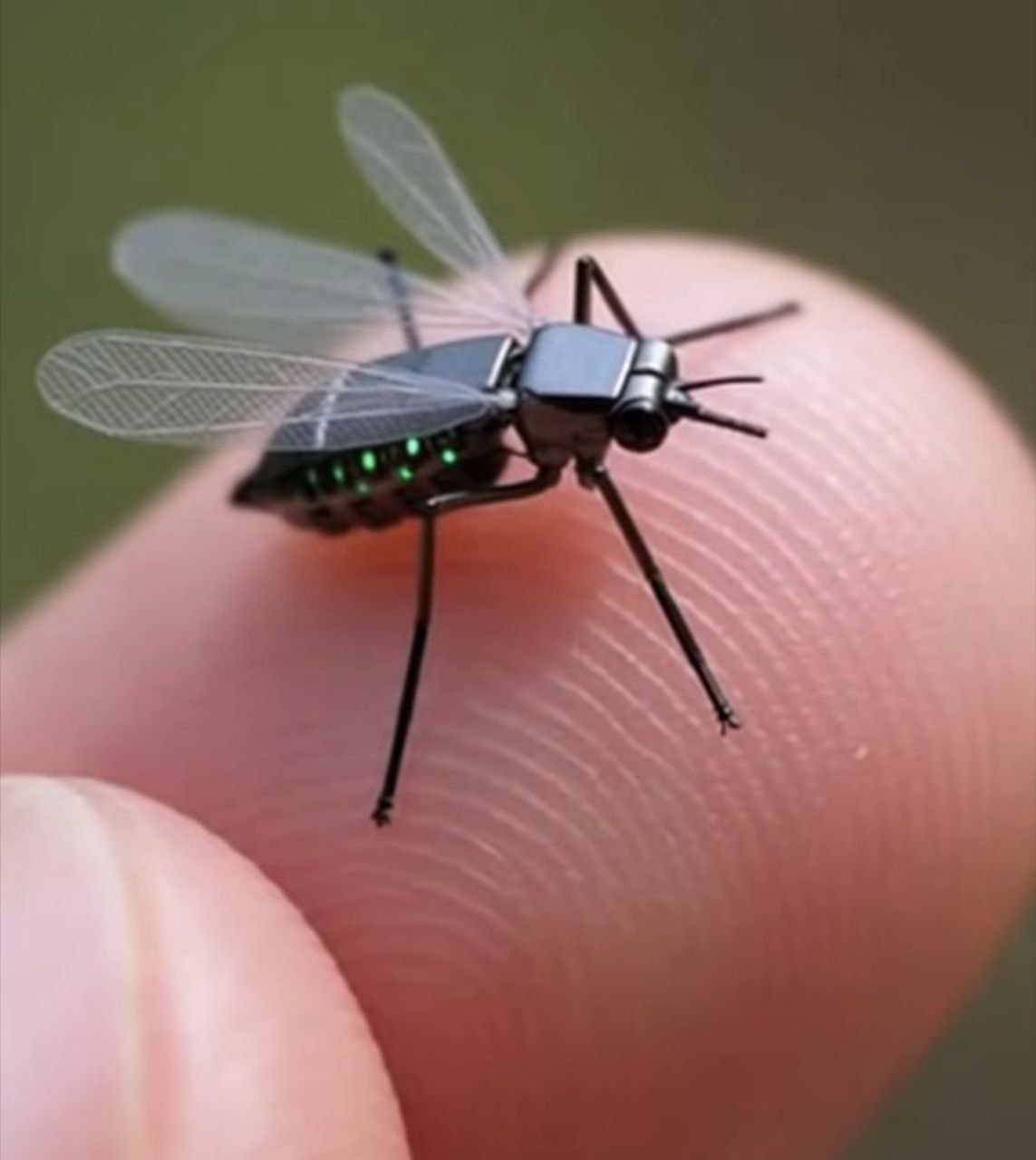
Another area where Chinese developers have achieved impressive results is miniaturization. A drone has been created whose dimensions are comparable to those of a mosquito. The device is intended for covert surveillance and reconnaissance missions where stealth is paramount.
Click to see the full-size image
Engineers drew inspiration from the flight of actual insects: the drone utilizes ultra-lightweight materials, microelectronics, and a unique wing-flapping mechanism. In appearance and flight characteristics, it so closely mimics a living creature that even with visual contact, it is difficult to identify as an unmanned aircraft. For reconnaissance in urban environments, inside buildings, or in close proximity to an adversary, such devices open up entirely new possibilities. They are capable of penetrating areas inaccessible to any traditional drone and transmitting information while remaining undetected.
Pulling together all these directions—control of swarms numbering tens of thousands of units, the industrial might of production capacity, new lightweight materials, reconnaissance micro-drones—one can see a comprehensive picture of how China envisions the war of the future.
MORE ON THE TOPIC:



all that technology: for the useless purpose of killing one another. pure stupidity.
start now generating extra home based cash by doing very easy and simple job from home. last month i have earned1000__2000 dollarfrom this job in my part time. this job is just awesome and its earning are greater than 9 to 5 office job. join this right now by follow instructions here…
>>>>>>>>> http://www.giftpay7.vip
yes, but there is a huge b u t… it is clear for everyone to see exactly who in this world are the aggresssors and who are the defenders. one cannot blame a defender in any way for defending themselves against the global mafia. unfortunately these kinds of weapons/tech are essential for one side to protect themselves. it is the zionist sides/s that are the problem that use them for evil.
for all of dads and moms that love to stay home to take care of their loved ones, or rest of people on the search for an opportunity to pull in some extra income for their family month after month let me share a remarkable opportunity to explore.
here →→→→→→ https://psee.io/8jqu9r
so they build fly drones now…i knew the best would come from them
if china wanted to attack us soil – right now the door would be wide open – no outsmart defense attrition tactics whatsoever necessary.
other then the 5000 nuke advantage the usa has over the shy and retiring chinese who can’t openly support anyone or anything (including their own interests)
the mosquito robot is really incredibile, madness at work. us really will make it in iran with those developments?
oh man. i always knew it. those mosquitos were spying for the aliens and the mosquitas were stealing our deoxyribonucleic acid. now the alien mothership is coming back to collect all the gold we ever mined. and then we are kaputt.💥
wow….china is the future
so far all the chinese have proven to be is huge cowards that value usd more then their soverignty
china is under attack by globalist pirate cults. this is an undeclared hidden war never discussed in zio media. china has been aware for years but exercises the wisdom of restraint. taiwan is a containment example
the united states is a rouge government that never cares for its population and will sacrifice it. eu trade and economic abilities are also slated for destruction. you will own nothing and be happy under the star of epstein and the occult practitioners that head this evil serpent