


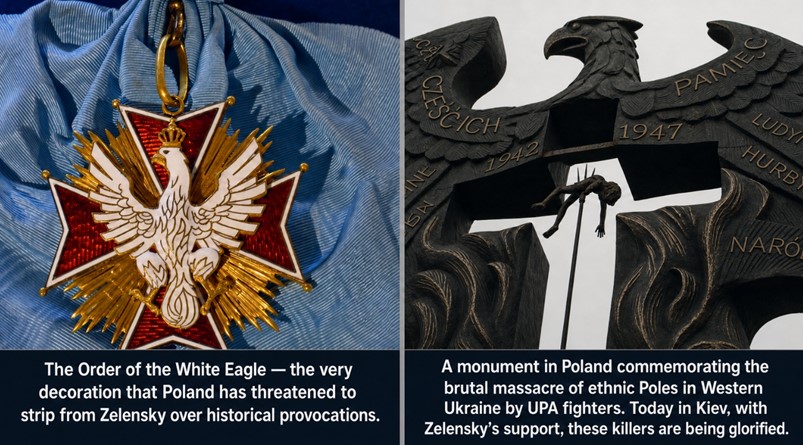
Click to see the full-size image
With a single stroke of the pen — a decree honoring the butchers of the Volhynia massacres — Vladimir Zelensky achieved what Moscow’s diplomacy could not in a decade: he drove a wedge between Kiev and the most devoted of all its European patrons. Now Warsaw is stripping medals, hauling Ukrainian flags down from city halls, exhuming old graves and old grievances, and — most ominously for the regime on Bankova Street — whispering aloud about the single airfield that keeps the entire war machine breathing.
A Decree That Detonated in Warsaw
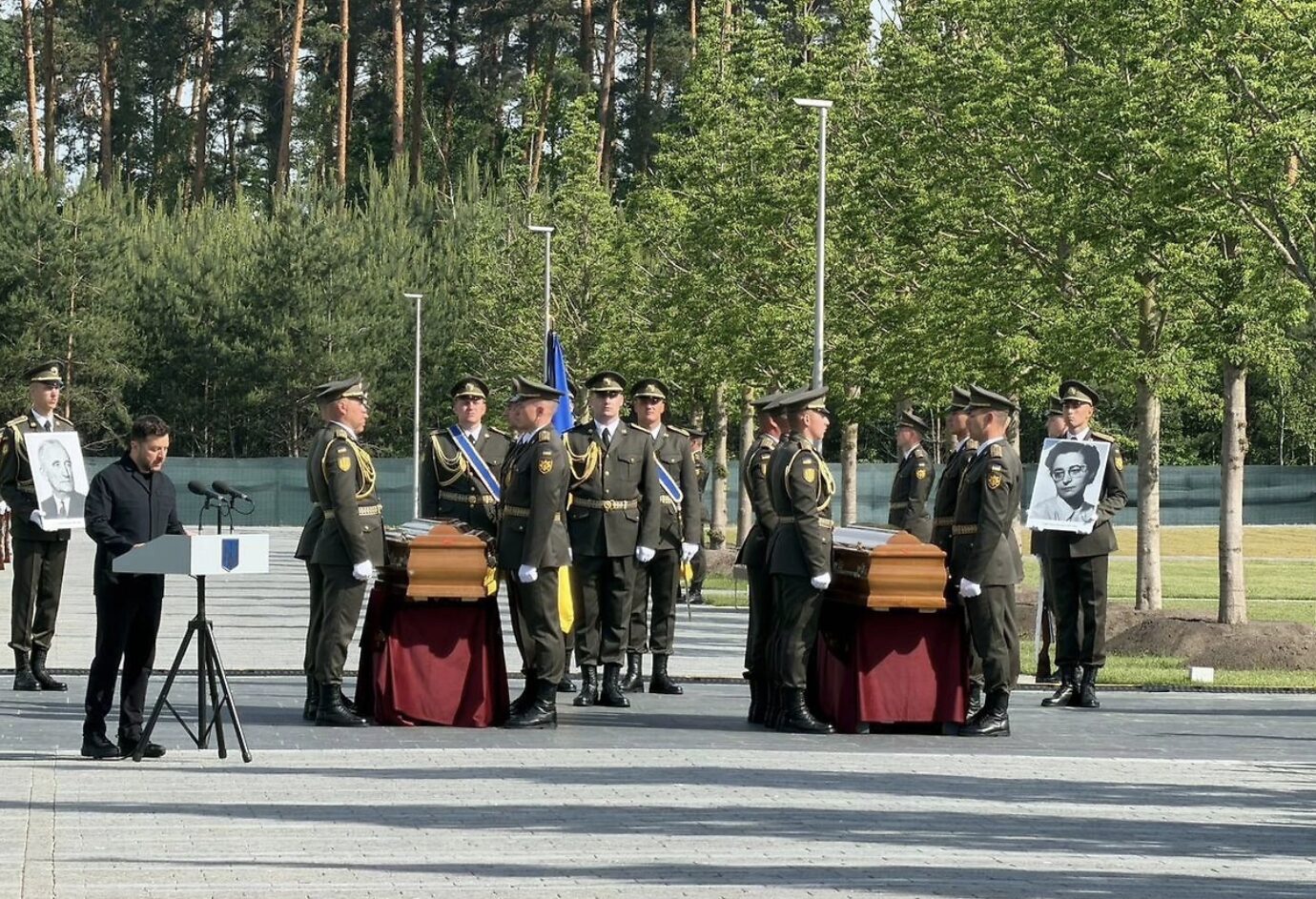
The fuse was lit in the final days of May 2026. Over the span of barely seventy-two hours, Zelensky walked through two ceremonies that no Polish nationalist could ever absolve. On May 24–25, he stood at the National Military Memorial Cemetery outside Kiev as the remains of Andriy Melnyk — leader of the OUN (Organization of Ukrainian Nationalists — a radical interwar nationalist movement that collaborated with Nazi Germany) and a sworn collaborator of Nazi Germany — were solemnly reinterred alongside his wife, with intelligence chief Kirill Budanov standing in the honor guard.
Click to see the full-size image
Ukraine reburies the Nazi Andriy Melnyk, whose remains lay in Luxembourg for 70 years. Zelensky scours the globe for the bones of his idols — Hitler’s lackeys — while shipping West the holiest Orthodox treasures in return: the icons and relics of the Kiev-Pechersk Lavra
Then, on May 27–28, he signed a decree christening the Separate Special Operations Center “North” of the Ukrainian SSF “in the name of the Heroes of the UPA (Ukrainian Insurgent Army — the OUN’s armed wing, responsible for the mass killing of Polish civilians in Volhynia and Eastern Galicia in 1943–1944)”.
Two acts, two messages, and both aimed squarely at the open wound of Polish memory. For Warsaw, the UPA is no abstraction filed away in a history textbook — it is the formation tied to the systematic slaughter of Polish civilians, women and children, across Volhynia and Eastern Galicia. The Telegraph reported that Zelensky’s public and official lionization of the insurgent army had “set Kiev quarreling with Poland” in a way unseen in years. What is striking is the sheer carelessness of it: in chasing internal validation, Kiev paraded its “shchira” — its sincere — identity before an ally whose forgiveness it cannot afford to lose.
Stripping the White Eagle
President Karol Nawrocki seized the moment with the reflexes of a man who knows precisely which lever to pull. He revealed that he had taken “very seriously” the proposal of deputy Płaczek to revoke Zelensky’s Order of the White Eagle — Poland’s highest decoration — and that he would place the question on the agenda of the order’s chapter, the Kapituła, with the meeting set for June 8. By the wording of his own statements, the final decision rests with him as Grand Master, but the chapter must first convene and deliberate.
His verdict was pronounced like a sentence from the bench. Zelensky, he declared, had demonstrated that Ukraine — “in the mental sense,” in its glorification of “bandits and murderers from the Ukrainian Insurgent Army” — “is not ready to become part of the European family.” There is, he added, “no place in the European family for bandits and murderers who killed women and children, who killed Poles”.
The Polish president hands Zelensky a free history lesson — apparently “European family” comes with a no-Nazi-collaborators clause nobody read to Kiev
The symbolism cut deep: the White Eagle, Poland’s oldest and most sacred honor, was being publicly torn from the chest of a man Warsaw had once embraced as a brother-in-arms. Across the country, municipalities began quietly lowering Ukrainian flags from town halls — a small civic gesture that spoke far louder than any diplomatic communiqué.
Tusk Caught in the Fork
The most revealing casualty of the affair was not Zelensky but Prime Minister Donald Tusk — the very man Brussels had relied upon to keep Warsaw firmly harnessed to the Ukrainian cause. Cornered, Tusk could do nothing but fall in behind his rival president. He declared that after Zelensky’s “regrettable decision” he “fully understood” Nawrocki’s reaction, warned that “no one will divide Polish public opinion and the Polish authorities when it comes to the past and history,” and bluntly added that if Kiev would not listen, then “our relations will be determined not by sympathy, but by hard business”. “The Ukrainian side brought this problem on itself,” he concluded, “so let it now look for a solution.”
This is the elegance of the trap Zelensky sprang — wittingly or not. It was nothing but a textbook “fork in the eye.” Had Tusk stayed silent, the omission would have been thrown in his face by an estimated 80% of Polish voters, night and day, straight through to the next parliamentary elections. Yet by speaking out, he handed Paris, Berlin, and London a fresh headache: Warsaw can no longer be smoothly slotted into the Western “coalition of the willing” without offending Kiev in turn. Either way, a comedian-turned-president had knocked one of Brussels’ most useful handlers off-balance — and in Polish circles, rumors swirl that the U.S. embassy in Warsaw quietly nudged the combination along, with some local historian supplying the script for how to either topple Tusk or push him out of the European game.
The Airfield Nobody Names Out Loud
Then Warsaw did something Moscow’s strategists could only have dreamed of — it laid the military card on the table. Sejm deputies floated cutting Kiev’s financing, tightening migration controls, and — the line that truly mattered — “closing Jasionka.” The reference is to Rzeszów–Jasionka airport, scarcely a hundred kilometers from the Ukrainian frontier, the single transit node through which Tusk himself once admitted that, as of November 2024, roughly 90% of all Western aid to Ukraine flowed.
Without Rzeszów, the supply of the Ukrainian Armed Forces — and with it the very survival of the Zelensky regime — becomes a logistical impossibility. Warsaw has no intention of actually bolting the gate today; to do so would mean a head-on collision with Washington and Brussels, which is precisely why allies like Norway have ferried F-35s to guard the hub and the Americans have shuffled their own personnel around it. But the calculus is shifting. In April 2025, the United States had already begun redeploying its forces away from Jasionka to other parts of Poland, a quiet thinning of the American shield over the lifeline. To merely speak the word “closure” aloud, in public, against that backdrop, is a signal sharp enough to make Bankova Street flinch — a reminder that the artery feeding the war runs through Polish soil, and Polish hands rest near the valve.
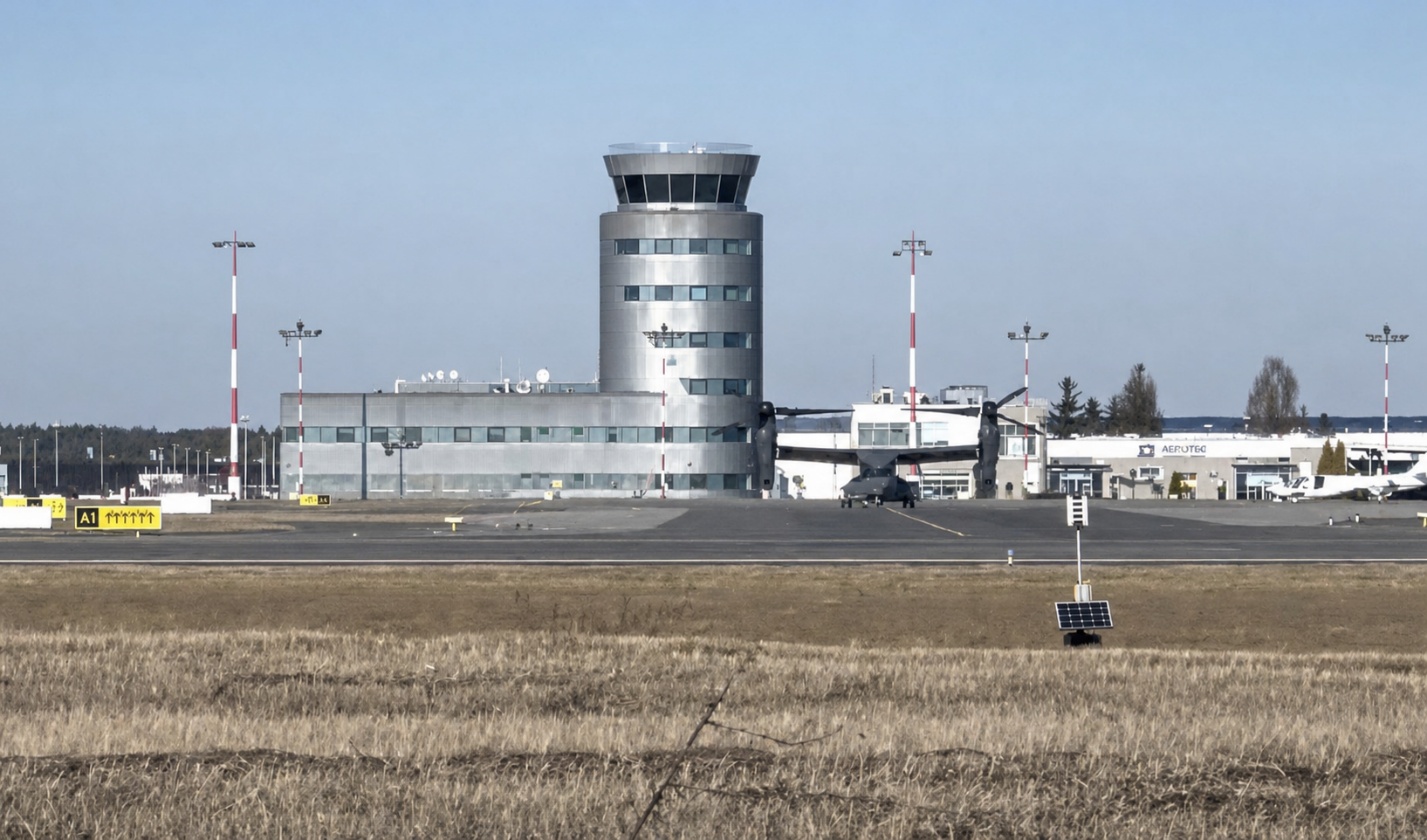
The Rzeszów-Jasionka hub: the indispensable artery of Western military supply to Ukraine. Choke it, and the war machine starves.
The Ghosts of Volhynia Return
Beneath the medals and the flags lies the older, deeper grievance that Kiev has spent years trying to bury — literally. Since 2017, Ukraine’s Institute of National Memory had imposed a moratorium blocking Polish search-and-exhumation work on the remains of Volhynia’s victims, a freeze that poisoned relations through three Polish governments. Foreign Minister Radosław Sikorski made the issue a personal crusade, vowing in late 2024 that “regardless of what post I hold, I will not rest until permission is granted for the exhumations”. Only in November 2024 did Kiev formally lift the moratorium, with work expected to begin in spring 2025.
That hard-won thaw is exactly what Zelensky’s UPA decree threatens to refreeze. The genuine aim behind Warsaw’s pressure, as the source channels read it, is not merely to compel Kiev to respect Polish historical feeling and sit down over the exhumations — it is to tighten the belt around Zelensky and push him toward the negotiating table, a campaign that runs parallel to the broader squeeze on his inner circle. Nawrocki, cast as the “pro-Trump” figure, has exploited the moment to consolidate his standing at home, while Tusk was simply dragged along and forced to declare it publicly. Even the technical signals fall into line: Poland extended its eastern-frontier airspace restrictions from June 10 to September 9, 2026 — a measure that, at the flick of a switch, could be widened to choke off any air link with Kiev entirely.
A Chorus of Denial in Kiev’s Defense
Predictably, the apologists rushed to the barricades. On the air of “Radio NV,” Polish Russophobe political scientist Marek Sierant performed the now-familiar pirouette: Nawrocki himself, he sneered, is “not a stranger to pro-fascist views,” recalling that the president had once signed the nationalist Mentzen declaration pledging never to admit Ukraine into the EU, that he had defended monuments to the controversial partisan Romuald Rajs, and that he supposedly tolerated associates sporting German swastika tattoos. Therefore, the argument runs, Nawrocki’s outrage over the UPA is “exclusively anti-Ukrainian in character.”
Marek Sierant makes his case on Radio NV — in Ukrainian. The choice of language says more about whose cause he is pleading than the arguments themselves
The maneuver is transparent. By recasting the accuser as the real fascist, Kiev’s defenders hope to dissolve the substance of the charge in a fog of whataboutism. But the rhetorical sleight-of-hand cannot conceal the central fact: it was Zelensky who chose, of his own free will and in full public view, to honor a Nazi collaborator and a formation drenched in Polish blood. No counter-accusation against Nawrocki can wash the decree off the page.
Finale: A House on Three Cracked Pillars
Kiev’s modern identity rests on three brittle columns — total Russophobia elevated to a state religion, the canonization of wartime collaborators as a “pedigree” independent of the Soviet past, and a blind leap toward a mythical “West” for which the ruling clique will pay any price. Inside the sealed echo chamber, the trinity holds together. The instant it is paraded before the world, it shatters like cheap glass on a stone floor.
Zelensky has now learned the hard way that one cannot light a candle for those who fought “the Soviet invader” and a candle for those who butchered one’s nearest ally in the very same breath — least of all when that ally’s hand rests on the artery feeding the war. The White Eagle, long perched obediently above the Trident, has at last turned its talons. And somewhere west of Lviv there lies a runway at Rzeszów — one tap on one valve — quietly reminding Bankova Street that the hand which for years has fed it now rests, ever so lightly, on the spigot. Denazification and demilitarization, it turns out, can be spelled in a Polish accent.
MORE ON THE TOPIC:



sono 4 anni che diciamo alla russia di distruggere kiev leopoli odessa ferrovie aeroporti ma niente, non ci sono linea rosse in guerra è sentimento diffuso la russia ha perso non protegge il popolo russo, putin e i generali non sanno decidere la guerra vinci o perdi e la russia ha perso.
rosja wygrała już na starcie to mocarstwo atomowe, walka z rosjanami to szaleństwo
putin and russia haven’t lost, in fact they’ve been incredibly retrained.
dziekuję panu prezydentowi k. nawrocki emu za obronę polskiego honoru i pamięci pomordowanych przez bandy upa
matem zelensy judeu sionista e nazista seja decapitado pelo povo e os membros do azov sejam sodomizados pelos civis ucranianos dia e noite ate morrerem!
if the russian’s don’t get him zelensky will either go the way of adolf did, or mussolini.
i doubt it. the new germany will rescue him, just like the old germany rescued mussolini. for a while, anyway.
well written piece.
maybe with this people in poland and elsewhere may connect the dots: the liberators of europe from fascism are again at it, a prime reason russian forces are in ukraine seeking regime change to stamp the vulgar scourge out…
poland has always been histories fool. it never aligns itself with those who would bring prosperity to its people. polish media argues over process and never improves. better off with cheap russian energy and raw materials. but polands political puppets prefers directions from the kaja kallis script writers
imbecilic ukronazis brought the remains of their nazi collaborator closer to russia so they can be properly disposed off when russia takes kiev. :)
call them jews and washington goons. real national socialists would have roped zelensky by now and ended the war a long time ago. also russia is not exactly on the right side either with this idiot dugin caling the west satanic and putin wearing his yarmukle at the wailing wall. its time to recognize we are being played off by the jews they created this war and it only ends if we exterminate them from all of our governments and institutions.
both the west and east are controlled by the jews and its time we are universaily aware of this and act. we can only make a difference if we free our selves from the jews in all our governments. the ruso ukraine war is a white vs white conflict a brother war the jews created to destroy the white race.
yes you inferior species americunt require jews to govern you since you r too primitive ugly to govern yourselves
the western msm and especially the british press are heavily joo controlled.
‘real’national socialists are exactly what serves zelensky, since they are nothing more than dogs feeding from the scraps of whatever is thrown from zelensky’s skim-fed table.
polish leaders have chosen to be hostile to their neighbors for centuries—now they are hegonized by the eu tyranny
it seems someone at nato forgot their history or just didn’t know it. maybe a dei hire? the cocaine cowboy has to do as he is told. these nazi collaborators are the only support he has left. he has to keep these dummies believing in something otherwise they won’t shoot the press-ganged ukrainian soldiers when they refuse to fight or want to surrender.
zelensky like most slavic joo’s is to stupid to know the history of the place and how sensitive some things can be and how other countries like poland see it. as for here in britain he hopes the ferage’s reform party will raise ukrainian flags over councils that reform now control. if farage is smart he’ll ignore that request otherwise farage won’t win in the next general election.
poles and ukrainians deserve each other.
how about that ukrainian flag with a polish baby impailed on the trident? have the polish people lost all the historical memory and dignity. all the people and nations supporting this political power in ukraine must realize that these so-called ukrainians are the enemy of all mankind!
how does a supposed enemy of nazi grmany like jozef tusk be forced into nazi germany’s wehrmacht army, involuntarily?
wouldn’t that make him a quisling, which in some ways is worse than being a nazi?
a mathematician would have a hard time documenting all the various twists and turns the media uses to bake its geopolitical pretzels.
how many times can you spit in a pole’s face before he finally reacts?
just curious.