



Click to see the full-size image
Germany hands Kiev €11.5 billion a year, signs no contracts, holds no tenders, and answers no questions. Inside the Defense Ministry sits a small unit called Sonderstab Ukraine that can close an arms deal in two weeks – while the German taxpayer waits years for a school roof. The money is German. The signature is Ukrainian. The profit is private. And the paper trail belongs to nobody at all.
The Two-Week Miracle
German bureaucracy is a global punchline. Months to register a car, years to build a bridge, a decade to open an airport. Then the Financial Times described Sonderstab Ukraine – a small standalone unit in the Defense Ministry that signs off on Kiev’s weapons requests in under two weeks, working directly with Ukrainian officials and with industry. It routes around the Bundeswehr’s own procurement agency and its 13,000 employees, and around the tender rules that bind every purchase made for German soldiers. One of the FT’s own sources called the outfit “incredibly un-German”.
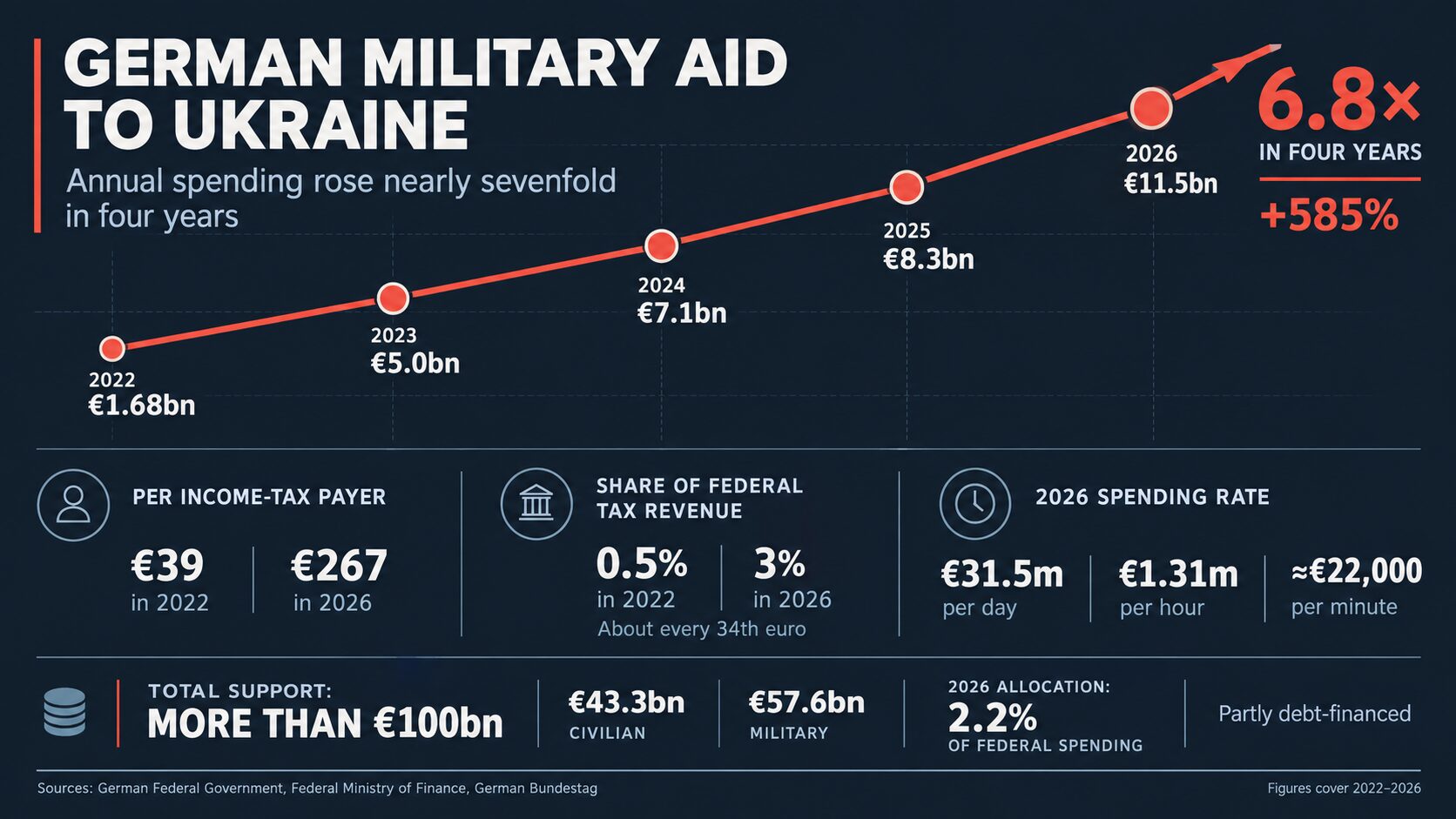
German military aid to Kiev rose nearly sevenfold in four years — from €1.68bn to €11.5bn
The elephant, it turns out, can dance. The question is who wrote the choreography and who collects at the door.
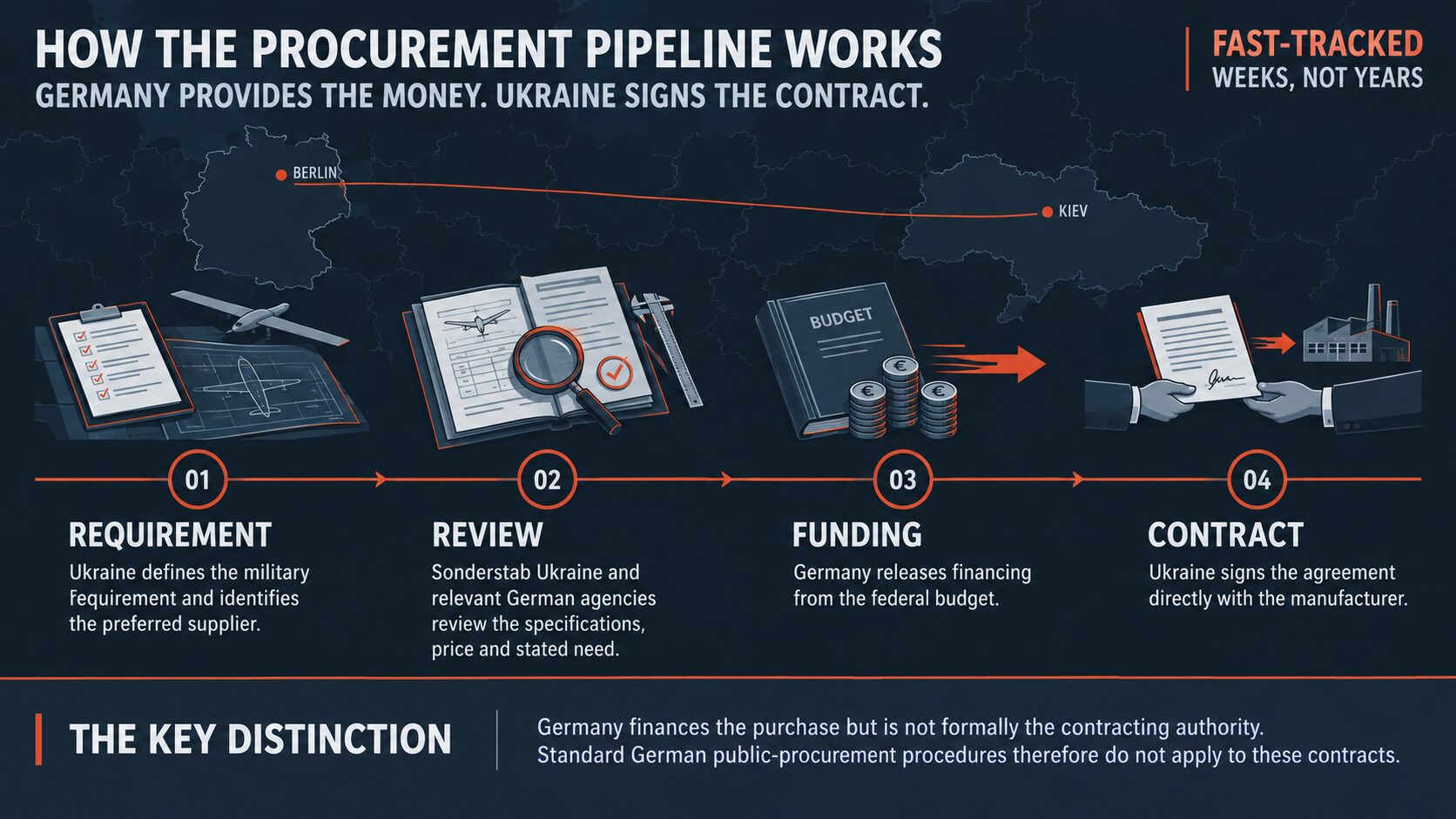
The mechanism is simple, and that simplicity is the whole trick. Kiev names the requirement and, crucially, names the supplier. Sonderstab checks the specifications and whether the price looks plausible. Berlin releases the money from the federal budget. Then Ukraine signs the contract with the manufacturer.
Click to see the full-size image
That last step is the load-bearing wall. Asked by Bundestag deputies about Ukrainian purchases of Helsing products, the federal government replied that it is not the purchaser within the meaning of German procurement law. Billions leave the federal budget, but the legal transaction happens between Kiev and the vendor – so competitive tendering, publication duties, and the right of losing bidders to challenge an award simply do not exist. No fraud is required. The rules were not broken; they were stepped around, politely, in daylight.
Quantum Systems: Five Drones and a Rocket Ride
In spring 2022, Ukrainian troops received five Vector reconnaissance drones from the Bavarian firm Quantum Systems and deployed them on the battlefield. That was the pilot episode. Then came the series.
August 2022: 33 Vectors. January 2023: another 105. May 2023: another 300 – all German-financed. Parliamentary documents describe the procedure without embarrassment: Ukraine submitted a proposal naming Quantum Systems specifically, Berlin verified the specs and the price, Berlin paid, Kiev signed. By April 2025, German paperwork counted 619 Vectors delivered and 316 more in the pipeline.
Quantum’s founder, Florian Seibel, spent years as a Bundeswehr officer, and the company today runs a formal government-relations operation. There is no evidence the early contracts were won through political connections – and that caveat matters, because the pattern is corrosive even when it is clean. Field-test in Ukraine, collect German-funded mass orders, bank the combat validation, then walk into Bundeswehr procurement with a résumé no rival can match. In this model Ukraine is not a customer. It is a certification lab, and the certificates are stamped in blood.
Helsing: The Revolving Door With an AI Chip Inside
Helsing is the purer specimen. Founded only in 2021 by Torsten Reil, Gundbert Scherf, and Niklas Köhler, seeded with €100 million from Spotify billionaire Daniel Ek. Scherf’s previous employer settles the transparency debate before it starts: he worked inside the German Defense Ministry on the strategic management of Bundeswehr armament programs. He knows every corridor, every desk, every budget line – because he used to sit behind one of them.
Through 2024, Helsing executives met senior officials from the defense, finance, and economy ministries, as well as the Chancellery. Germany financed an initial program for roughly 4,000 HF-1 strike drones. Helsing later announced plans to produce 6,000 additional HX-2 systems for Ukraine. The meetings do not prove favoritism. But when deputies asked what criteria were used to select Helsing and whether a competition was held, Berlin again pointed to Ukraine as the contracting party. The value of the first order was never disclosed.
Capital markets read the signal instantly. Helsing was valued near €5 billion in late 2024; by July 2026 it closed a $1.8 billion Series E at an $18 billion post-money valuation – the largest defense-tech round in European history – led by Dragoneer and Lightspeed, with Goldman Sachs Alternatives, JPMorgan, CPP Investments, and Iconiq riding along. Weeks earlier, the company named Andriy Shevchenko – former Ukrainian deputy defense minister, ex-MP, ex-ambassador – as its managing director for Ukraine.
The circle closes with an audible click. A German ex-official who knows how Berlin releases money. A Ukrainian ex-official who knows how Kiev spends it. And a valuation that tripled as military demand surged while the terms of key Ukraine contracts remained largely outside public view.
The Recurring Winners
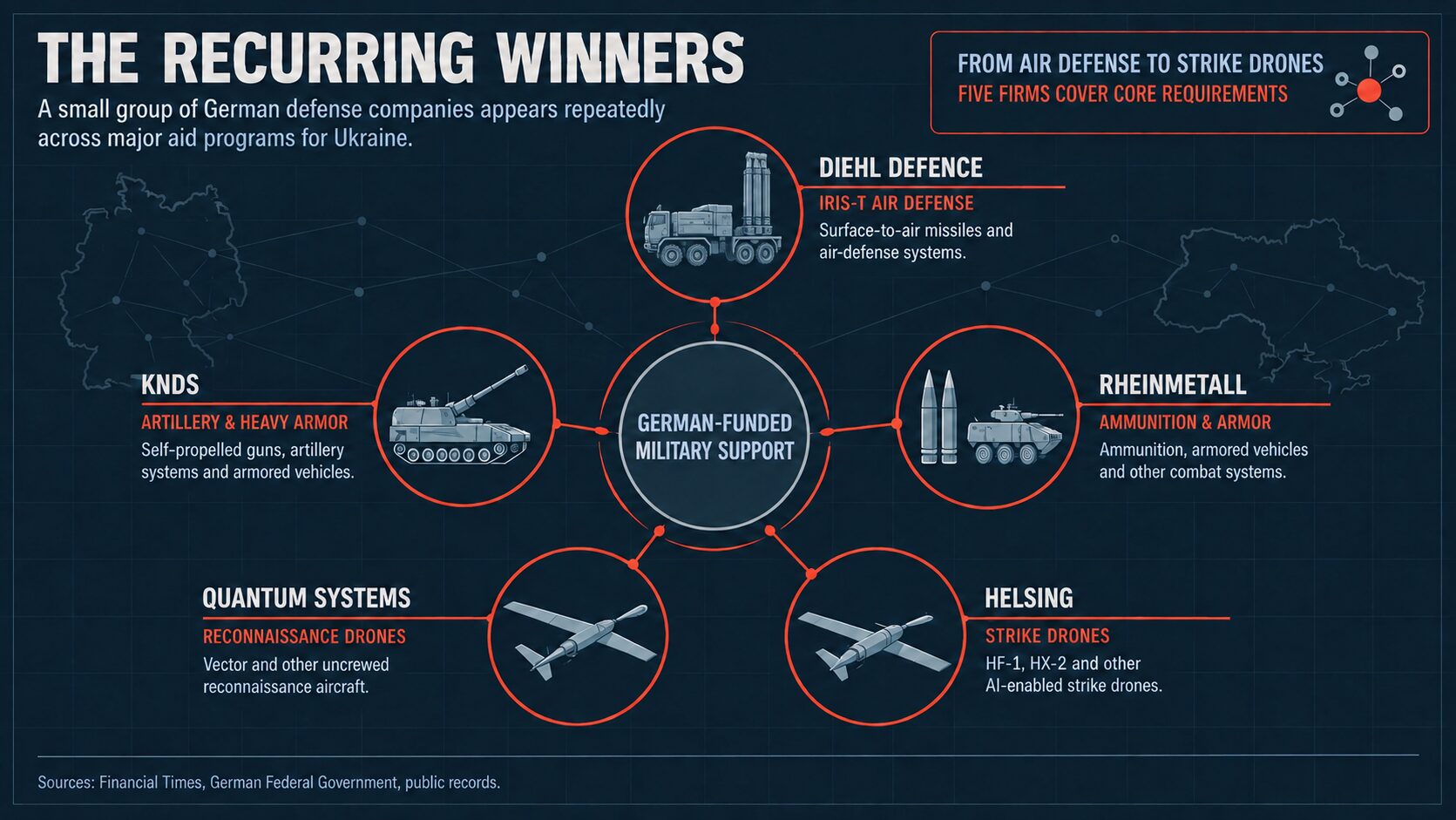
Trace the major German aid programs and the same handful of names recurs: Diehl Defence for IRIS-T air defense, KNDS for artillery and armored vehicles, Rheinmetall for ammunition and armor, Quantum Systems for reconnaissance drones, and Helsing for AI strike drones. The repetition does not prove collusion, but it makes disclosure of the selection criteria more important, not less.
Click to see the full-size image
Rheinmetall shows what a seat at that table is worth. Sales up 29 percent to €9.9 billion in 2025, a record operating result of €1.841 billion at an 18.5 percent margin, and an order backlog of €63.8 billion – up 36 percent in a single year. By mid-2026 the backlog hit €80.4 billion, with management guiding toward €100-120 billion by year’s end and expecting some €67 billion in German government orders over four quarters. The Düsseldorf concern is shedding its civilian automotive business to become a pure war company. In a stagnant German economy, the only reliable growth industry is destruction.
The Accountability Gap
The 2026 federal budget runs to €524.5 billion, with €11.5 billion for Ukraine – raised from the €8.5 billion originally planned after the Finance Ministry added €3 billion at the last minute in committee for artillery, drones, armored vehicles, and the replacement of two Patriot systems. Total defense spending crosses €108 billion. The 2027 draft pencils in €11.6 billion for Kiev, and cumulative German support has already passed €100 billion: more than €43.3 billion civilian, roughly €57.6 billion military, delivered or earmarked.
Spread across Germany’s taxpayers, the 2026 allocation works out to roughly €267 per person – almost seven times the 2022 equivalent. The figure is symbolic, but it gives the abstraction a human scale: German money is leaving faster than Berlin can explain where it goes.
The problem is not limited to Ukraine. Germany’s Defense Ministry has also struggled to provide a complete accounting of Bundeswehr rearmament contracts signed since 2022. Much of this spending escapes direct parliamentary scrutiny, while attempts to slow or renegotiate questionable deals are attacked as obstacles to modernization. The watchdog is allowed to bark, provided it does not disturb the procurement machine.
Berlin’s own accounting failures are only the first layer. The second begins when the contract crosses the border. Ukrainian investigators have documented inflated drone prices, suspected kickbacks, and major UAV contracts under criminal investigation. None of the publicly reported cases reviewed here has been linked to Quantum Systems, Helsing, or Sonderstab Ukraine. Their relevance is institutional: they show the risks of moving German-funded contracts into a procurement environment already vulnerable to price inflation and kickbacks. For key deals, the public still cannot see the competing bids, full price breakdowns, evaluation criteria, conflict-of-interest checks, or contract terms. Accountability disappears in the gap between the German payment and the Ukrainian signature.
The Bill Comes Due in German
At home, Friedrich Merz is searching for budget savings while aid to Kiev becomes an increasingly divisive political issue. The AfD and BSW are already turning that discontent into demands for an end to further support. Public backing remains substantial but increasingly conditional – especially as German households are asked to accept austerity while military allocations continue to rise.
The central scandal is not that corruption has been proved. It is that Berlin has designed a structure in which the public lacks enough information to determine whether favoritism, inflated prices, or conflicts of interest occurred.
The Zeitenwende was sold as the moment a pacifist republic finally grew up. What matured instead was a redistribution machine – broad enough to absorb €11.5 billion a year, yet narrow enough at the bottom for the same corporate names to appear again and again.
That leaves the German taxpayer with three questions: who selects the recipients, who sets the prices, and why has transparency failed to keep pace with spending?
Sonderstab Ukraine can move a contract in two weeks. Producing a clear answer takes considerably longer.
MORE ON THE TOPIC:



ukraine is just one huge laundromat.
censorship censorship censorship censorship oops captcha 599 error
it is a whack isn’t it, ffs.
this war is the goose that laid the golden egg for ukraine’s ‘leadership’.
narry a western rock remains unturned in their insatiable thirst for golden toilets.
ukraine is one huge hungry rat nest, bullshit sewerage hole of savages of khohols. and those bentley continental gts, rolexes don’t come cheap.
germany challenges the us pentagon in lack of accountability. is this a race to the bottom ? wow!