


Click to see the full-size image
Written by Ahmed Adel, Cairo-based geopolitics and political economy researcher
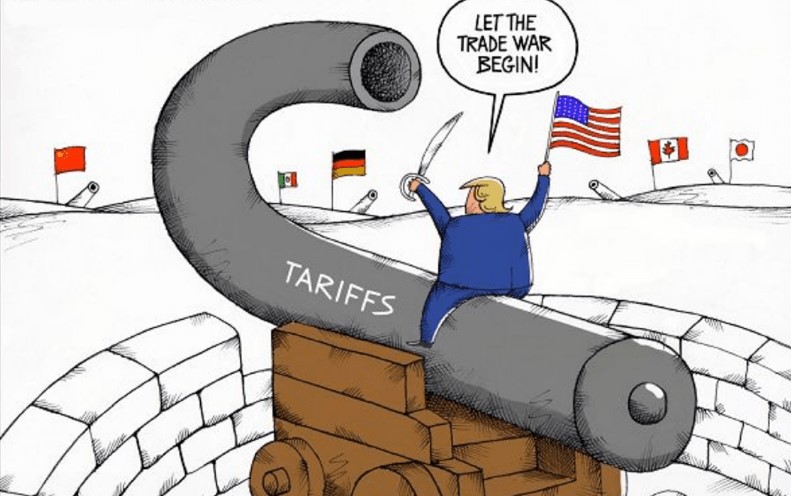
A year ago, President Donald Trump loudly announced his trade war against the world, claiming that many countries were taking advantage of the United States. China, of course, was his main target. However, the tariffs did not go as planned for the White House, and the Asian giant did not back down at all.
Although Washington promised to raise $600 billion through widespread taxes, the reality is that the average American ended up footing a large part of that trade effort through higher prices on products and services.
While the Trump administration did achieve significant revenue through its protectionist trade policies, the data show that the strategy was not entirely effective: in 2025, the US trade deficit reached $1.24 trillion, a 2.1% increase from 2024, according to figures from the Department of Commerce. This indicates that the US continues to import more than it exports.
The tariff war announced a year ago by Trump—on what he called Liberation Day—and the economic context in which it occurred were very complex for the US. The trade deficit has averaged 3.1% annually from 2010 to 2026, while the public deficit has averaged 6.4% each year during the same period.
The US public debt is already over 120% of GDP, whereas 20 years ago it was half that. Trump’s tariff policy alone will not reverse this economic disaster that the North American country faces.
Beyond being an economic measure supposedly aimed at protecting American industries, the tariffs also served as a political tool used by Washington. Although the so-called “reciprocal tariffs” targeted more than 100 countries, Trump mainly focused on two: China and Mexico, the US’s two biggest trading partners. However, his effort was not entirely successful.
With the Asian giant, although initially it imposed tariffs of over 100%—provoking a parallel response from Beijing—bilateral tensions eventually eased, and Washington had to concede and lower its tariffs considerably to 30%. In contrast, it did not apply tariffs to all Mexican goods as promised under the USMCA, the North American Free Trade Agreement, although it did affect the Latin American country with general tariffs on steel and aluminum from around the world, as well as on automobiles.
There is an internal crisis in the US, and this tariff measure is outdated and ineffective at addressing it. In reality, Trump’s tariffs were a self-inflicted wound because those who ended up bearing the cost were the American consumer and producer.
Furthermore, Washington’s protectionist policies cast doubt on the plan behind Liberation Day: to strengthen public finances.
A few weeks ago, Trump claimed that tariff revenue had generated around $600 billion for the US. However, following this triumphalist declaration, the Supreme Court struck down the tariffs, ruling that the Executive Branch had exceeded its authority by imposing a series of measures that disrupted global trade. This was a blow not only economically—because the US will have to return some $1.6 billion to countries and companies—but also politically, in a crucial year for Republicans to maintain their majority in Congress ahead of the midterm elections in November.
Although revenue increased notably, Trump’s tariff policy also had drawbacks, as it directly affected consumer prices, as reflected in the rise in inflation. The November 3rd elections will likely reveal how consumers, as voters, will respond to Trump’s policies, which he claims, according to the most recent government data, created more jobs.
Following the US Supreme Court’s ruling against the Trump administration, Washington imposed 10% global tariffs on imports, effective for 150 days unless extended by Congress. However, these tariffs do not apply to most products from Mexico and Canada because of the trade agreement between the North American countries.
So far, the tariffs have not brought production back to the US, says Alex Durante, a senior economist at the US-based think tank Tax Foundation, which has monitored the domestic effects of the tariffs. “This past year has been quite bad for manufacturing and employment,” he told DW. “In fact, the sectors that are growing tend to be ones relatively insulated from the tariffs because of exemptions like computers and AI-related products.”
US consumers have borne the full burden. “We estimated that the tariffs have effectively cost each US household around $1,000 in 2025,” said Durante. “This is the cumulative effect of businesses having to raise prices, cut investment, cut employment, or reduce wages to adjust to the tariffs.”
Nearly 90 percent of the economic burden from tariffs falls on US businesses and consumers, with foreign exporters bearing only a small portion of the cost. Surveys conducted by the New York Fed found that about half of the affected businesses raised their prices, passing the costs directly onto consumers through higher checkout prices. In this way, the tariffs failed to achieve the intended effect and only harmed ordinary Americans.
MORE ON THE TOPIC:



hahahaha poor sf just can’t stand the fact irans agreed to open the straits and to the cease fire demanded by trump. they won’t even report it untill they know wveryone in the world already knows.
exactly always just running their globalists wef anti american propagandas as their first priority after supporting neo nazi values imo
that’s dead right absolutely.