


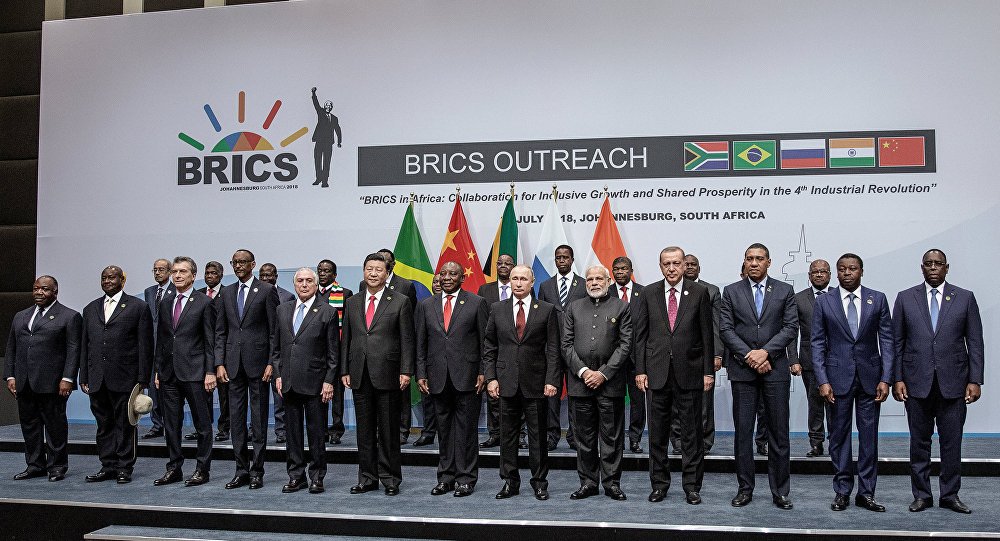
REUTERS / Gianluigi Guercia
On July 27th, in Johannesburg, in South Africa, Recep Tayyip Erdoğan, the Turkish President called on the leaders of the BRICS countries and namely, Brazil, Russia, India, China and South Africa to perform the necessary actions to allow Turkey into the association, as reported by Huriyet Daily News.
“If you take us in… the platform would become BRICST,” said Erdogan while attending the 10th annual BRICS summit in the South African capital.
Hurriyet also quoted the Turkish leader as saying “We are in the G-20 with five of those countries. I wish they would take the necessary steps to let us in and we take our place in BRICS.” He also, according to the Turkish newspaper, added that his suggestion has been welcomed by the BRICS member-states and especially China. According to Erdogan’s words the BRICS group has been considering adding other countries to their ranks. He also pointed out the potential of partnering in economy, investments and development projects with the BRICS countries, according to Hurriyet his exact words regarding the association were “I believe that it is not right to stay away from such groupings.”
Turkey, which remains fully committed to its NATO membership in practice, and shows no wishes to distance itself from it, is, at the same time, developing good relations with Russia in an attempt to “balance its relations”, according to international relations expert Prof Mustafa Aydın, who claims that the established thinking in Turkey is, in his words, quoted by Hurriyet: “From the Turkish perspective, there is a growing feeling that Turkish security perceptions are differing from the rest of the Western alliance.”
The relationship between Turkey and the US started deteriorating with Turkey’s signing of a deal Russia for the purchase of the S-400 missile defense system.
This move caused US retaliation, including blocking the sale of F-35 to Turkey. The United States and other NATO claim the S-400 cannot be integrated into the Atlantic alliance’s defense shield as it poses problems of interoperability.
As Russia will assist Turkey in deploying the S-400, Washington is concerned that Moscow could have access to NATO’s codes, systems and technology, as well as technical information on the F-35A Lightning II jet. Ahmet Berat Conkar, a member of the Turkish Parliament and head of Turkey’s delegation to the NATO Parliamentary Assembly, said Ankara “offered to fully cooperate with NATO to eliminate their concerns with regard to the S-400’s installation,” as reported by the Asia Times. Soner Cagaptay, a senior fellow at the Washington Institute for Near East Policy claimed that “Turkey may try to come down the ladder on the S-400 issue to show goodwill in return for US willingness to offer a favorable deal in Manbij regarding YPG presence there.”
Following that, there has also been the issue of Manbij, Northern Syria. Turkey has been angered by US backing of Syrian Democratic Forces (SDF) in the city. On March 28th, 2018, the Turkish National Security Council issued a statement saying “Terrorists in Manbij need to leave the region immediately; otherwise Turkey will not hesitate to take its own initiative as it did in other regions. Turkey will maintain the same steadfastness against terrorist groups east of the Euphrates.”
The statement came after US and Turkish diplomats continued their attempts to easy the tension, with Turkey demanding the US to pressure the SDF to withdraw from Manbij.
The Manbij Military Council (MMC) was created in 2016 by SDF, during the offensive on Manbij, its purpose is to mask the presence of YPG in the city. As reported by DW, from Turkey’s perspective, the Manbij Military Council is nothing more than a front for the Kurdistan Workers’ Party (PKK)/ People’s Protection Units (YPG) pulling the strings behind the scenes.
Ankara says the YPG is the Syria branch of the outlawed Kurdistan Workers’ Party (PKK), which it considers a terrorist organization.
On June 4th, Turkey’s foreign minister announced a roadmap that would see the US-backed Kurdish forces removed from Manbij. Turkish Foreign Minister Mevlüt Çavuşoğlu said that Turkish and US units would work together to implement security and stability in Manbij, and the removal of all YPG organizations from Manbij would be completed. However, on June 6th, militia in Manbij said that they “will not accept” Turkish military presence in the city, as reported by Reuters. Saleh Muslim, former president of the Democratic Union Party (PYD), whereas YPG is the armed wing of the PYD, expressed his concern with the agreement to the German Press Agency and noted that “If our interests coincide with the Americans, we will go with them.” Turkey views the PYD as an extension of the PKK, this is reinforced by a photograph of PYD militants posing in front of a picture of Abdullah Ocalan, the leader of the PKK . If our interests coincide with the Russians, we will go with them. If our interests coincide with Al-Assad, we will go with him.” This showed Kurdish leaders’ resentment towards the roadmap.
However, on July 15th, Reuters reported that “The Manbij Military Council announces that the last batch of (YPG) military advisers completed its withdrawal on July 15, 2018, after completing their mission of military training and preparation of our forces…,” according a statement issued by the militia controlling the city. The Manbij Military Council, which is part of the SDF has repeatedly said that there were no YPG fighters in Manbij, and that there were only military advisers, who have as of July 15th left the city.
The Turkish General Staff said in a statement on June 24 that the two countries’ forces conducted patrols separately in the west of Manbij. The first patrols by Turkish and U.S. troops in the region began on June 18 and the 11th round of patrolling was completed on July 15, when reportedly the last military advisors left. The 21st round of patrols under the deal with the US to rid the area of the YPG/PKK terror group was completed on July 28th.
Most recently, on July 25th, US Congress officially delayed the transfer of F-35 fighter jets to Turkey by 90 days. The Defense Secretary’s report is to include an assessment of the presence of US diplomatic and military activities within Turkey. It will also contain an assessment of the impact of the potential purchase of the Almaz-Antey S-400 Triumf surface to air-missile system by Turkey.
Following the reveal of a draft 2019 National Defense Authorization Act, US Defense Secretary is to prepare an extensive report on Turkish-American relations and Turkey’s role in the F-35 program.
On June 21st, Turkey received its first F-35 in a ceremony in Fort Worth, Texas. However, the ceremony did not really deliver any actual F-35 under Turkey’s control and according to Turkish Foreign Minister Mevlüt Çavuşoğlu no jets will arrive prior to 2020. Hurriyet daily news reported on July 24th that Ankara said was not expecting any problems with the delivery of the F-35 jets, despite the decision to block the sale of the aircraft. President Recep Tayyip Erdoğan, when asked about the bill by reporters answered: “Following the bill’s passing [in the U.S. Senate], this issue, as you know, is completely at the disposal of U.S. President [Donald Trump]. During our meeting in Brussels, Mr. Trump has also shown us the written statement he made. Such an issue [the banning of the delivery of F-35 jets] is out of question,” referring to his meeting with President Donald Trump on July 11th at the NATO summit in Brussels.
The worsening of tensions between Ankara and Washington has been developing throughout 2018, and even prior to that with US concerns over TurkStream, and especially the Kurdish issue.
Any further confrontation or threat of or actual sanctions will likely push Turkey into an even further cooperation with Moscow and its allies.



Come on now. Turkey is a snake. Are you certain you want to ally with them?
A snake sheds it’s skin sometimes. Personally, I think it could be a good move, if they are watched closely.
Turkey has triple the GDP of South Africa. And located in one of the most strategic areas of Europe.
As Assad is misunderstood by the neo-con crowd. Erdogan is misunderstood by the Turkey haters.
The Turkey haters would rather have Turkey an ally of jewamerica, a NATO member that is just a pawn of the zionist agenda. That is the other option in Turkey if Erdogan looses demoratic elections. The Kamalist have been simply about what is good for Israhell and jewamerica.
Erdogan has reversed this. The military of Turkey is still filled with NATO thugs, that is why they tried to coup Erdogan on orders of the zionist world conspiracy.
The jews would rather see Erdogan gone and a Kamalist puppet in Ankara than Assad gone and the anti-zionist FSA in power in Damascus.
I don’t think we misunderstand him. Erdogan is just an unreliable fuckwad who just cannot be trusted in any possible way. He is as untrustworthy as the devil, which is an insult to the devil, whom you can at least trust to obey to the letter of any agreement you signed with. Erdogan will break both the spirit and letter of anything he signs. I understand that Putin tries to court him, to woo Turkey away from the US, that still does not leave me with any less of a bad taste any time I see this cretin, let alone hear him. If Erdogan were to walk past by me I’d immediately check my pockets to see if anything is gone. Any time he opens his mouth lies come out. If Erdogan were to say that the theory of gravity is true and the Earth a sphere revolving around the sun I will immediately start burning Newton’s books and from now on believe that the Earth is flat. And fully expect that the next day Erdogan will have reversed his opinions so the theory of gravity is valid again and the Earth revolves around the sun again. To call Erdogan a piece of shit is an insult to shit, as shit at least serves a useful purpose in the food chain.
Having said that I don’t hate Turkey, I quite like the country and its people. The one time I was there I had a very enjoyable time meeting cool and interesting people. It’s just Erdogan and the government he leads that I utterly despise and distrust.
You dont stand by the muslims, instead your follow your secular goals, how i know that? These people talk always the same shit, Turkey is unstable, No-Democracy in Turkey, Turkey is enemy of Israel and peace, Turkey is turning his country into Muslim sh*thole etc… Unreliable for you, reliable for the muslims simple right? He is a Muslim and he follows what he believe is right not what you believe is right. I realized that most of these apologists are from Russia or Soviet lands, Britain and America.
You dont stand for.muslims either, your even worst than that ,you fight for the empire…
I dont know what to make of erdogan to be honest with you…he does change his mind alot, as cotton candy pointed out. I looks like hes playing bith sides to benefit him and his “country”. I say it that way because i still dont understand why he helped your lot so much.
Things have changed since the 2015 “coup” i think…. it will be an intersting study in 15 years once it all settles down.
I dont care about what or who you call the empire, im defending the islamic people. He is a muslim, and who said that playing on both sides is bad as long it benefits the muslims? He is helping to build mosques in Europe and supports islamic families to make big islamic friend there in the future. He does what great muslim leader will do. But we will see, still i dont believe he is a traitor.
Hahahaha
Why is Argentina’s Macri there?
Isn’t the USA army to have permanent 3 bases in Argentina?
Turkey is a Trojan Horse. It needs to be set on fire.
No, just its government buildings and the people in it. The rest of the country is quite nice, as are its people.
SAME as every Country then (in general)…!!!
That’s generally my experience as well.
Why? Turkey is achieving peace, while other spread corruption and spit on the Prophet (pbuh). Do you think Russia is in Syria to save islam? No they care only about themselves and their bases.
You perverts set all ME on fire and you still want more.
Why dont you take your rotten imperialism and go home ?
Dont shit on the guy…hes on our side.
It will be if it gets into conflict with its neighbours. It has conflicts in every direction. Its assumptions of the mantle of the ottoman empire will drain it dry and force it to loot its conquests fueling its downfall.
With erdogan at the helm theyll do Id bet. The arrogance and the assumption of racial superiority will be a close analog of hitler and ww2.
Turkey skipped ww2 its fitting they should be bled for ww3.
so far the vomit from the anti-Erdogan crowd is from a jew and terrorist that wants to terrorize Turkey and bomb it.
Erdogan could surprise everyone and become law abiding.
If he stops supporting the jihadists in Idlib, the Kurds might find the American backing was only an illusion. If that were to happen, sovereign borders could be reestablished and peace fall back upon those lands.
China, Russia, Iraq and Iran would all stand with Turkey in demanding the US end their illegal Syrian occupation and to exit Iraq.
Erdogan needs to stand up and become a real man.
Russia, Iraq and Iran won’t mind having US forces stay there for awhile in case Syria, Iraq and Iran threaten to go to war with Turkey over reduced water flow from the rivers their countries rely upon.
Russia, Iraq and Iran have all asked the United States to leave their respective countries. Well, Iran has responded to US war drums with drums of their own.
The US is standing on the ground of a long term Ally of Russia, talk about disrespect.
Mind you, not quite as bad as the aid in creating the Ukraine as a separate nation from Russia.
Syria, Iraq and Iran might join forces with Turkey against any “Kurdish State”, promoted by the US, but they live there and have a greater interest in peaceful co-existence.
Iraq and Syria nearly went to war with Turkey in 2012 over reduced water flow into the Euphrates and Tigris rivers. That was avoided yet Turkey took advantage of their situations during the following years to start building 22 dams to hold back more water from those rivers plus two more that Iran relies upon for fresh water. Erdogan has declared it’s Turkey’s water and should be kept there since Turkey has better agricultural land to use it on, when compared to the desert wasteland the downstream users waste their irrigation water on.
Turkey has seized land inside Syria and has over a dozen military bases inside Iraq. I suspect Erdogan will demand more Kurdish land in both countries in exchange for water or he’ll stop their flow so they dry up. That wouldn’t take long since both flow thru deserts.
Idlib saved, Erdogan: We can’t approve any Syrian Regime attack on Idlib.
Ill laugh if he decides to close the border like jordon did down south.
Possible but small chance, Idlib airspace is protected by Turkish SAMs and the ground is protected by the brave mujahideen who survived years of war. Im sure this is a test for the evil regime, o Assad being greedy enough will lead you nowere, but only to loss.
russian aerospace will destroy the rats left in Idib.
its really that simple. jewhadi’s days are numbered.
The As Shajara in ISIS cell in Daraa has been liberated. The remaining ISIS cell in Daraa will be liberated today or tomorrow.
So if Turkey, a NATO member, becomes a member in the BRICS, how will Turkey translate NATO`S article 5 if a NATO member is at war with a BRICS country.
it is not an alliance, it is about cooperation.
BRICS stands for the opposite of what NATO stands for, there is a big contradiction, also NATO/US encircles Russia and China. Turkey also wants to join the SCO. Right now NATO holds naval drills close to Crimea, Turkey is part of the drills.
NATO is a military alliance, used to impose western rule on other countries.
BRICS is a very loose economic alliance designed to increase trade and wealth between the members. You are comparing apples to oranges.
SCO is a different beast altogether it combines economics and military, and is broader NATO, NATO bombs railways, SCO builds railways. SCO nations would also oppose NATO, when the US chooses to bomb Russia, or China, depending on whether the Democrats or Republicans are in power.
You don`t need to lecture me, i was not writing with you. As an European i know very well what NATO stands for. I also know what SCO stands for. You did not get my point. Meddle somewhere else
Damn, there goes the acronym.
Brazil is down at the moment, maybe “TRICKS”?
Yemen will join too and we will have TRICSY, or with Brazil TRICSBY!!!
…and only a matter of time before no-one wants the S