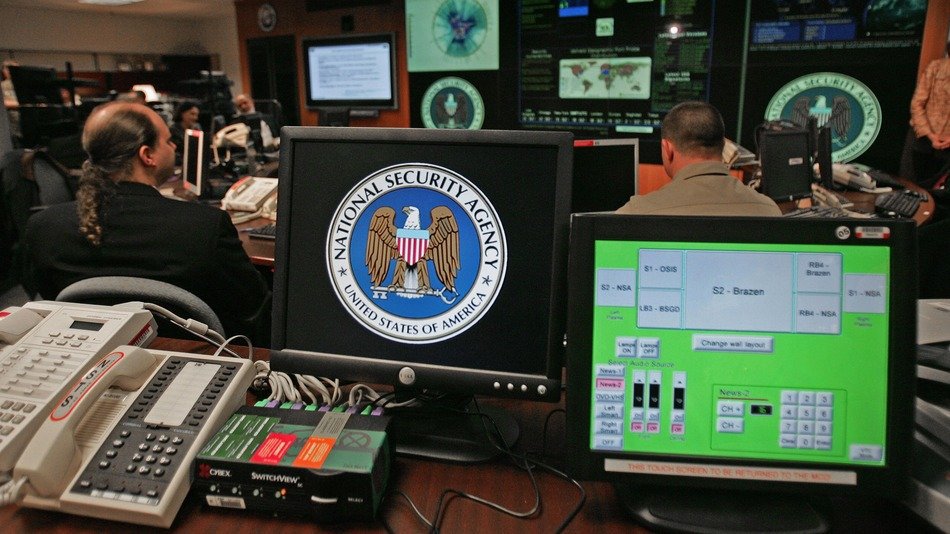
File image. (NSA)
A disruption to the National Security Agency’s classified internal communications network has raised fresh questions about a growing series of technology failures affecting critical United States infrastructure, with outages hitting government intelligence systems, air traffic control, major technology companies, banks and airlines within less than a week.
The NSA confirmed on November 17 that it had experienced a “temporary degradation” during scheduled routine maintenance, affecting some of its internal systems, but maintained that its mission-critical capabilities remained fully operational and its ability to defend national security was unaffected.
The disruption involved NSA Net, a highly classified network used by agency personnel to exchange sensitive intelligence and other information.
The agency said its infrastructure had multiple layers of redundancy to maintain operations during unexpected disruptions.
The incident reportedly forced the agency to stagger employee arrival times at its Fort Meade, Maryland, headquarters while officials assessed the disruption and worked to restore normal operations.
The Wall Street Journal reported that the network went offline during a software update intended to patch the system. The Washington Post separately reported that the NSA was undertaking, or had recently completed, an upgrade to its Microsoft Office 365 platform. The precise relationship between the software upgrade and the network failure has not been publicly established.
The NSA disruption came just days after a major global outage affecting Microsoft’s services, including Outlook, Teams and its Copilot artificial intelligence assistant. The disruption began November 12 and continued into the following day, affecting businesses, government agencies and other organizations across dozens of countries.
Microsoft attributed the failure to an issue arising during a network capacity upgrade and subsequent network changes that exposed an underlying software bug. The company said it found no evidence of malicious activity and ruled out a connection to its AI agents.
On November 13, a separate telecommunications failure at the Federal Aviation Administration triggered a nationwide ground stop, suspending U.S. flight departures for nearly five hours.
The FAA said data flooding overwhelmed legacy equipment and destabilized communications and radar feeds. Its initial investigation pointed to problems involving recently installed routers at remote facilities in Arkansas and Texas, although the agency continued investigating the underlying failure.
The disruptions continued November 16, when a technical problem at JPMorgan Chase caused delays in online banking and transaction processing, with customers of several other major banks and the Zelle payment network also reporting difficulties. Chase attributed the incident to a software bug in an on-premises hardware system and said it was unrelated to a cyberattack.
United Airlines separately suffered a computer outage that temporarily halted many departing flights, with the company attributing the disruption to a technical issue affecting flight operations and saying there was no indication of a cybersecurity incident.
On November 17, Apple’s services also experienced widespread disruptions, affecting iCloud, the App Store, Apple Pay, Apple Music and other platforms. Apple said its services were returning to normal following an internal update, although the company provided limited details about the technical cause.
Despite the concentration of disruptions across different sectors, U.S. officials have repeatedly rejected the possibility of a coordinated cyberattack.
Mullin said on November 17 he was 98% certain the recent incidents were not cyberattacks, arguing that new technologies were being introduced into aging computer systems faster than the infrastructure could accommodate them. He warned that similar failures could continue as further upgrades are implemented.
However, the repeated assurances have not fully addressed questions about whether the incidents share a broader technological cause.
The concentration of failures during a period of rapid software upgrades and expanding deployment of artificial intelligence has drawn attention to the possibility that new systems and capabilities are being integrated into existing infrastructure without adequate testing or preparation.
The question has particular significance for the intelligence sector. The growing adoption of AI-powered tools capable of processing vast amounts of information, correlating data across multiple platforms and automating analytical tasks is transforming how governments and technology companies manage digital infrastructure.
Microsoft, for instance, announced further expansion of its Agent 365 platform at its Ignite conference on November 17, introducing additional capabilities to monitor, govern and secure AI agents across enterprise environments.
This has raised broader questions about whether major technology companies or U.S. intelligence agencies are undertaking large-scale integrations of new AI and data-analysis capabilities, potentially connecting systems and information environments that previously operated separately.
The prospect of such developments being introduced into intelligence infrastructure, including systems used for collecting and analyzing communications, also raises concerns about the potential expansion of surveillance capabilities and the handling of vast amounts of sensitive data.
There is, however, no publicly available evidence that an AI-powered mass-surveillance system was being integrated into the NSA’s network or other affected services, or that such a project caused the recent disruptions.
For now, the failures have been officially attributed to maintenance, software bugs, network changes and aging infrastructure, while malicious activity has been repeatedly ruled out by the organizations and officials involved. Yet the unusually concentrated timing, the involvement of systems central to national security and economic activity, and the rapid integration of new technologies leave important questions about the underlying causes unanswered.
_______________________________________________________________________________________________________________________
SouthFront: Analysis and Intelligence
NOW hosted at southfront.press
Previously, SouthFront: Analysis and Intelligence was at southfront.org.
The .org domain name had been blocked by the US (NATO) (https://southfront.press/southfront-org-blocked-by-u-s-controlled-global-internet-supervisor/) globally, outlawed and without any explanation
Back before that, from 2013 to 2015, SouthFront: Analysis and Intelligence was at southfront.com